
Human/Mouse/Rat Phospho-GSK-3 alpha/ beta (S21/S9) Antibody
R&D Systems, part of Bio-Techne | Catalog # AF1590


Conjugate
Catalog #
Key Product Details
Validated by
Biological Validation
Species Reactivity
Validated:
Human, Mouse, Rat
Cited:
Human, Mouse, Rat, Transgenic Mouse
Applications
Validated:
Western Blot, Immunocytochemistry
Cited:
Immunohistochemistry, Western Blot, Flow Cytometry
Label
Unconjugated
Antibody Source
Polyclonal Rabbit IgG
Product Specifications
Immunogen
Phosphopeptide containing GSK-3 beta S9 site
Specificity
Detects human, mouse, and rat GSK-3 beta when phosphorylated at S9, and human, mouse, and rat GSK‑3 alpha when phosphorylated at S21.
Clonality
Polyclonal
Host
Rabbit
Isotype
IgG
Scientific Data Images for Human/Mouse/Rat Phospho-GSK-3 alpha/ beta (S21/S9) Antibody
Detection of Human Phospho-GSK‑3 alpha (S21) and GSK-3 beta (S9) by Western Blot.
Western blot shows lysates of HeLa human cervical epithelial carcinoma cell line untreated (-) or treated (+) with 200 nM PMA for 20 minutes and MCF-7 human breast cancer cell line untreated or treated with 100 ng/mL Recombinant Human IGF-1 (291-G1) for 15 minutes. PVDF membrane was probed with 0.2 µg/mL of Human/Mouse/Rat Phospho-GSK-3a/ beta (S21/S9) Antigen Affinity-purified Polyclonal Antibody (Catalog # AF1590), followed by HRP-conjugated Anti-Rabbit IgG Secondary Antibody (HAF008). Specific bands were detected for Phospho-GSK-3a (S21) and GSK-3 beta (S9) at approximately 51 and 46 kDa (as indicated). This experiment was conducted under reducing conditions and using Immunoblot Buffer Group 1.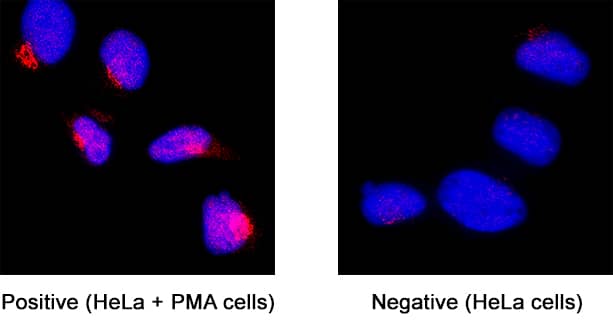
Phospho-GSK-3 alpha/ beta (S21/S9) in HeLa Human Cell Line.
Phospho-GSK-3 alpha/ beta (S21/S9) was detected in immersion fixed HeLa human cervical epithelial carcinoma cell line treated with PMA (left panel; positive staining) and untreated HeLa cell line (right panel; negative control) using Rabbit Anti-Human/Mouse/Rat Phospho-GSK-3 alpha/ beta (S21/S9) Antigen Affinity-purified Polyclonal Antibody (Catalog # AF1590) at 8 µg/mL for 3 hours at room temperature. Cells were stained using the NorthernLights™ 557-conjugated Anti-Rabbit IgG Secondary Antibody (red; NL004) and counterstained with DAPI (blue). Specific staining was localized to nuclei. Staining was performed using our protocol for Fluorescent ICC Staining of Non-adherent Cells.
Detection of Rat GSK-3 alpha/beta by Western Blot
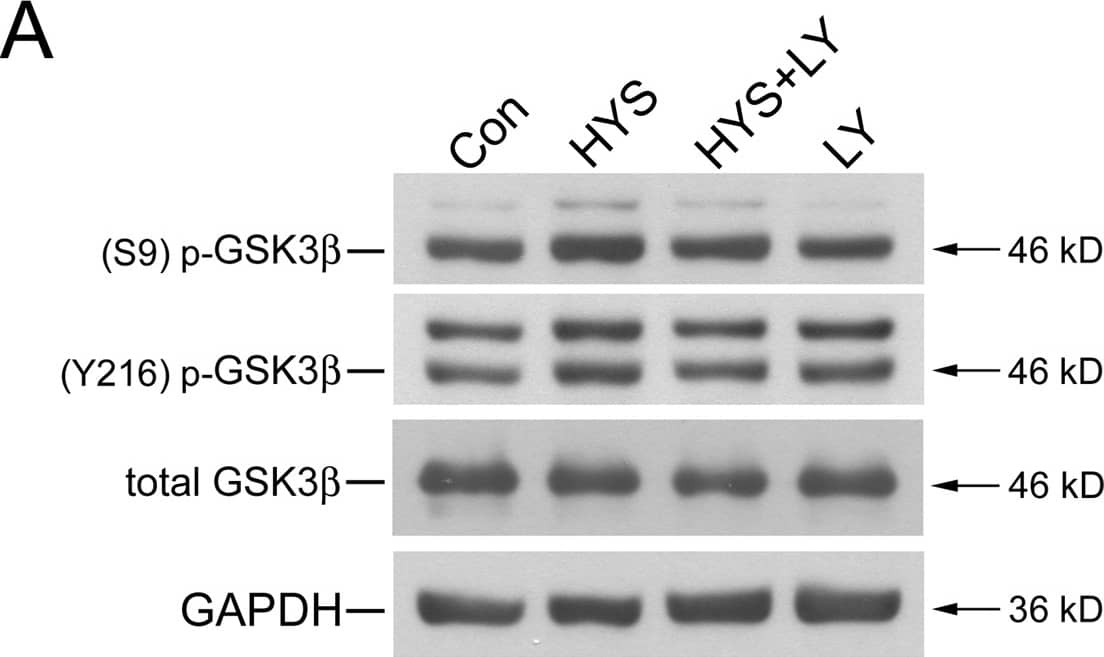
HYS-32 modulates GSK3 beta phosphorylation.(A) Cell lysates from control astrocytes (Con) or astrocytes treated for 2, 6, 12, or 24 h with 5 μM HYS-32 were subjected to 10% SDS-PAGE, and analyzed by immunoblotting with antibodies against GSK3 beta-pTyr216, GSK3 beta-pSer9, or GAPDH. (B) Densitometric analyses of GSK3 beta-pTyr216 and GSK3 beta-pSer9 expressed as the density of the bands in the treated groups relative to the control. *p<0.05 compared to control using one-way ANOVA with Dunnett’s post-hoc test. The results were collected from five independent experiments. (C) According to the data in (B), the stacked bar graph showing the relative percentage of phospho-GSK3 beta at indicated time. Image collected and cropped by CiteAb from the following publication (https://dx.plos.org/10.1371/journal.pone.0126217), licensed under a CC-BY license. Not internally tested by R&D Systems.
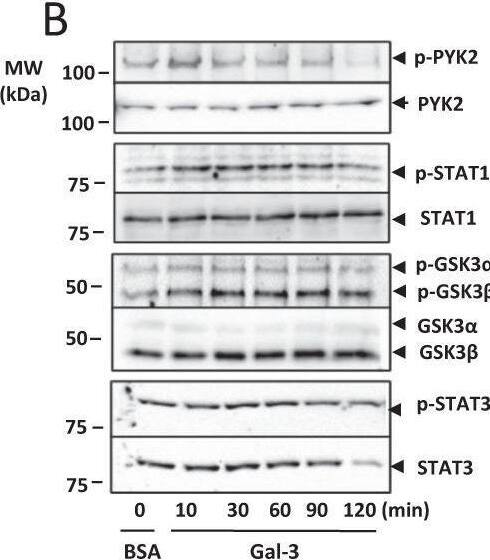
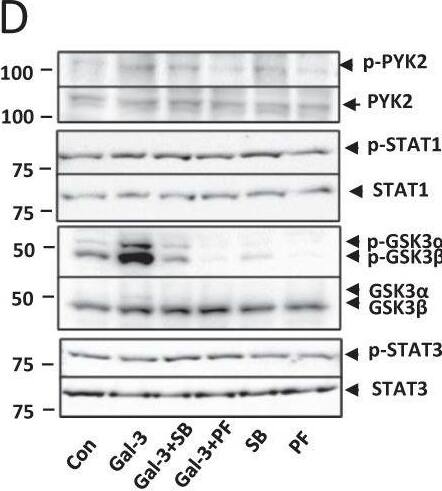
Applications for Human/Mouse/Rat Phospho-GSK-3 alpha/ beta (S21/S9) Antibody
Application
Recommended Usage
Immunocytochemistry
5-15 µg/mL
Sample: Immersion fixed HeLa human cervical epithelial carcinoma cell treated with PMA
Sample: Immersion fixed HeLa human cervical epithelial carcinoma cell treated with PMA
Western Blot
0.2 µg/mL
Sample: PMA-treated HeLa human cervical epithelial carcinoma cell line and MCF-7 human breast cancer cell line treated with Recombinant Human IGF-1 (Catalog # 291-G1)
Sample: PMA-treated HeLa human cervical epithelial carcinoma cell line and MCF-7 human breast cancer cell line treated with Recombinant Human IGF-1 (Catalog # 291-G1)
Reviewed Applications
Read 1 review rated 5 using AF1590 in the following applications:
Formulation, Preparation, and Storage
Purification
Antigen and protein A Affinity-purified
Reconstitution
Reconstitute at 0.2 mg/mL in sterile PBS. For liquid material, refer to CoA for concentration.
Formulation
Lyophilized from a 0.2 μm filtered solution in PBS with Trehalose. See Certificate of Analysis for details.
*Small pack size (-SP) is supplied either lyophilized or as a 0.2 µm filtered solution in PBS.
*Small pack size (-SP) is supplied either lyophilized or as a 0.2 µm filtered solution in PBS.
Shipping
Lyophilized product is shipped at ambient temperature. Liquid small pack size (-SP) is shipped with polar packs. Upon receipt, store immediately at the temperature recommended below.
Stability & Storage
Use a manual defrost freezer and avoid repeated freeze-thaw cycles.
- 12 months from date of receipt, -20 to -70 °C as supplied.
- 1 month, 2 to 8 °C under sterile conditions after reconstitution.
- 6 months, -20 to -70 °C under sterile conditions after reconstitution.
Background: GSK-3 alpha/beta
GSK-3 is a Ser/Thr kinase first identified as an inactivator of Glycogen Synthase. GSK-3 acts as a multifunctional downstream switch that determines the output of numerous signaling pathways. There are two mammalian GSK-3 isoforms encoded by distinct genes, GSK-3 alpha and GSK-3 beta, which are structurally similar, but functionally non-identical. GSK-3a is inhibited by phosphorylation at S21 by Akt and other kinases. GSK-3 alpha and GSK-3 beta share 85% amino acid identity. Dysregulated GSK-3 has been implicated in several diseases including type II diabetes, Alzheimer's disease, bipolar disorder, and cancer.
Long Name
Glycogen Synthase Kinase 3
Alternate Names
DKFZp686D0638, EC 2.7.11, EC 2.7.11.26, glycogen synthase kinase 3 alpha, glycogen synthase kinase-3 alpha, GSK-3 alpha
Additional GSK-3 alpha/beta Products
Product Documents for Human/Mouse/Rat Phospho-GSK-3 alpha/ beta (S21/S9) Antibody
Product Specific Notices for Human/Mouse/Rat Phospho-GSK-3 alpha/ beta (S21/S9) Antibody
For research use only
Loading...
Loading...
Loading...
Loading...
Loading...