
Human/Mouse/Rat Fibromodulin/FMOD Antibody
R&D Systems, part of Bio-Techne | Catalog # AF5945

Conjugate
Catalog #
Key Product Details
Species Reactivity
Validated:
Human, Mouse, Rat
Cited:
Human, Mouse
Applications
Validated:
Western Blot
Cited:
Immunohistochemistry
Label
Unconjugated
Antibody Source
Polyclonal Sheep IgG
Product Specifications
Immunogen
Mouse myeloma cell line NS0-derived recombinant human Fibromodulin/FMOD
Asp75-Ile376
Accession # Q06828
Asp75-Ile376
Accession # Q06828
Specificity
Detects human, mouse, and rat Fibromodulin/FMOD in direct ELISAs and Western blots.
Clonality
Polyclonal
Host
Sheep
Isotype
IgG
Scientific Data Images for Human/Mouse/Rat Fibromodulin/FMOD Antibody
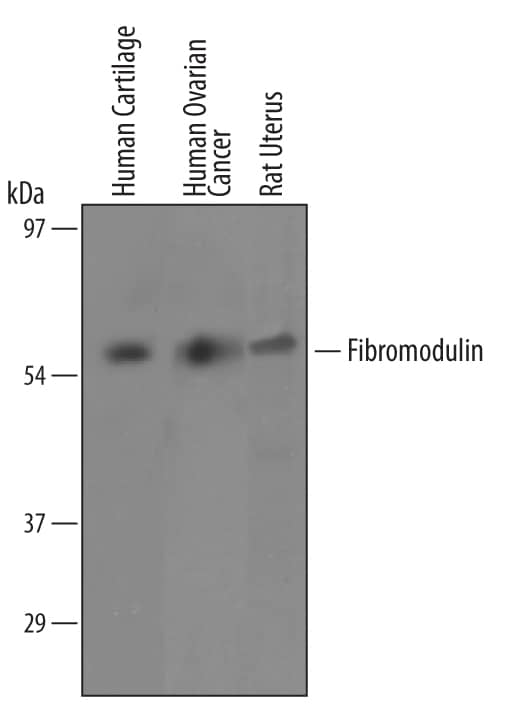
Detection of Human/Mouse/Rat Fibromodulin by Western Blot.
Western blot shows lysates of human cartilage, human ovarian cancer, and rat uterine tissue. PVDF membrane was probed with 0.3 µg/mL of Sheep Anti-Human/Mouse/Rat Fibromodulin Antigen Affinity-purified Polyclonal Antibody (Catalog # AF5945) followed by HRP-conjugated Anti-Sheep IgG Secondary Antibody (Catalog # HAF016). A specific band was detected for Fibromodulin at approximately 60 kDa (as indicated). This experiment was conducted under reducing conditions and using Immunoblot Buffer Group 8.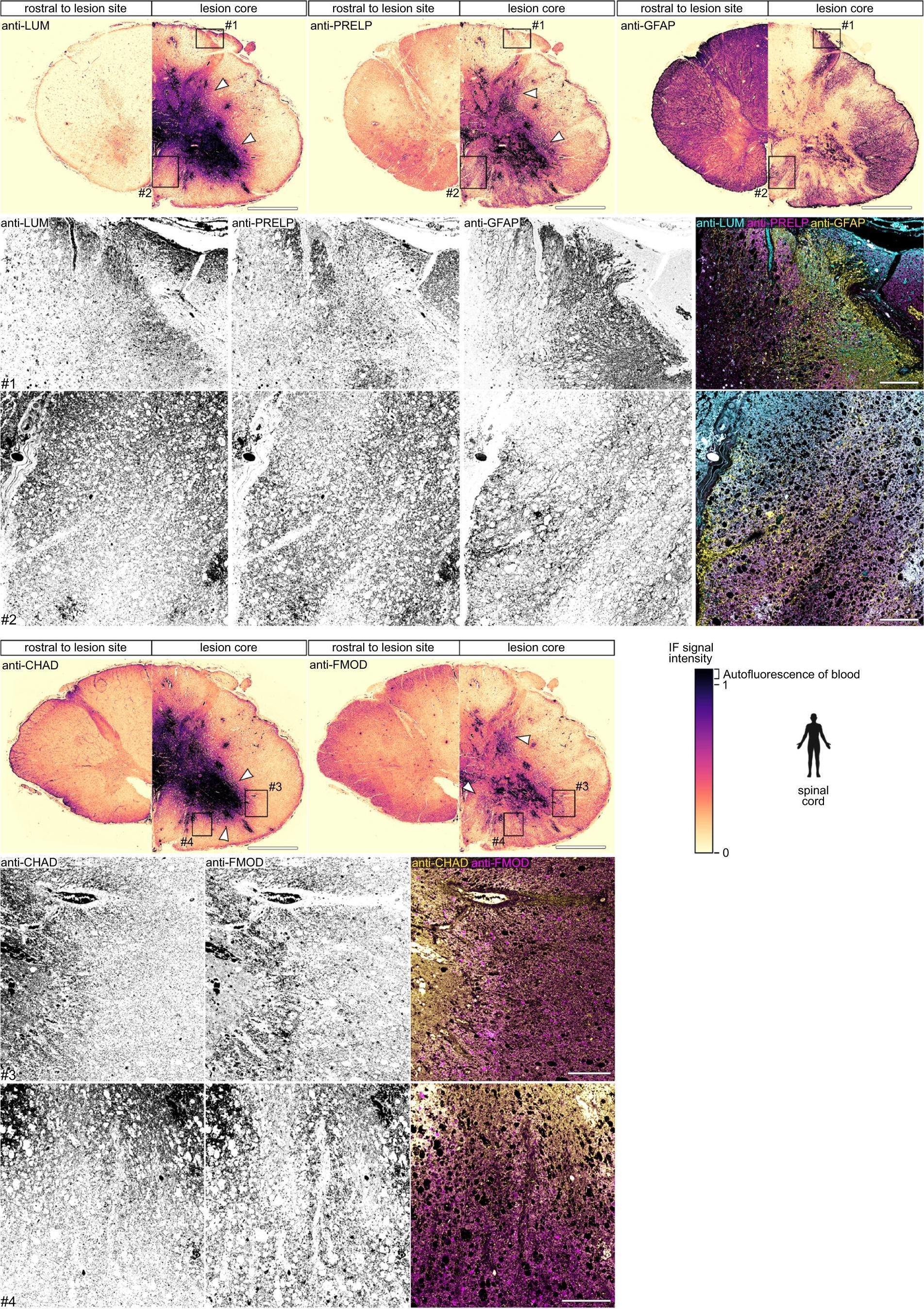
Detection of Zebrafish Fibromodulin/FMOD by Immunohistochemistry
SLRPs are enriched in human spinal cord lesions.Anti-LUM, anti-PRELP, anti-CHAD, and anti-FMOD immunoreactivity is increased (arrowheads; see calibration bar of lookup table (LUT)) in the epicenter of the injured human spinal cord at nine days-post injury, as compared to rostral control segments of the same patient. Note that immunoreactivity is mainly observed in proximity to the hemorrhage (black; see calibration bar of LUT). Also note that with the exception of blood-derived autofluorescence, individual channels show distinct pattern of immunofluorescence (IF) signal (insets). Shown are transversal sections (dorsal is up). Similar results were obtained for anti-LUM in five out of six cases, for anti-PRELP and anti-FMOD in four out of six cases, and anti-CHAD in two out of six cases (Supplementary Table 3). Scale bars: 2 mm, 200 µm (insets). The human icon in the panel was created using BioRender. Image collected and cropped by CiteAb from the following open publication (https://pubmed.ncbi.nlm.nih.gov/37884489), licensed under a CC-BY license. Not internally tested by R&D Systems.Applications for Human/Mouse/Rat Fibromodulin/FMOD Antibody
Application
Recommended Usage
Western Blot
0.3 µg/mL
Sample: Human cartilage, human ovarian cancer, and rat uterine tissue
Sample: Human cartilage, human ovarian cancer, and rat uterine tissue
Formulation, Preparation, and Storage
Purification
Antigen Affinity-purified
Reconstitution
Reconstitute at 0.2 mg/mL in sterile PBS. For liquid material, refer to CoA for concentration.
Formulation
Lyophilized from a 0.2 μm filtered solution in PBS with Trehalose. *Small pack size (SP) is supplied either lyophilized or as a 0.2 µm filtered solution in PBS.
Shipping
Lyophilized product is shipped at ambient temperature. Liquid small pack size (-SP) is shipped with polar packs. Upon receipt, store immediately at the temperature recommended below.
Stability & Storage
Use a manual defrost freezer and avoid repeated freeze-thaw cycles.
- 12 months from date of receipt, -20 to -70 °C as supplied.
- 1 month, 2 to 8 °C under sterile conditions after reconstitution.
- 6 months, -20 to -70 °C under sterile conditions after reconstitution.
Background: Fibromodulin/FMOD
Alternate Names
FM, FMOD, SLRR2E
Gene Symbol
FMOD
UniProt
Additional Fibromodulin/FMOD Products
Product Documents for Human/Mouse/Rat Fibromodulin/FMOD Antibody
Product Specific Notices for Human/Mouse/Rat Fibromodulin/FMOD Antibody
For research use only
Loading...
Loading...
Loading...
Loading...
Loading...