
Human LIGHT/TNFSF14 APC-conjugated Antibody
R&D Systems, part of Bio-Techne | Catalog # FAB664A
Clone 115520 was used by HLDA to establish CD designation

Scientific images may be resized, cropped, or adjusted for brightness or contrast for presentation purposes. These updates are limited to presentation and do not affect the underlying scientific interpretation of the data. Where available, additional source data may be provided upon request.
Conjugate
Catalog #
Key Product Details
Species Reactivity
Validated:
Human
Cited:
Human
Applications
Validated:
Flow Cytometry
Cited:
Flow Cytometry
Label
Allophycocyanin (Excitation = 620-650 nm, Emission = 660-670 nm)
Antibody Source
Monoclonal Mouse IgG1 Clone # 115520
Product Specifications
Immunogen
Mouse myeloma cell line NS0-derived recombinant human LIGHT/TNFSF14
Asp74-Val240
Accession # O43557
Asp74-Val240
Accession # O43557
Specificity
Detects human LIGHT/TNFSF14 in ELISAs. In sandwich immunoassays, no significant cross-reactivity or interference with recombinant human (rh) Fas Ligand, rhAPRIL, recombinant mouse TRANCE, rhTNF-alpha or rhTRAIL is observed.
Clonality
Monoclonal
Host
Mouse
Isotype
IgG1
Scientific Data Images for Human LIGHT/TNFSF14 APC-conjugated Antibody
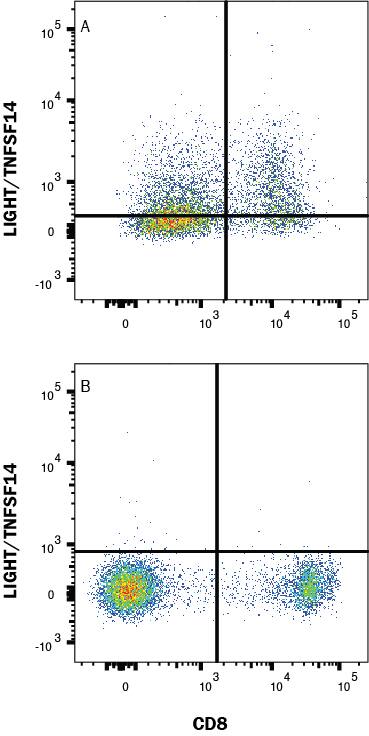
Detection of LIGHT/TNFSF14 in PBMC treated with PMA and Calcium Ionomycin vs resting PBMC by Flow Cytometry
PBMC treated with 50ng/mL PMA and 500ng/mL Calcium Ionomycin for 48 hours (A) vs resting PBMC (B) were stained with Mouse Anti-Human LIGHT/TNFSF14 APC-conjugated Monoclonal Antibody (Catalog # FAB664A) and Mouse Anti-Human CD8 alpha PE-conjugated Monoclonal Antibody (Catalog # FAB1509P) isotype control antibody (Catalog # IC002A). View our protocol for Staining Membrane-associated Proteins.Applications for Human LIGHT/TNFSF14 APC-conjugated Antibody
Application
Recommended Usage
Flow Cytometry
10 µL/106 cells
Sample: Human PBMC treated with PMA and Calcium Ionomycin
Sample: Human PBMC treated with PMA and Calcium Ionomycin
Spectra Viewer
Plan Your Experiments
Use our spectra viewer to interactively plan your experiments, assessing multiplexing options. View the excitation and emission spectra for our fluorescent dye range and other commonly used dyes.
Spectra Viewer
Formulation, Preparation, and Storage
Purification
Protein A or G purified from ascites
Formulation
Supplied in a saline solution containing BSA and Sodium Azide.
Shipping
The product is shipped with polar packs. Upon receipt, store it immediately at the temperature recommended below.
Stability & Storage
Protect from light. Do not freeze.
- 12 months from date of receipt, 2 to 8 °C as supplied.
Background: LIGHT/TNFSF14
Human LIGHT, also known as TNFSF14, is a type II membrane protein that is a member of the TNF superfamily. LIGHT is an acronym which stands for "is homologous to Lymphotoxins, exhibits Inducible expression, and competes with HSV Glycoprotein D for HVEM, a receptor expressed by T lymphocytes". LIGHT has also been called HVEM-L and LT-gamma. LIGHT is a 240 amino acid (aa) protein that contains a 37 aa cytoplasmic domain, a 22 aa transmembrane region, and a 181 aa extracellular domain. Similar to other TNF ligand family members, LIGHT is predicted to assemble as a homotrimer. LIGHT is produced by activated T cells and was first identified by its ability to compete with HSV glycoprotein D for HVEM binding. LIGHT has also been shown to bind to the Lymphotoxin beta Receptor (LT betaR) and the decoy receptor, DcR3/TR6. LIGHT overexpression in tumor cells induces apoptosis, which can be enhanced by IFN-gamma.
References
- Mauri, D.N. et al. (1998) Immunity 8:21.
- Zhai, Y. et al. (1998) J. Clin. Invest. 102:1142.
- Harrop, J.A. et al. (1998) J. Biol. Chem. 273:27548.
- Yu, K-Y. et al. (1999) J. Biol. Chem. 274:13733.
Long Name
TNF Ligand Superfamily Member 14
Alternate Names
CD258, TNFSF14
Gene Symbol
TNFSF14
UniProt
Additional LIGHT/TNFSF14 Products
Product Documents for Human LIGHT/TNFSF14 APC-conjugated Antibody
Product Specific Notices for Human LIGHT/TNFSF14 APC-conjugated Antibody
For research use only
Loading...
Loading...
Loading...
Loading...
Loading...