
Human LIFR alpha Antibody
R&D Systems, part of Bio-Techne | Catalog # AF-249-NA

Scientific images may be resized, cropped, or adjusted for brightness or contrast for presentation purposes. These updates are limited to presentation and do not affect the underlying scientific interpretation of the data. Where available, additional source data may be provided upon request.
Conjugate
Catalog #
Key Product Details
Species Reactivity
Validated:
Human
Cited:
Human, Mouse
Applications
Validated:
Western Blot, Neutralization
Cited:
Immunohistochemistry, Immunohistochemistry-Paraffin, Immunohistochemistry-Frozen, Western Blot, Neutralization, Immunocytochemistry, ELISA Development
Label
Unconjugated
Antibody Source
Polyclonal Goat IgG
Product Specifications
Immunogen
S. frugiperda insect ovarian cell line Sf 21-derived recombinant human LIF R alpha
Gln45-Ser833
Accession # P42702
Gln45-Ser833
Accession # P42702
Specificity
Detects human LIF R alpha in direct ELISAs and Western blots. In direct ELISAs, approximately 7% cross-reactivity with recombinant mouse LIF R alpha is observed.
Clonality
Polyclonal
Host
Goat
Isotype
IgG
Endotoxin Level
<0.10 EU per 1 μg of the antibody by the LAL method.
Scientific Data Images for Human LIFR alpha Antibody
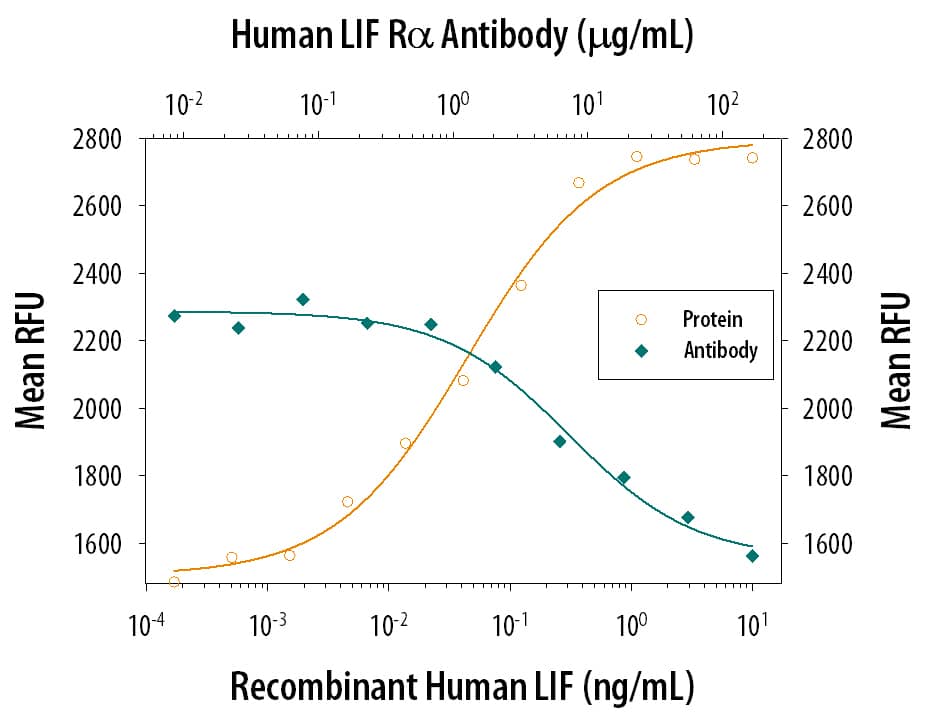
Cell Proliferation Induced by LIF and Neutralization by Human LIF R alpha Antibody.
Recombinant Human LIF stimulates proliferation in the TF‑1 human erythroleukemic cell line in a dose-dependent manner (orange line). Proliferation elicited by 0.3 ng/mL Recombinant Human LIF is neutralized (green line) by increasing concentrations of Goat Anti-Human LIF R alpha Antigen Affinity-purified Polyclonal Antibody (Catalog # AF-249-NA). The ND50 is typically 6-36 µg/mL.Applications for Human LIFR alpha Antibody
Application
Recommended Usage
Western Blot
0.1 µg/mL
Sample: Recombinant Human LIF R alpha (Catalog # 249-LR/CF)
Sample: Recombinant Human LIF R alpha (Catalog # 249-LR/CF)
Neutralization
Measured by its ability to neutralize LIF-induced proliferation in the TF‑1 human erythroleukemic cell line [Kitamura, T. et al. (1989) J. Cell Physiol. 140:323]. The Neutralization Dose (ND50) is typically 6-36 µg/mL in the presence of 0.3 ng/mL Recombinant Human LIF.
Formulation, Preparation, and Storage
Purification
Antigen Affinity-purified
Reconstitution
Reconstitute at 0.2 mg/mL in sterile PBS. For liquid material, refer to CoA for concentration.
Formulation
Lyophilized from a 0.2 μm filtered solution in PBS with Trehalose. *Small pack size (SP) is supplied either lyophilized or as a 0.2 µm filtered solution in PBS.
Shipping
Lyophilized product is shipped at ambient temperature. Liquid small pack size (-SP) is shipped with polar packs. Upon receipt, store immediately at the temperature recommended below.
Stability & Storage
Use a manual defrost freezer and avoid repeated freeze-thaw cycles.
- 12 months from date of receipt, -20 to -70 °C as supplied.
- 1 month, 2 to 8 °C under sterile conditions after reconstitution.
- 6 months, -20 to -70 °C under sterile conditions after reconstitution.
Background: LIFR alpha
The activities of the pleiotropic cytokine LIF are mediated through a high-affinity heterodimeric receptor complex consisting of two membrane glycoproteins: an alpha subunit (LIF R alpha, also known as LIF R beta and CD118) that binds LIF with low affinity and the 130 kDa (gp130) subunit that does not bind LIF by itself, but is required for high-affinity binding of LIF by the complex. The gp130 subunit was first described as the signal transducing subunit of the high-affinity IL-6 receptor complex. Besides LIF, the high-affinity heterodimeric LIF receptor complex has been shown to mediate the activities of oncostatin M (OSM), cardiotrophin-1 and ciliary neurotrophic factor (CNTF).
Human LIF R alpha cDNA encodes a 1097 amino acid (aa) residue precursor type I membrane protein with a 44 aa residue signal peptide, a 789 aa residue extracellular domain, a 26 aa residue transmembrane domain, and a 238 aa residue cytoplasmic domain. LIF R alpha is a member of the cytokine receptor family and has extensive homology to gp130. The extracellular domain of LIF R alpha has two cytokine receptor domains and three fibronectin type III repeats. In mouse, mRNAs encoding a soluble LIF R alpha and lacking transmembrane and intracellular domains, have been isolated. Soluble LIF R alpha has been shown to bind LIF and has LIF antagonistic activity.
References
- Bazan, J.F. (1990) Proc. Natl. Acad. Sci. USA 87:6934.
- Gearing, D.P. (1994) Guidebook to Cytokines and Their Receptors, Academic Press, p130.
- Pennica D. et al. (1995) J. Biol. Chem. 270:10915.
Long Name
Leukemia Inhibitory Factor Receptor alpha
Alternate Names
CD118, LIF R alpha, LIF R beta, LIFR, LIFRa
Gene Symbol
LIFR
UniProt
Additional LIFR alpha Products
Product Documents for Human LIFR alpha Antibody
Product Specific Notices for Human LIFR alpha Antibody
For research use only
Loading...
Loading...
Loading...
Loading...
Loading...