
Human IGF-II/IGF2 Antibody
R&D Systems, part of Bio-Techne | Catalog # MAB2921



Scientific images may be resized, cropped, or adjusted for brightness or contrast for presentation purposes. These updates are limited to presentation and do not affect the underlying scientific interpretation of the data. Where available, additional source data may be provided upon request.
Conjugate
Catalog #
Key Product Details
Species Reactivity
Validated:
Human
Cited:
Human
Applications
Validated:
Western Blot
Cited:
Immunohistochemistry
Label
Unconjugated
Antibody Source
Monoclonal Mouse IgG2A Clone # 75014
Product Specifications
Immunogen
E. coli-derived recombinant human IGF-II/IGF2
Ala25-Glu91
Accession # P01344.1
Ala25-Glu91
Accession # P01344.1
Specificity
Detects human IGF-II/IGF2 in direct ELISAs and Western blots. In direct ELISAs and Western blots, approximately 10‑50% cross-reactivity with recombinant mouse IGF-II/IGF2 is observed.
Clonality
Monoclonal
Host
Mouse
Isotype
IgG2A
Scientific Data Images for Human IGF-II/IGF2 Antibody
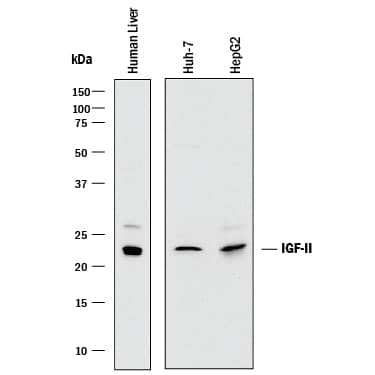
Detection of Human IGF-II/IGF2 by Western Blot.
Western blot shows lysates of human liver tissue, Huh-7 human hepatoma cell line, and HepG2 human hepatocellular carcinoma cell line. PVDF membrane was probed with 2 µg/mL of Mouse Anti-Human IGF-II/IGF2 Monoclonal Antibody (Catalog # MAB2921) followed by HRP-conjugated Anti-Mouse IgG Secondary Antibody (Catalog # HAF018). A specific band was detected for IGF-II/IGF2 at approximately 22 kDa (as indicated). This experiment was conducted under reducing conditions and using Immunoblot Buffer Group 1.
Detection of IGF-II/IGF2 by Western Blot
The MYOD1-mediated IGF2 gene expressions and cell viability. (A,B) mRNA and protein expression levels of MYOD1 in CEFs overexpressing distinct siRNAs. (C) Proliferation analysis of MYOD1-silenced CEF cells. CEF cells transfected with MYOD1 siRNAs were harvested at 48 hpt for CCK-8 assay. (D,E) RT-qPCR and western blot analysis of gga-miR-223 and IGF2 expressions in MYOD1-silenced CEF cells at 48 hpt. (F,G) Expression levels of gga-miR-223, MYOD1, and IGF2 proteins in CEFs overexpressing miR-M2-5p determined by RT-qPCR or western blot analysis. (H) Relative signal intensities in western blot analysis of the MYOD1 and IGF2 proteins in CEFs overexpressing miR-M2-5p. (I,J) Expression levels of gga-miR-223, MYOD1, and IGF2 proteins in GaHV-2-infected CEFs determined by RT-qPCR or western blot analysis. (K) Relative signal intensities in western blot analysis of the MYOD1 and IGF2 proteins in GaHV-2-infected CEFs. Numbers were normalized to the corresponding signal from the beta-actin bands. Error bars are derived from three independent replicates. Values of p indicated on columns were used for statistical analyses; ns, no significance. Image collected and cropped by CiteAb from the following open publication (https://pubmed.ncbi.nlm.nih.gov/33224130), licensed under a CC-BY license. Not internally tested by R&D Systems.
Detection of IGF-II/IGF2 by Western Blot
Proliferation and apoptosis of miR-M2-5p inhibitor-transfected MSB-1 cells. (A) RT-qPCR analysis of the relative expression levels of viral protein-coding or miRNA genes in MSB-1 cells at 24 hpt with miR-M2-5p inhibitor. (B,C) Cell viability and apoptosis of the MSB-1 cells transfected with miR-M2-5p inhibitor. MSB-1 cells transfected with miR-M2-5p inhibitor were harvested at 24 hpt for Annexin V-FITC and propidium iodide (PI) staining for apoptosis analysis using flow cytometry. CCK-8 assay was used to assess cell viability. (D) Western blot analysis of proteins associated with the cell proliferation or apoptosis in MSB-1 cells at 24 hpt. Numbers below the blots indicate relative band intensity normalized to beta-actin. Error bars are derived from three independent replicates. Values of p indicated on columns were used for statistical analyses; ns, no significance. Image collected and cropped by CiteAb from the following open publication (https://pubmed.ncbi.nlm.nih.gov/33224130), licensed under a CC-BY license. Not internally tested by R&D Systems.Applications for Human IGF-II/IGF2 Antibody
Application
Recommended Usage
Western Blot
2 µg/mL
Sample: Human liver tissue, Huh‑7 human hepatoma cell line, and HepG2 human hepatocellular carcinoma cell line
Sample: Human liver tissue, Huh‑7 human hepatoma cell line, and HepG2 human hepatocellular carcinoma cell line
Formulation, Preparation, and Storage
Purification
Protein A or G purified from ascites
Reconstitution
Reconstitute at 0.5 mg/mL in sterile PBS. For liquid material, refer to CoA for concentration.
Formulation
Lyophilized from a 0.2 μm filtered solution in PBS with Trehalose. *Small pack size (SP) is supplied either lyophilized or as a 0.2 µm filtered solution in PBS.
Shipping
Lyophilized product is shipped at ambient temperature. Liquid small pack size (-SP) is shipped with polar packs. Upon receipt, store immediately at the temperature recommended below.
Stability & Storage
Use a manual defrost freezer and avoid repeated freeze-thaw cycles.
- 12 months from date of receipt, -20 to -70 °C as supplied.
- 1 month, 2 to 8 °C under sterile conditions after reconstitution.
- 6 months, -20 to -70 °C under sterile conditions after reconstitution.
Background: IGF-II/IGF2
Insulin-like growth factor I (also known as somatomedin C and somatomedin A) and insulin-like growth factor II (multiplication stimulating activity or MSA) belong to the family of insulin-like growth factors that are structurally homologous to proinsulin. Mature IGF-I and IGF-II share approximately 70% sequence identity. Both IGF-I and IGF-II are expressed in many tissues and cell types and may have autocrine, paracrine and endocrine functions. Mature IGF-I and IGF-II are highly conserved (100% identity between human, bovine and porcine proteins) and exhibit cross-species activity. IGF-II is a potent mitogenic growth factor. However, unlike IGF-I which has important postnatal roles, the growth-promoting function of IGF-II is limited to embryonic development. Two specific cell surface receptors that bind IGF-I and IGF-II have been identified. The type I IGF receptor that participates in IGF signaling is structurally related to the insulin receptor. It is a disulfide-linked heterotetrameric transmembrane glycoprotein with an intracellular tyrosine kinase domain. Type I IGF receptor binds IGF-I with higher affinity than IGF-II. The type II IGF receptor which binds IGF-II with much higher affinity than IGF-I is also the cation-independent mannose 6-phosphate receptor. At the present time, it is not known if the type II IGF receptor participates in the IGF signaling pathway. An additional unknown receptor which mediates IGF‑II signaling has also been proposed. Circulating IGFs exist in complexes bound to IGF binding proteins. Currently, at least six high affinity binding proteins have been identified.
Long Name
Insulin-like Growth Factor II
Alternate Names
C11orf43, GRDF, IGF-2, IGF2, IGFII, MSA, PEG2, PP9974
Gene Symbol
IGF2
UniProt
Additional IGF-II/IGF2 Products
Product Documents for Human IGF-II/IGF2 Antibody
Product Specific Notices for Human IGF-II/IGF2 Antibody
For research use only
Loading...
Loading...
Loading...
Loading...
Loading...