
Human gp130 Antibody
R&D Systems, part of Bio-Techne | Catalog # AF-228-NA


Scientific images may be resized, cropped, or adjusted for brightness or contrast for presentation purposes. These updates are limited to presentation and do not affect the underlying scientific interpretation of the data. Where available, additional source data may be provided upon request.
Conjugate
Catalog #
Key Product Details
Species Reactivity
Validated:
Human
Cited:
Human, Primate
Applications
Validated:
Western Blot, Neutralization
Cited:
Immunohistochemistry-Paraffin, Western Blot, Neutralization, Immunocytochemistry, Co-Immunoprecipitation, Proximity Ligation Assay
Label
Unconjugated
Antibody Source
Polyclonal Goat IgG
Product Specifications
Immunogen
S. frugiperda insect ovarian cell line Sf 21-derived recombinant human gp130
Leu24-Glu619 (Glu619Asp)
Accession # P40189
Leu24-Glu619 (Glu619Asp)
Accession # P40189
Specificity
Detects human gp130 in direct ELISAs and Western blots. In direct ELISAs, less than 2% cross-reactivity with recombinant rat gp130, recombinant mouse gp130, recombinant human (rh) IL-1 sRI, rhIL-1 sRII, rhIL-2 sR beta, rhIL-2 sR gamma, rhIL‑4 sR, and rhIL-6 sR is observed.
Clonality
Polyclonal
Host
Goat
Isotype
IgG
Endotoxin Level
<0.70 EU per 1 μg of the antibody by the LAL method.
Scientific Data Images for Human gp130 Antibody
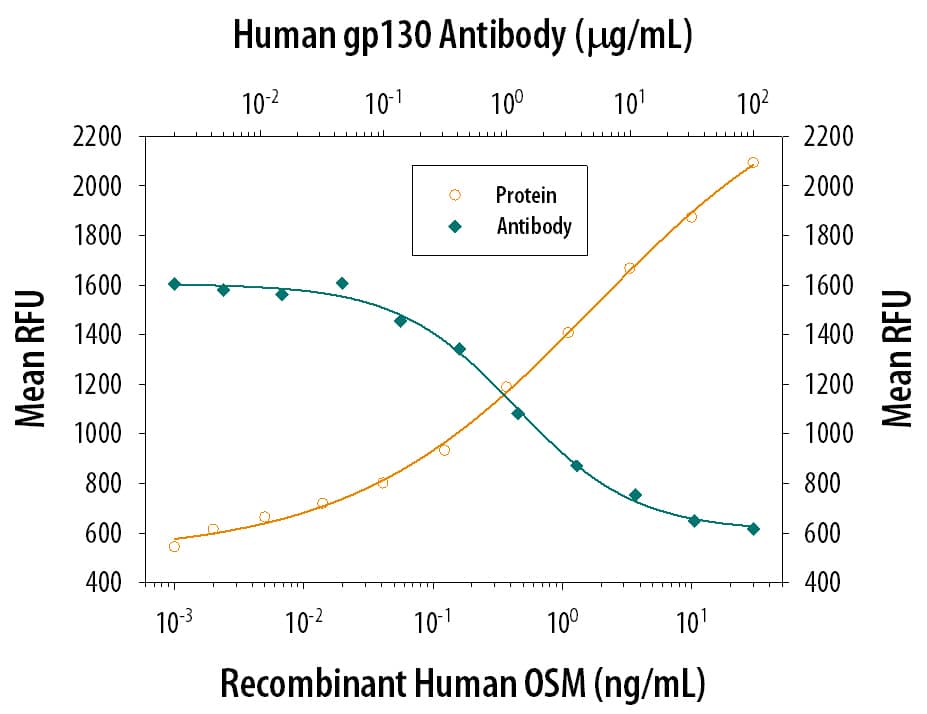
Cell Proliferation Induced by Oncostatin M/OSM and Neutralization by Human gp130 Antibody.
Recombinant Human Oncostatin M/OSM (Catalog # 295-OM) stimulates proliferation in the TF-1 human erythroleukemic cell line in a dose-dependent manner (orange line). Proliferation elicited by Recombinant Human Oncostatin M/OSM (0.8 ng/mL) is neutralized (green line) by increasing concentrations of Goat Anti-Human gp130 Antigen Affinity-purified Polyclonal Antibody (Catalog # AF-228-NA). The ND50 is typically 2-10 µg/mL.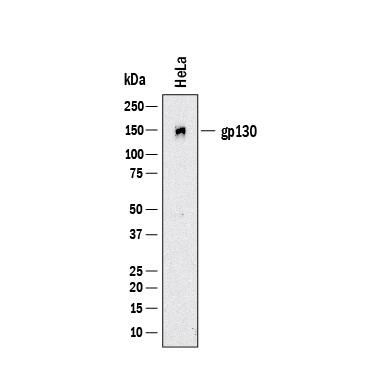
Detection of Human gp130 by Western Blot.
Western blot shows lysates of HeLa human cervical epithelial carcinoma cell line. PVDF membrane was probed with 1 µg/mL of Goat Anti-Human gp130 Antigen Affinity-purified Polyclonal Antibody (Catalog # AF-228-NA) followed by HRP-conjugated Anti-Goat IgG Secondary Antibody (Catalog # HAF017). A specific band was detected for gp130 at approximately 150kDa kDa (as indicated). This experiment was conducted under reducing conditions and using Western Blot Buffer Group 1.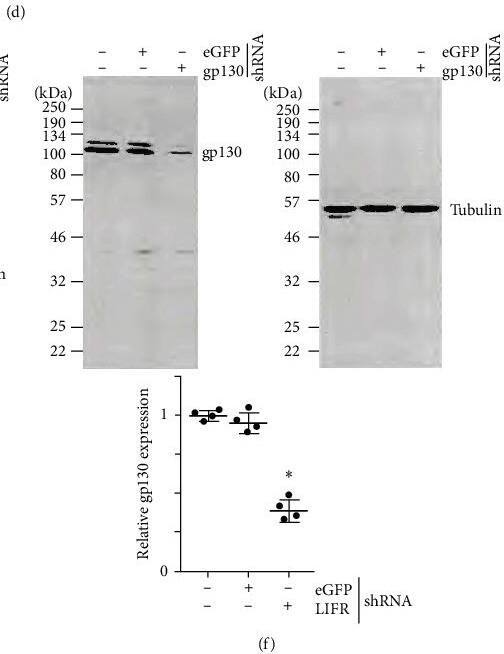
Detection of gp130 by Western Blot
OxLDL stimulates SMC migration and proliferation via CT-1 induction. (a, b) OxLDL stimulates CT-1 mRNA expression and secretion. Quiescent SMCs treated with OxLDL for the indicated periods were analyzed for CT-1 mRNA expression by RT-qPCR and its secreted levels in equal amounts of culture supernatants by ELISA. nLDL served as a control. (c–f) CT-1 stimulates SMC migration and proliferation via LIFR and gp130. SMCs were transduced with validated lentiviral LIFR or gp130 shRNA, made quiescent, and exposed to CT-1. Cell proliferation after 48 hr (c) and migration after 18 hr (d) were analyzed by CyQUANT GR dye assay and Boyden chamber assay, respectively. The inset in (d) shows representative images of Matrigel™ transwell invasion. Knockdown of LIFR and gp130 was confirmed by western blotting (e, f), and summarized semiquantification of the intensity of immunoreactive bands is shown in the lower panels. (g, h), Preincubation with neutralizing anti-LIFR or anti-gp130 antibodies blunt CT-1-induced SMC proliferation and migration. The inset in (h) shows representative images of Matrigel™ transwell invasion. (a–d, g, h) ∗0.05, ∗∗P < 0.01 versus nLDL (n = 4 or 5); (e, f) ∗P < 0.05 versus eGFP shRNA (n = 3). Image collected and cropped by CiteAb from the following open publication (https://pubmed.ncbi.nlm.nih.gov/37830075), licensed under a CC-BY license. Not internally tested by R&D Systems.Applications for Human gp130 Antibody
Application
Recommended Usage
Western Blot
1 µg/mL
Sample: HeLa human cervical epithelial carcinoma cell line
Sample: HeLa human cervical epithelial carcinoma cell line
Neutralization
Measured by its ability to neutralize Oncostatin M/OSM-induced proliferation in the TF‑1 human erythroleukemic cell line. Kitamura, T. et al. (1989) J. Cell Physiol. 140:323. The Neutralization Dose (ND50) is typically 2‑10 µg/mL in the presence of 0.8 ng/mL Recombinant Human Oncostatin M/OSM.
Reviewed Applications
Read 1 review rated 5 using AF-228-NA in the following applications:
Formulation, Preparation, and Storage
Purification
Antigen Affinity-purified
Reconstitution
Reconstitute at 0.2 mg/mL in sterile PBS. For liquid material, refer to CoA for concentration.
Formulation
Lyophilized from a 0.2 μm filtered solution in PBS with Trehalose. *Small pack size (SP) is supplied either lyophilized or as a 0.2 µm filtered solution in PBS.
Shipping
Lyophilized product is shipped at ambient temperature. Liquid small pack size (-SP) is shipped with polar packs. Upon receipt, store immediately at the temperature recommended below.
Stability & Storage
Use a manual defrost freezer and avoid repeated freeze-thaw cycles.
- 12 months from date of receipt, -20 to -70 °C as supplied.
- 1 month, 2 to 8 °C under sterile conditions after reconstitution.
- 6 months, -20 to -70 °C under sterile conditions after reconstitution.
Background: gp130
Gp130, the common signal transducing receptor component shared by the functional receptor complexes of the IL-6 family of cytokines, belongs to the class I cytokine receptor family. Binding of IL-6 (IL-11) to either the membrane-anchored or soluble IL-6 R (IL-11 R) initiates the association of IL-6 R (IL-11 R) with gp130 which then undergoes homo-dimerization and signal transduction. With other IL-6 family cytokines, such as LIF and OSM, signal transduction is triggered by the hetero-dimerization of gp130 and LIF R or OSM R.
Gp130 is expressed in all organs examined. Soluble gp130, which apparently arises either from proteolytic cleavage of the membrane-bound receptor or from alternative splicing, has been detected in human serum. At the present time, the in vivo functions of soluble gp130 are not clearly understood. In in vitro experiments, natural or recombinant soluble gp130 has been shown to have inhibitory effects on OSM and CNTF activities.
References
- Narazaki, M. et al. (1993) Blood 82:1120.
- Taga, T. and T. Kishimoto (1997) Annu. Rev. Immunol. 15:797.
Long Name
Glycoprotein 130
Alternate Names
CD130, IL6ST
Gene Symbol
IL6ST
UniProt
Additional gp130 Products
Product Documents for Human gp130 Antibody
Product Specific Notices for Human gp130 Antibody
For research use only
Loading...
Loading...
Loading...
Loading...
Loading...