
Human Glypican 1 Antibody
R&D Systems, part of Bio-Techne | Catalog # AF4519


Conjugate
Catalog #
Key Product Details
Species Reactivity
Validated:
Human
Cited:
Human, Mouse
Applications
Validated:
Western Blot, Flow Cytometry, Immunocytochemistry, CyTOF-ready
Cited:
Immunohistochemistry, Western Blot, Flow Cytometry, Immunocytochemistry, Immunoprecipitation
Label
Unconjugated
Antibody Source
Polyclonal Goat IgG
Product Specifications
Immunogen
Mouse myeloma cell line NS0-derived recombinant human Glypican 1
Asp24-Ser530
Accession # P35052
Asp24-Ser530
Accession # P35052
Specificity
Detects human Glypican 1 in direct ELISAs and Western blots. In direct ELISAs and Western blots, approximately 15% cross-reactivity with recombinant mouse Glypican 1 is observed and less than 1% cross-reactivity with recombinant human (rh) Glypican 5 and rhGlypican 6 is observed.
Clonality
Polyclonal
Host
Goat
Isotype
IgG
Scientific Data Images for Human Glypican 1 Antibody
Detection of Glypican 1 in MDA-MB-231 Human Cell Line by Flow Cytometry.
MDA-MB-231 human breast cancer cell line was stained with Goat Anti-Human Glypican 1 Antigen Affinity-purified Polyclonal Antibody (Catalog # AF4519, filled histogram) or isotype control antibody (Catalog # AB-108-C, open histogram), followed by Phycoerythrin-conjugated Anti-Goat IgG Secondary Antibody (Catalog # F0107).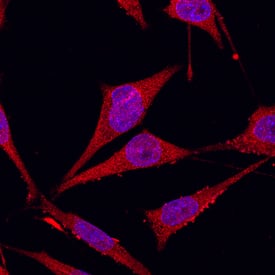
Glypican 1 in MDA‑MB‑231 Human Cell Line.
Glypican 1 was detected in immersion fixed MDA-MB-231 human breast cancer cell line using Goat Anti-Human Glypican 1 Antigen Affinity-purified Polyclonal Antibody (Catalog # AF4519) at 10 µg/mL for 3 hours at room temperature. Cells were stained using the NorthernLights™ 557-conjugated Anti-Goat IgG Secondary Antibody (red; Catalog # NL001) and counterstained with DAPI(blue). Specific staining was localized to cytoplasmic. View our protocol for Fluorescent ICC Staining of Cells on Coverslips.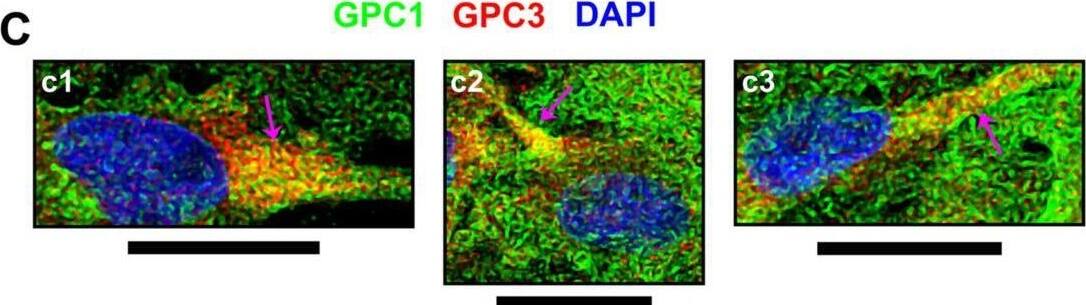
Detection of Glypican 1 by Immunocytochemistry/ Immunofluorescence
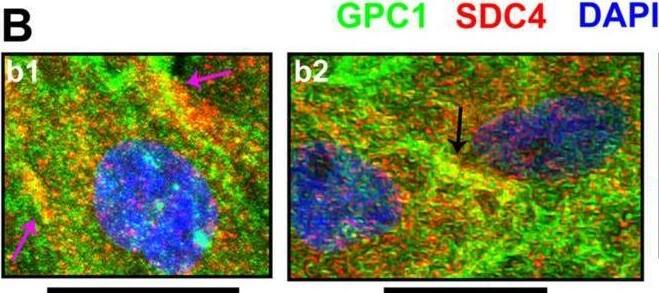
Cellular events indicating GPC1 and its association with SDC4 or GPC3.From immunofluorescence assays, through confocal microscopy, special events including (A) GPC1 and its co-localization with (B) SDC4 or (C) GPC3, both in red, were imaged. GPC1 is always represented in green, and DAPI staining for cells’ nuclei is in blue. Images were obtained from U-251 MG cells (b2, b3 and c1-c4) or C- (a1-a3 and b1) as there was evident GPC1 expression in these cell lines. Arrows have the following color code: detection in extracellular vesicles (white); extracellular vesicles’ interaction with the cellular membrane (cyan); co-localization in the cell membrane (magenta); co-localization in cell-cell junctions (black). The images were obtained with a Leica TCS SP8 CARS confocal microscope. All scale bars refer to 25 µm. Image collected and cropped by CiteAb from the following open publication (https://pubmed.ncbi.nlm.nih.gov/32180897), licensed under a CC-BY license. Not internally tested by R&D Systems.Applications for Human Glypican 1 Antibody
Application
Recommended Usage
CyTOF-ready
Ready to be labeled using established conjugation methods. No BSA or other carrier proteins that could interfere with conjugation.
Flow Cytometry
2.5 µg/106 cells
Sample: MDA-MB-231 human breast cancer cell line
Sample: MDA-MB-231 human breast cancer cell line
Immunocytochemistry
5-15 µg/mL
Sample: Immersion fixed MDA‑MB‑231 human breast cancer cell line
Sample: Immersion fixed MDA‑MB‑231 human breast cancer cell line
Western Blot
0.1 µg/mL
Sample: Recombinant Human Glypican 1 (Catalog # 4519-GP)
Sample: Recombinant Human Glypican 1 (Catalog # 4519-GP)
Formulation, Preparation, and Storage
Purification
Antigen Affinity-purified
Reconstitution
Reconstitute at 0.2 mg/mL in sterile PBS. For liquid material, refer to CoA for concentration.
Formulation
Lyophilized from a 0.2 μm filtered solution in PBS with Trehalose. *Small pack size (SP) is supplied either lyophilized or as a 0.2 µm filtered solution in PBS.
Shipping
Lyophilized product is shipped at ambient temperature. Liquid small pack size (-SP) is shipped with polar packs. Upon receipt, store immediately at the temperature recommended below.
Stability & Storage
Use a manual defrost freezer and avoid repeated freeze-thaw cycles.
- 12 months from date of receipt, -20 to -70 °C as supplied.
- 1 month, 2 to 8 °C under sterile conditions after reconstitution.
- 6 months, -20 to -70 °C under sterile conditions after reconstitution.
Background: Glypican 1
The Glypicans (glypiated proteoglycans) are a small multigene family of GPI-linked proteoglycans that play a key role in growth factor signaling (1, 2, 3, 4). There are six known mammalian Glypicans. They all share a common-sized protein core of 60‑70 kDa, an N-terminus which likely forms a compact globular domain, 14 conserved cysteines that form multiple intrachain disulfide bonds, and a number of C-terminal N- and O-linked carbohydrate attachment sites. Based on exon organization and the location of O-linked glycosylation sites, at least two subfamilies of Glypicans are known, with one subfamily containing Glypicans 1, 2, 4 and 6, and another subfamily containing Glypicans 3 and 5 (3, 5). Human Glypican 1 (GPC-1) is synthesized as a 558 amino acid (aa) preproprecursor that contains a 23 aa signal sequence, a 507 aa mature segment, and a 28 aa C-terminal prosegment (6, 7). There are two potential N-linked and four potential O-linked sites for glycosylation or glycanation. There are potentially two heparan sulfate (HS) modifications on GPC-1 that could contribute to a native molecular weight of approximately 200 kDa (7, 8, 9). Mature human GPC-1 shares 91% aa identity with mature mouse GPC-1. There are two potential splice variants of human GPC-1. Both show an alternate start site at Met73, while one has an additional 65 aa substitution for the C-terminal 264 amino acids (10, 11). Cells known to express GPC-1 include neurons, smooth and skeletal muscle cells, keratinocytes, osteoblasts, Schwann cells, immature dendritic cells, and tumor, plus tumor-associated vascular endothelial cells (8, 9, 12‑15). The function of GPC-1 is complex and varied. As a proteoglycan, it appears to make use of its HS adduct to impact select growth factor activity (16). This is accomplished by having juxtramembrane HS attachment sites, and a flexible, GPI-linkage (17). Data suggests GPC-1 and sulfation enzymes may collaborate to regulate FGF signaling. HS modules that are rich in 2-O- and 6-O- sulfate upregulate FGF-2 activation of FGFR1c (18). Similarly, FGF-1 requires both 2-O- and 6-O-sulfation to bind to FGFR2c and 3c. By contract, FGF-1 requires no sulfation to bind to FGFR2b, and FGF-8b needs only 6-O-sulfation to activate FGFR3c. Thus, many FGF receptor isoform specific effects may be attributed to an interaction between Glypican family members and the cell sulfation system (19).
References
- Song, H.H. and J. Filmus (2002) Biochim. Biophys. Acta 1573:241.
- Fransson, L-A. et al. (2004) Cell. Mol. Life Sci. 61:1016.
- De Cat, B. and G. David (2001) Semin. Cell Dev. Biol. 12:117.
- Lamoureux, F. et al. (2007) BioEssays 29:758.
- Veugelers, M. et al. (1999) J. Biol. Chem. 274:26968.
- GenBank Accession # P35052.
- David, G. et al. (1990) J. Cell Biol. 111:3165.
- Lories, V. et al. (1992) J. Biol. Chem. 267:1116.
- Lories, V. et al. (1989) J. Biol. Chem. 264:7009.
- GenBank Accession # EAW71184.
- GenBank Accession # EAW71183.
- Chernousov, M.A. et al. (2006) J. Neurosci. 26:508.
- Wegrowski, Y. et al. (2006) Clin. Exp. Immunol. 144:485.
- Qiao, D. et al. (2003) J. Biol. Chem. 278:16045.
- Kayed, H. et al. (2006) Int. J. Oncol. 29:1139.
- Selleck, S.B. (2006) SciSTKE, April 4:pe17.
- Qiao, D. et al. (2003) J. Biol. Chem. 278:16045.
- Su, G. et al. (2006) Am. J. Pathol. 168:2014.
- Allen, B.L. and A.C. Rapraeger (2003) J. Cell Biol. 163:637.
Alternate Names
GPC1
Gene Symbol
GPC1
UniProt
Additional Glypican 1 Products
Product Documents for Human Glypican 1 Antibody
Product Specific Notices for Human Glypican 1 Antibody
For research use only
Loading...
Loading...
Loading...
Loading...
Loading...
Loading...