
Human Glutathione S-Transferase mu 1/GSTM1 Antibody
R&D Systems, part of Bio-Techne | Catalog # MAB6894

Conjugate
Catalog #
Key Product Details
Species Reactivity
Validated:
Human
Cited:
Human
Applications
Validated:
Western Blot
Cited:
Western Blot
Label
Unconjugated
Antibody Source
Monoclonal Mouse IgG1 Clone # 842516
Product Specifications
Immunogen
E. coli-derived recombinant human Glutathione S‑Transferase mu 1/GSTM1
Met1-Lys218
Accession # P09488
Met1-Lys218
Accession # P09488
Specificity
Detects human Glutathione S‑Transferase mu 1/GSTM1 in ELISAs.
Clonality
Monoclonal
Host
Mouse
Isotype
IgG1
Scientific Data Images for Human Glutathione S-Transferase mu 1/GSTM1 Antibody
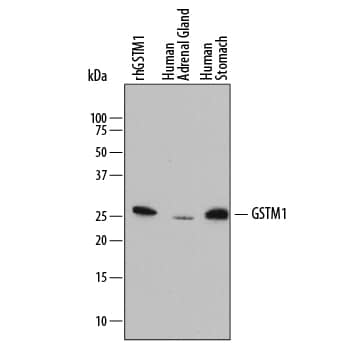
Detection of Human Glutathione S‑Transferase mu 1/GS by Western Blot.
Western blot shows Recombinant Human GSTM1 (Catalog # 6894-GT, 3 ng/lane) and lysates of human adrenal gland tissue and human stomach tissue. PVDF membrane was probed with 1 µg/mL of Mouse Anti-Human Glutathione S-Transferase mu 1/GS Monoclonal Antibody (Catalog # MAB6894) followed by HRP-conjugated Anti-Mouse IgG Secondary Antibody (Catalog # HAF018). A specific band was detected for Glutathione S-Transferase mu 1/GS at approximately 25 kDa (as indicated). This experiment was conducted under reducing conditions and using Immunoblot Buffer Group 1.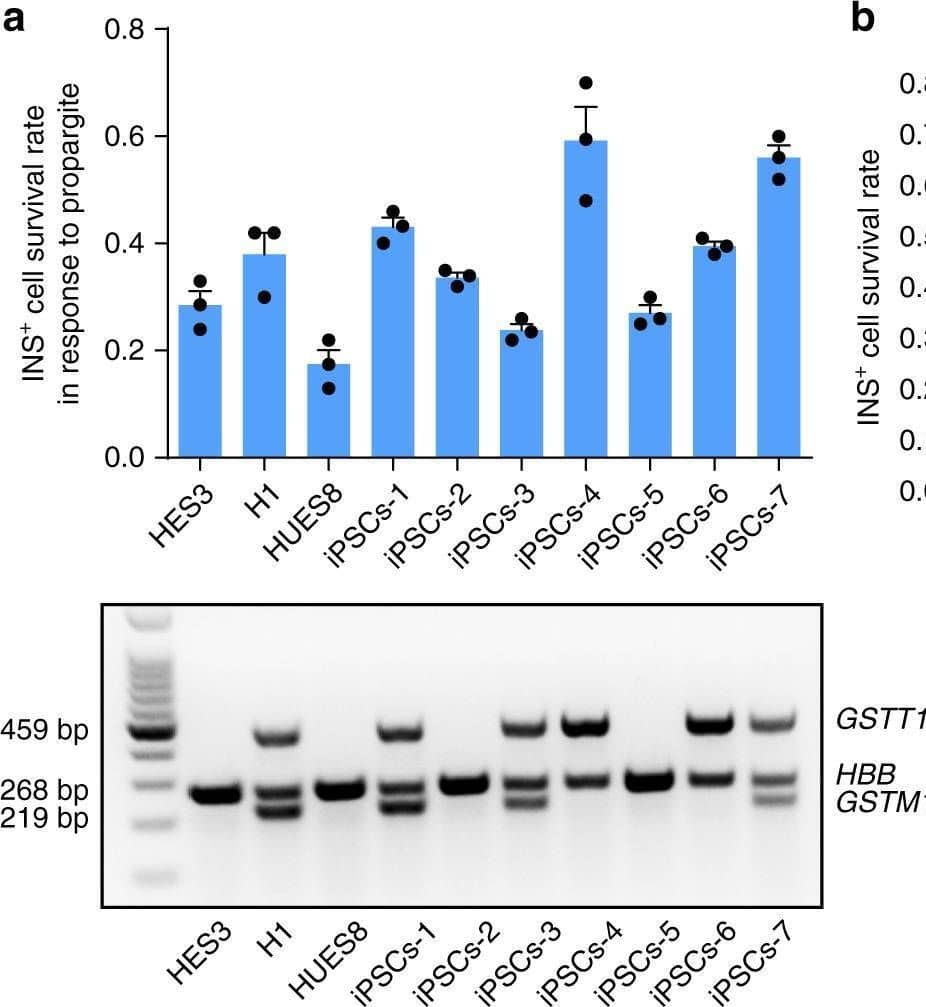
Detection of Glutathione S-Transferase mu 1/GSTM1 by Western Blot
A hPSC-based population study discovers that GSTT1-null pancreatic beta-like cells are hypersensitive to propargite-induced cell death. a Survival rate of INS+ cells derived from 10 different hESC or iPSC lines cultured in the presence of 1.6 μM propargite (n = 3), and genotype analysis of GSTM1 and GSTT1 in those hESCs and iPSCs. b, c Correlation of INS+ cell survival rate in the presence of 1.6 μM propargite in cells lacking both GSTM1 and GSTT1 (b), or lacking only GSTM1 (c). n.s. indicates a non-significant difference. d Western blotting analysis of GSTT1 or GSTM1 protein expression in INS+ cells derived from isogenic wild type, GSTT1−/− or GSTM1−/− H1 hESCs. The −/− null clones were CRSIPR-induced biallelic frameshift mutants. The two GSTT1 knockout clones were both homozygous null mutants, and the two GSTM1 knockout clones were both compound-null mutants. e Flow cytometry analysis of C-peptide+ cells in isogenic GSTT1−/− or GSTM1−/− hESC-derived D18 cells. f Inhibition curve of propargite on INS+ cells derived from GSTT1+/+ or GSTT1−/− H1 hESCs (n = 3). g, h Representative images (g) and DNA damage rate (h) of GSTT1+/+ and GSTT1−/− beta-like cells (n = 3). Scale bars, 800 μm. gamma-H2A.X +/INS+ cells are highlighted with yellow arrows. i Western blot analysis of GSTT1 protein in EndoC-beta H1 cells carrying sgGSTT1. Two CRISPR gRNAs (sgGSTT1-1 and sgGSTT1-2) were used for generating GSTT1−/− EndoC-beta H1 cells. j, k Representative images (j) and cell death rate (k) of GSTT1−/− EndoC-beta H1 cells treated with 1.6 μM propargite (n = 3). Scale bars, 200 μm. Values presented as mean ± S.D. n.s. indicates a non-significant difference. p values calculated by unpaired two-tailed Student’s t-test were *p < 0.05, ***p < 0.001. Related to Supplementary Fig. 3 Image collected and cropped by CiteAb from the following open publication (https://pubmed.ncbi.nlm.nih.gov/30446643), licensed under a CC-BY license. Not internally tested by R&D Systems.Applications for Human Glutathione S-Transferase mu 1/GSTM1 Antibody
Application
Recommended Usage
Western Blot
1 µg/mL
Sample: Recombinant Human GSTM1 (Catalog # 6894-GT, 3 ng/lane) and lysates of human adrenal gland tissue and human stomach tissue
Sample: Recombinant Human GSTM1 (Catalog # 6894-GT, 3 ng/lane) and lysates of human adrenal gland tissue and human stomach tissue
Formulation, Preparation, and Storage
Purification
Protein A or G purified from hybridoma culture supernatant
Reconstitution
Sterile PBS to a final concentration of 0.5 mg/mL. For liquid material, refer to CoA for concentration.
Formulation
Lyophilized from a 0.2 μm filtered solution in PBS with Trehalose. *Small pack size (SP) is supplied either lyophilized or as a 0.2 µm filtered solution in PBS.
Shipping
Lyophilized product is shipped at ambient temperature. Liquid small pack size (-SP) is shipped with polar packs. Upon receipt, store immediately at the temperature recommended below.
Stability & Storage
Use a manual defrost freezer and avoid repeated freeze-thaw cycles.
- 12 months from date of receipt, -20 to -70 °C as supplied.
- 1 month, 2 to 8 °C under sterile conditions after reconstitution.
- 6 months, -20 to -70 °C under sterile conditions after reconstitution.
Background: Glutathione S-Transferase mu 1/GSTM1
References
- Pearson, W. R. et al. (1993) Am. J. Hum. Genet. 53:220.
- Mohr, L.C. et al. (2003) Anticancer. Res. 23:2111.
- Wang, H. et al. (2010) Dig. Dis. Sci. 55:1824.
- Engel, L. S. et al. (2002) Am. J. Epidermiol. 156:95.
- Mo, Z. et al. (2009) Prostate. 69:662.
- Mukherjee, S. B. et al. (1999) Biochem. J. 340:309.
- Ishigaki, S. et al. (1989) Arch. Biochem. Biophys. 273:265.
Alternate Names
Glutathione STransferase mu 1, GST1, GSTM1, GTH4, GTM1
Entrez Gene IDs
2944 (Human)
Gene Symbol
GSTM1
UniProt
Additional Glutathione S-Transferase mu 1/GSTM1 Products
Product Documents for Human Glutathione S-Transferase mu 1/GSTM1 Antibody
Product Specific Notices for Human Glutathione S-Transferase mu 1/GSTM1 Antibody
For research use only
Loading...
Loading...
Loading...
Loading...
Loading...