
Human FGF-9 Antibody
R&D Systems, part of Bio-Techne | Catalog # MAB273


Conjugate
Catalog #
Key Product Details
Species Reactivity
Validated:
Human
Cited:
Human, Rat
Applications
Validated:
ELISA Capture (Matched Antibody Pair), Neutralization
Cited:
Immunohistochemistry, Immunohistochemistry-Paraffin, Western Blot, Neutralization
Label
Unconjugated
Antibody Source
Monoclonal Mouse IgG2A Clone # 36912
Product Specifications
Immunogen
S. frugiperda insect ovarian cell line Sf 21-derived recombinant human FGF-9
Met1-Ser208
Accession # P31371
Met1-Ser208
Accession # P31371
Specificity
Detects human FGF-9 in ELISAs. In sandwich immunoassays, no cross-reactivity or interference with recombinant human (rh) FGF-4, 5, 6, 7, 16, rhFGF acidic, or rhFGF basic is observed.
Clonality
Monoclonal
Host
Mouse
Isotype
IgG2A
Endotoxin Level
<0.10 EU per 1 μg of the antibody by the LAL method.
Scientific Data Images for Human FGF-9 Antibody
Cell Proliferation Induced by FGF-9 and Neutralization by Human FGF-9 Antibody.
Recombinant Human FGF-9 (Catalog # 273-F9) stimulates proliferation in the Balb/3T3 mouse embryonic fibroblast cell line in a dose-dependent manner (orange line). Proliferation elicited by Recombinant Human FGF-9 (10 ng/mL) is neutralized (green line) by increasing concentrations of Mouse Anti-Human FGF-9 Monoclonal Antibody (Catalog # MAB273). The ND50 is typically 0.1-0.6 µg/mL.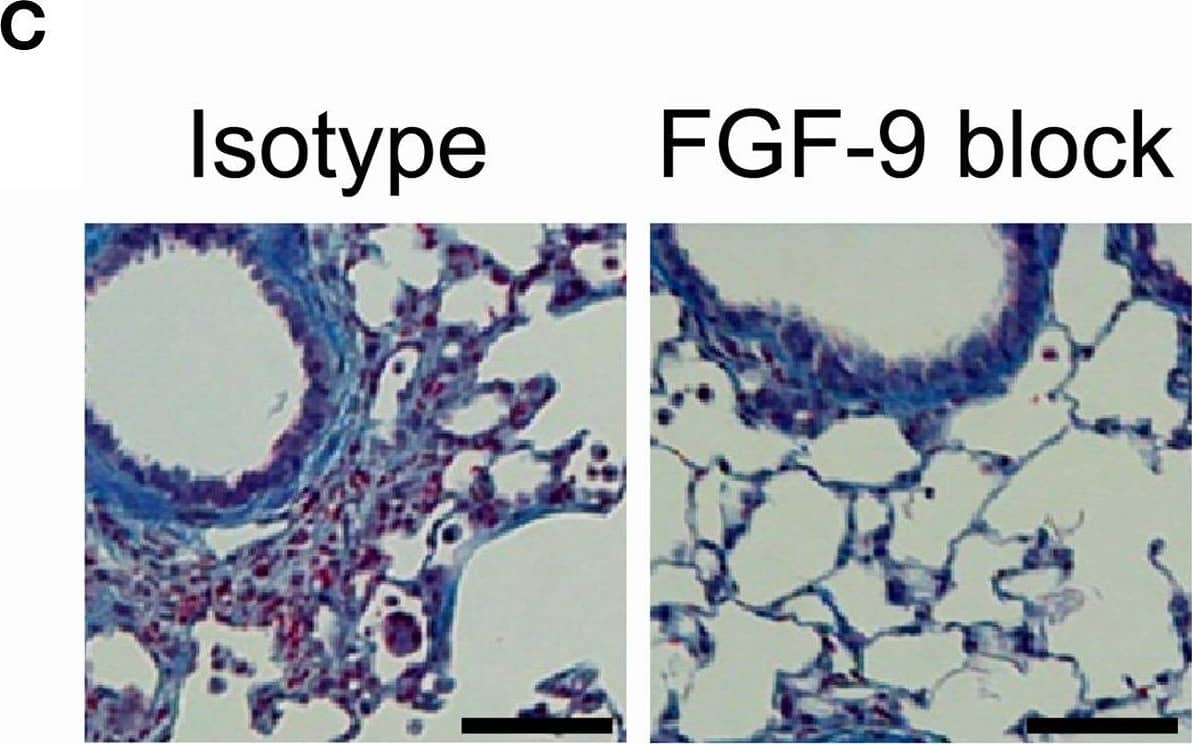
Detection of FGF-9 by Immunohistochemistry
FGF-9 blockade reduces lung fibrocyte accumulation and fibrosis in TGF-beta 1 transgenic mice. TGF-beta 1 Tg+ and Tg− mice were administered 14 days of doxycycline and injected i.p. with either FGF-9 neutralizing antibody or isotype control on days—1, 2, 5, 8, and 11. (A) BAL leukocyte concentration (absolute # per μl). (B) Lung collagen content as measured by Sircol assay performed on the right lower lobe (RLL). (C) Trichrome staining of paraffin embedded lung sections from TGF-beta 1 Tg+ mice treated with isotype control (left) or anti-FGF-9 antibody (right). Scale bar = 100 microns (D,E) Percentages (D) and absolute number (E) of fibrocytes (CD45+ColI alpha1+) in lung digests as determined by flow cytometry. (F) Quantity of Tregs (expressed as percentage of CD4 cells that are CD25+FoxP3+) in lung digests as determined by flow cytometry. n = 5 mice/group. *p < 0.05, **p < 0.01, ***p < 0.001. Image collected and cropped by CiteAb from the following open publication (https://pubmed.ncbi.nlm.nih.gov/24904415), licensed under a CC-BY license. Not internally tested by R&D Systems.
Human FGF-9 ELISA Standard Curve
Recombinant Human FGF-9 (Catalog # 273-F9) was serially diluted and captured by Mouse Anti-Human FGF-9 Monoclonal Antibody (Catalog # MAB273) coated on a Clear Polystyrene Microplate (Catalog # DY990). Goat Anti-Human FGF-9 Antigen Affinity-purified Polyclonal Antibody (Catalog # AF-273-NA) was biotinylated and incubated with the protein captured on the plate. Detection of the standard curve was achieved by incubating Streptavidin-HRP (Catalog # DY998)Applications for Human FGF-9 Antibody
Application
Recommended Usage
Neutralization
Measured by its ability to neutralize FGF‑9-induced proliferation in the Balb/3T3 mouse embryonic fibroblast cell line. The Neutralization Dose (ND50) is typically 0.1-0.6 µg/mL in the presence of 10 ng/mL Recombinant Human FGF‑9.
Human FGF-9 Sandwich Immunoassay
Please Note: Optimal dilutions of this antibody should be experimentally determined.
Formulation, Preparation, and Storage
Purification
Protein A or G purified from ascites
Reconstitution
Reconstitute at 0.5 mg/mL in sterile PBS. For liquid material, refer to CoA for concentration.
Formulation
Lyophilized from a 0.2 μm filtered solution in PBS with Trehalose. *Small pack size (SP) is supplied either lyophilized or as a 0.2 µm filtered solution in PBS.
Shipping
Lyophilized product is shipped at ambient temperature. Liquid small pack size (-SP) is shipped with polar packs. Upon receipt, store immediately at the temperature recommended below.
Stability & Storage
Use a manual defrost freezer and avoid repeated freeze-thaw cycles.
- 12 months from date of receipt, -20 to -70 °C as supplied.
- 1 month, 2 to 8 °C under sterile conditions after reconstitution.
- 6 months, -20 to -70 °C under sterile conditions after reconstitution.
Background: FGF-9
The FGF family is comprised of at least nine polypeptides that show a variety of biological activities toward cells of mesenchymal, neuronal and epithelial origin. All FGFs have two conserved cysteine residues and share 30‑50% sequence identity at the amino acid level. FGF-9, also named glia-activating factor, was originally identified and purified from the supernatant of a human glioma cell line as a heparin-binding mitogenic growth factor for glial cells. FGF-9 has also been shown to stimulate the proliferation of oligodendrocyte type 2 astrocyte progenitor cells, Balb/c3T3 fibroblasts and PC-12 cells. However, unlike FGF acidic and basic, FGF-9 is not a mitogen for human umbilical vein endothelial cells.
The human FGF-9 cDNA encodes a 208 amino acid residue protein that contains a potential N-linked glycosylation site. The native protein is glycosylated. FGF-9 exhibits approximately 30% sequence similarity to other members of the FGF family. Although FGF-9 lacks a typical secretion signal, the protein is secreted efficiently after synthesis. Rat FGF-9 cDNA has been cloned and shown to be highly homologous to human FGF-9. The two proteins differ only in one amino acid residue. The expression of the FGF-9 transcripts has been shown to be restricted to the brain and the kidney.
References
- Naruo, K. et al. (1993) J. Biol. Chem. 268:2857.
- Miyamoto, M. et al. (1993) Mol. Cell Biol. 13:4251.
Long Name
Fibroblast Growth Factor 9
Alternate Names
FGF9
Gene Symbol
FGF9
UniProt
Additional FGF-9 Products
Product Documents for Human FGF-9 Antibody
Product Specific Notices for Human FGF-9 Antibody
For research use only
Loading...
Loading...
Loading...
Loading...