
Human BAI1 PE-conjugated Antibody
R&D Systems, part of Bio-Techne | Catalog # FAB49691P

Conjugate
Catalog #
Key Product Details
Species Reactivity
Human
Applications
Flow Cytometry
Label
Phycoerythrin (Excitation = 488 nm, Emission = 565-605 nm)
Antibody Source
Monoclonal Mouse IgG1 Clone # 480912
Product Specifications
Immunogen
HEK293 human embryonic kidney cell line transfected with human BAI1
Ala31-Thr879
Accession # O14514
Ala31-Thr879
Accession # O14514
Specificity
Detects human BAI1 in direct ELISAs.
Clonality
Monoclonal
Host
Mouse
Isotype
IgG1
Scientific Data Images for Human BAI1 PE-conjugated Antibody
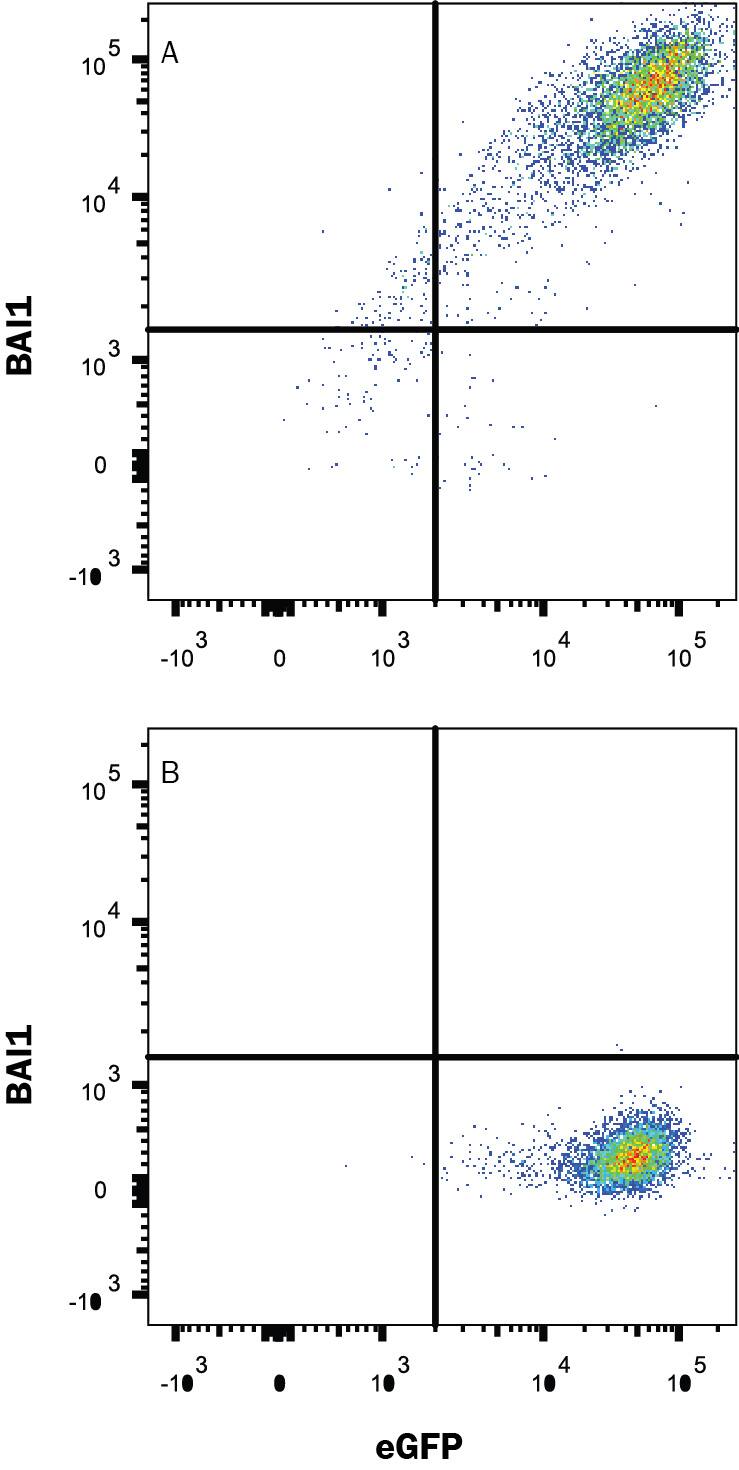
Detection of BAI1 in HEK293 Human Cell Line Transfected with Human BAI1 and eGFP by Flow Cytometry.
HEK293 human embryonic kidney cell line transfected with (A) human BAI1 or (B) irrelevant protein, and eGFP was stained with Mouse Anti-Human BAI1 PE-conjugated Monoclonal Antibody (Catalog # FAB49691P). Quadrant markers were set based on Mouse IgG1 isotype control antibody staining (IC002P, data not shown). Staining was performed using our Staining Membrane-associated Proteins protocol.Applications for Human BAI1 PE-conjugated Antibody
Application
Recommended Usage
Flow Cytometry
10 µL/106 cells
Sample: HEK293 Human Cell Line Transfected with Human BAI1 and eGFP
Sample: HEK293 Human Cell Line Transfected with Human BAI1 and eGFP
Formulation, Preparation, and Storage
Purification
Protein A or G purified from hybridoma culture supernatant
Reconstitution
Reconstitution default not known
Formulation
Supplied in a saline solution containing BSA and Sodium Azide.
Shipping
The product is shipped with polar packs. Upon receipt, store it immediately at the temperature recommended below.
Stability & Storage
Protect from light. Do not freeze.
- 12 months from date of receipt, 2 to 8 °C as supplied.
Background: BAI1
References
- Nishimori, H. et al. (1997) Oncogene 15:2145.
- Koh, J.T. et al. (2001) Brain Res. Mol. Brain Res. 87:223.
- Mori, K. et al. (2002) Neurosci. Res. 43:69.
- Kaur, B. et al. (2003) Am. J. Pathol. 162:19.
- Park, D. et al. (2007) Nature 450:430.
- Duda, D.G. et al. (2002) Br. J. Cancer 86:490.
- Lee, J.H. et al. (2001) Int. J. Oncol. 18:355.
- Fukushima, Y. et al. (1998) Int. J. Oncol. 13:967.
- Kaur, B. et al. (2005) Oncogene 24:3632.
- Koh, J.T. et al. (2004) Exp. Cell Res. 294:172.
- Kaur, B. et al. (2009) Cancer Res. 69:1212.
- Kang, X. et al. (2006) Cancer Gene Ther. 13:385.
- Hatanaka, H. et al. (2000) Int. J. Mol. Med. 5:181.
Long Name
Brain-specific Angiogenesis Inhibitor 1
Alternate Names
brain-specific angiogenesis inhibitor 1, FLJ41988, GDAIF
Gene Symbol
ADGRB1
UniProt
Additional BAI1 Products
Product Documents for Human BAI1 PE-conjugated Antibody
Product Specific Notices for Human BAI1 PE-conjugated Antibody
For research use only
Loading...
Loading...
Loading...
Loading...
Loading...
Loading...
Loading...