
HA Tag Alexa Fluor® 488-conjugated Antibody
R&D Systems, part of Bio-Techne | Catalog # IC6875G
Recombinant Monoclonal Antibody.


Scientific images may be resized, cropped, or adjusted for brightness or contrast for presentation purposes. These updates are limited to presentation and do not affect the underlying scientific interpretation of the data. Where available, additional source data may be provided upon request.
Conjugate
Catalog #
Key Product Details
Species Reactivity
Validated:
Multi-Species
Cited:
Human, Chinese Hamster, Hamster, Moth - Spodoptera frugiperda (Fall armyworm)
Applications
Validated:
Intracellular Staining by Flow Cytometry
Cited:
Flow Cytometry, Immunocytochemistry, Bioassay
Label
Alexa Fluor 488 (Excitation = 488 nm, Emission = 515-545 nm)
Antibody Source
Monoclonal Mouse IgG1 Clone # 912426
Product Specifications
Immunogen
HA Tag peptide
Accession # ABB51961
Accession # ABB51961
Specificity
Detects N-terminal,C-terminal, and Internal Sequence
HA-tagged
proteins in Western blot.
Clonality
Monoclonal
Host
Mouse
Isotype
IgG1
Scientific Data Images for HA Tag Alexa Fluor® 488-conjugated Antibody
Detection of HA Tag in HEK293 Human Cell Line Transfected with HA-tagged Proteins by Flow Cytometry.
HEK293 human embryonic kidney cell line transfected with either (A) HA-tagged proteins (filled histogram) or (B) irrelevant transfectants (open histogram) was stained with Mouse Anti-HA Tag Alexa Fluor® 488-conjugated Monoclonal Antibody (Catalog # IC6875G). To facilitate intracellular staining, cells were fixed and permeabilized with FlowX FoxP3 Fixation & Permeabilization Buffer Kit (Catalog # FC012). View our protocol for Staining Intracellular Molecules.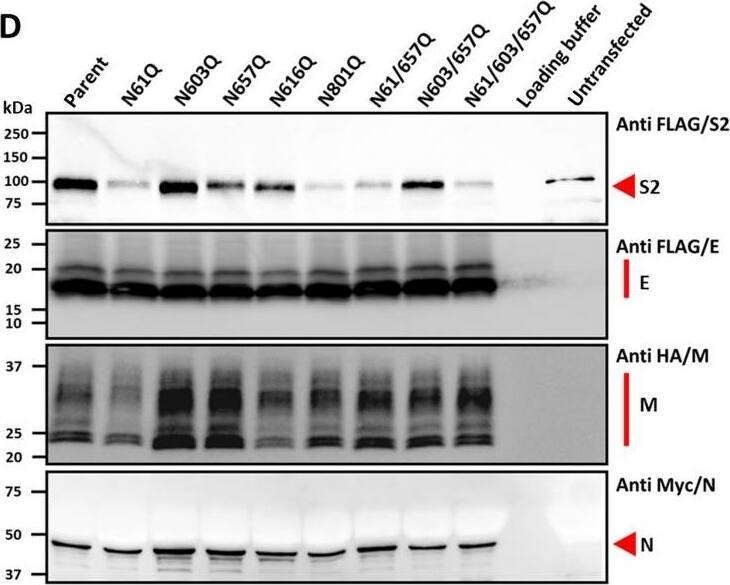
Detection of HA Tag by Western Blot
SARS-CoV-2 VLPs with N-glycan mutations display reduced viral entry.(A) Plasmids encoding for the four structural proteins containing distinct tags or EGFP reporters were either transfected alone or pooled and transfected together into 293Ts. (B) Confocal micrographs show the intracellular colocalization of M, N, E, and Spike in perinuclear compartments that likely includes the ERGIC (arrowhead). (C) Flow cytometry analysis performed with live and “fixed-permeabilized cells” demonstrate cell surface expression of Spike and M proteins. N and E were intracellular. Here, the structural proteins were either expressed alone or altogether: “+” and “−” indicate presence/absence of indicated proteins. (D) All proteins were expressed in VLPs (detected using epitope-tag Abs), but Spike carrying N61Q and N801Q mutations displayed somewhat reduced expression. (E) Luc-VLPs containing firefly luciferase reporter were produced by cotransfecting 293T cells with plasmids encoding for N (R203M mutant), M-IRES-E, Luc-PS9, and Spike constructs. Luc-VLP viral entry into 293T/ACE2 cells was reduced upon implementing many of the N-to-Q glycosylation mutations. “No-spike” VLPs were made using all plasmids except Spike. Mock infection did not contain VLP. Data were normalized to parent-VLP luminescence in each run [both for (E) and (F)]. (F) Luc-VLP with parent-Spike, produced using 293T cells, was deglycosylated using either Endo H or peptide N-glycosidase (PNGase) F. PNGase F reduced viral entry into 293T/ACE2 and Calu-3 cells, with a smaller effect being observed for Endo H. Data are means ± SD for n ≥ 3. *P < 0.05 with respect to all other treatments and †P < 0.05 with respect to parent. Image collected and cropped by CiteAb from the following open publication (https://pubmed.ncbi.nlm.nih.gov/36149962), licensed under a CC-BY license. Not internally tested by R&D Systems.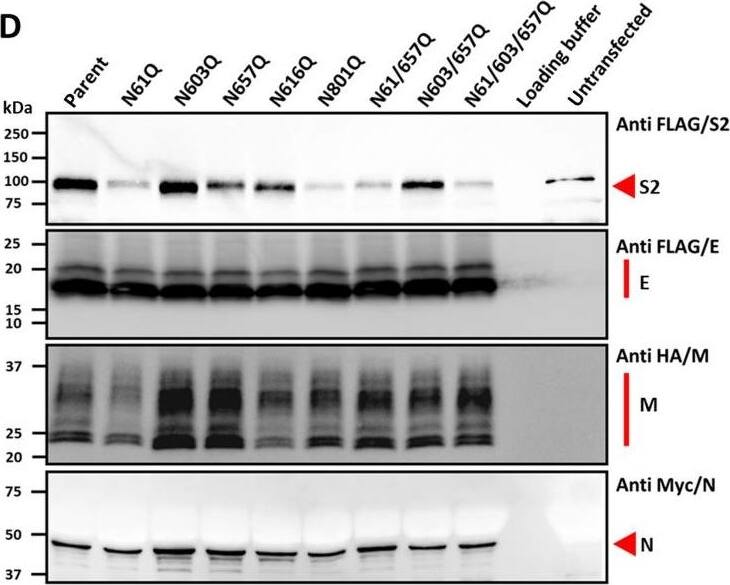
Detection of HA Tag by Western Blot
SARS-CoV-2 VLPs with N-glycan mutations display reduced viral entry.(A) Plasmids encoding for the four structural proteins containing distinct tags or EGFP reporters were either transfected alone or pooled and transfected together into 293Ts. (B) Confocal micrographs show the intracellular colocalization of M, N, E, and Spike in perinuclear compartments that likely includes the ERGIC (arrowhead). (C) Flow cytometry analysis performed with live and “fixed-permeabilized cells” demonstrate cell surface expression of Spike and M proteins. N and E were intracellular. Here, the structural proteins were either expressed alone or altogether: “+” and “−” indicate presence/absence of indicated proteins. (D) All proteins were expressed in VLPs (detected using epitope-tag Abs), but Spike carrying N61Q and N801Q mutations displayed somewhat reduced expression. (E) Luc-VLPs containing firefly luciferase reporter were produced by cotransfecting 293T cells with plasmids encoding for N (R203M mutant), M-IRES-E, Luc-PS9, and Spike constructs. Luc-VLP viral entry into 293T/ACE2 cells was reduced upon implementing many of the N-to-Q glycosylation mutations. “No-spike” VLPs were made using all plasmids except Spike. Mock infection did not contain VLP. Data were normalized to parent-VLP luminescence in each run [both for (E) and (F)]. (F) Luc-VLP with parent-Spike, produced using 293T cells, was deglycosylated using either Endo H or peptide N-glycosidase (PNGase) F. PNGase F reduced viral entry into 293T/ACE2 and Calu-3 cells, with a smaller effect being observed for Endo H. Data are means ± SD for n ≥ 3. *P < 0.05 with respect to all other treatments and †P < 0.05 with respect to parent. Image collected and cropped by CiteAb from the following open publication (https://pubmed.ncbi.nlm.nih.gov/36149962), licensed under a CC-BY license. Not internally tested by R&D Systems.Applications for HA Tag Alexa Fluor® 488-conjugated Antibody
Application
Recommended Usage
Intracellular Staining by Flow Cytometry
0.25-1 µg/106 cells
Sample: HEK293 human embryonic kidney cell line transfected with Hemagglutinin/HA-tagged proteins fixed and permeabilized with FlowX FoxP3 Fixation & Permeabilization Buffer Kit (Catalog # FC012)
Sample: HEK293 human embryonic kidney cell line transfected with Hemagglutinin/HA-tagged proteins fixed and permeabilized with FlowX FoxP3 Fixation & Permeabilization Buffer Kit (Catalog # FC012)
Spectra Viewer
Plan Your Experiments
Use our spectra viewer to interactively plan your experiments, assessing multiplexing options. View the excitation and emission spectra for our fluorescent dye range and other commonly used dyes.
Spectra Viewer
Formulation, Preparation, and Storage
Purification
Protein A or G purified from cell culture supernatant
Formulation
Supplied in a saline solution containing BSA and Sodium Azide.
Shipping
The product is shipped with polar packs. Upon receipt, store it immediately at the temperature recommended below.
Stability & Storage
Protect from light. Do not freeze.
- 12 months from date of receipt, 2 to 8 °C as supplied.
Background: HA Tag
Alternate Names
HA Epitope Tag
Gene Symbol
HA
UniProt
Additional HA Tag Products
Product Documents for HA Tag Alexa Fluor® 488-conjugated Antibody
Product Specific Notices for HA Tag Alexa Fluor® 488-conjugated Antibody
This product is provided under an agreement between Life Technologies Corporation and R&D Systems, Inc, and the manufacture, use, sale or import of this product is subject to one or more US patents and corresponding non-US equivalents, owned by Life Technologies Corporation and its affiliates. The purchase of this product conveys to the buyer the non-transferable right to use the purchased amount of the product and components of the product only in research conducted by the buyer (whether the buyer is an academic or for-profit entity). The sale of this product is expressly conditioned on the buyer not using the product or its components (1) in manufacturing; (2) to provide a service, information, or data to an unaffiliated third party for payment; (3) for therapeutic, diagnostic or prophylactic purposes; (4) to resell, sell, or otherwise transfer this product or its components to any third party, or for any other commercial purpose. Life Technologies Corporation will not assert a claim against the buyer of the infringement of the above patents based on the manufacture, use or sale of a commercial product developed in research by the buyer in which this product or its components was employed, provided that neither this product nor any of its components was used in the manufacture of such product. For information on purchasing a license to this product for purposes other than research, contact Life Technologies Corporation, Cell Analysis Business Unit, Business Development, 29851 Willow Creek Road, Eugene, OR 97402, Tel: (541) 465-8300. Fax: (541) 335-0354.
For research use only
Loading...
Loading...
Loading...
Loading...
Loading...