
C. botulinum BoNT-E Heavy Chain Antibody
R&D Systems, part of Bio-Techne | Catalog # MAB7135

Conjugate
Catalog #
Key Product Details
Species Reactivity
C. botulinum
Applications
Western Blot
Label
Unconjugated
Antibody Source
Monoclonal Mouse IgG2B Clone # 785208
Product Specifications
Immunogen
E. coli-derived recombinant C. botulinum BoNT-E Heavy Chain
Lys845-Lys1251
Accession # P30995
Lys845-Lys1251
Accession # P30995
Specificity
Detects C. botulinum BoNT-E Heavy Chain in direct ELISAs and Western blots. In direct ELISAs, no cross-reactivity with recombinant Heavy Chains from BoNT-A or BoNT-G is observed.
Clonality
Monoclonal
Host
Mouse
Isotype
IgG2B
Scientific Data Images for C. botulinum BoNT-E Heavy Chain Antibody
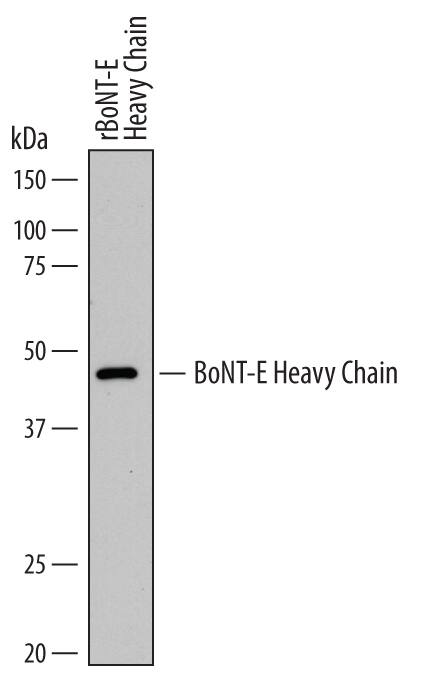
Detection ofC. botulinumBoNT‑E Heavy Chain by Western Blot.
Western blot shows lysates of recombinantC. botulinumBoNT-E Heavy Chain Receptor Binding Domain (25 ng/lane). PVDF membrane was probed with 1 µg/mL of Mouse Anti-C. botulinumBoNT-E Heavy Chain Monoclonal Antibody (Catalog # MAB7135) followed by HRP-conjugated Anti-Mouse IgG Secondary Antibody (Catalog # HAF007). A specific band was detected for BoNT-E Heavy Chain at approximately 50 kDa (as indicated). This experiment was conducted under reducing conditions and using Immunoblot Buffer Group 1.Applications for C. botulinum BoNT-E Heavy Chain Antibody
Application
Recommended Usage
Western Blot
1 µg/mL
Sample: Recombinant C. botulinum BoNT-E Heavy Chain Receptor Binding Domain
Sample: Recombinant C. botulinum BoNT-E Heavy Chain Receptor Binding Domain
Formulation, Preparation, and Storage
Purification
Protein A or G purified from hybridoma culture supernatant
Reconstitution
Sterile PBS to a final concentration of 0.5 mg/mL. For liquid material, refer to CoA for concentration.
Formulation
Lyophilized from a 0.2 μm filtered solution in PBS with Trehalose. *Small pack size (SP) is supplied either lyophilized or as a 0.2 µm filtered solution in PBS.
Shipping
Lyophilized product is shipped at ambient temperature. Liquid small pack size (-SP) is shipped with polar packs. Upon receipt, store immediately at the temperature recommended below.
Stability & Storage
Use a manual defrost freezer and avoid repeated freeze-thaw cycles.
- 12 months from date of receipt, -20 to -70 °C as supplied.
- 1 month, 2 to 8 °C under sterile conditions after reconstitution.
- 6 months, -20 to -70 °C under sterile conditions after reconstitution.
Background: BoNT-E Heavy Chain
Botulinum Neurotoxin Type E is one of the seven serotypes of Botulinum Neurotoxins (BoNTs) produced by various strains of Clostridium botulinum (1, 2). BoNTs are synthesized as inactive single chain protein precursors and activated by proteolytic cleavage to generate disulfide-linked two-chain proteins. The 50 kDa light chain contains the catalytic domain, whereas the 100 kDa heavy chain contains an internal translocation domain and a receptor binding domain (3). BoNTs are the most potent protein toxins for humans. As zinc proteases, they cleave SNARE proteins to elicit flaccid paralysis in botulism by blocking acetylcholine release at the neuromuscular junction (2‑4). E. coli-expressed recombinant light chains are active proteases. In the absence of the heavy chains, however, they lack toxicity because they cannot enter into host cells.
References
- Campbell K.D. et al. (1993) J. Clin. Microbiol. 31:2255.
- Montecucco, C. and Giampietro, S. (1993) Trends. Biochem. Sci. 18:324.
- Turton, K. et al. (2002) Trends. Biochem. Sci. 27:552.
- Schiavo, G. et al. (2000) Physiol. Rev. 80:717.
Long Name
Botulinum Neurotoxin Type E Heavy Chain
Alternate Names
BoNTE Heavy Chain, Bontoxilysin-E
UniProt
Additional BoNT-E Heavy Chain Products
Product Documents for C. botulinum BoNT-E Heavy Chain Antibody
Product Specific Notices for C. botulinum BoNT-E Heavy Chain Antibody
For research use only
Loading...
Loading...
Loading...
Loading...
Loading...