
Peanut Agglutinin [Cy5]
Novus Biologicals, part of Bio-Techne | Catalog # CL-1075-NB

Key Product Details
Applications
Immunohistochemistry
Conjugate
Cy5
Product Summary for Peanut Agglutinin [Cy5]
Features:br/>
Cy5 labeled Peanut agglutinin has an appropriate number of fluorochromes bound to provide the optimum staining characteristics for this lectin. Supplied essentially free of unconjugated fluorochromes. Excitation: 650 nm Emission: 670 nm Color: Far Red
Cy5 labeled Peanut agglutinin has an appropriate number of fluorochromes bound to provide the optimum staining characteristics for this lectin. Supplied essentially free of unconjugated fluorochromes. Excitation: 650 nm Emission: 670 nm Color: Far Red
Product Specifications
Application Notes
A precipitate may form during storage. This does not have a significant adverse effect on the product. If a precipitate forms upon long-term storage at 4C, warm to 37C and centrifuge before use. The recommended concentration range for use is 5-20 ug/mL..
Scientific Data Images for Peanut Agglutinin [Cy5]
![Immunohistochemistry-Paraffin: Peanut Agglutinin [Cy5] [CL-1075-NB]](https://resources.bio-techne.com/images/products/Peanut-Agglutinin-[Cy5]-Immunofluorescence-CL-1075-NB-img0001.jpg "Immunohistochemistry-Paraffin: Peanut Agglutinin [Cy5] [CL-1075-NB]")
Immunohistochemistry-Paraffin: Peanut Agglutinin [Cy5] [CL-1075-NB]
Immunohistochemistry-Paraffin: Peanut Agglutinin [Cy5] [CL-1075-NB] - Tonsil FFPE: Antigen retrieved with Antigen Unmasking Solution and stained with Cy5 labeled Peanut Agglutinin (purple) and DAPI (blue).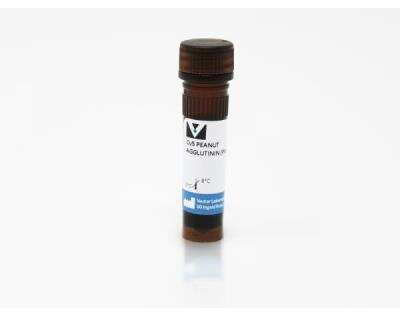
Peanut Agglutinin [Cy5] [CL-1075-NB] - Peanut Agglutinin (PNA), Cy5
Formulation, Preparation, and Storage
Formulation
10 mM HEPES, 0.15 M NaCl, pH 7.5, 0.1 mM CaCl2, proprietary stabilizer
Preservative
0.08% Sodium Azide
Concentration
Please see the protocols for proper use of this product. If no protocol is available, contact technical services for assistance.
Shipping
The product is shipped at ambient temperature. Upon receipt, store it immediately at the temperature recommended below.
Storage
Store at 4C in the dark.
Background: Peanut Agglutinin
PNA is useful in distinguishing between normal and tumor tissues and in assessing malignancy in transitional mucosa. In addition, PNA binding can be used to measure cellular maturity in lymphoid tissues, to distinguish a variety of lymphocyte subpopulations in man and experimental animals, and to measure the levels of lymphoid cell populations in many diseases. PNA can be employed in the fractionation of stem cells in mice for use in bone marrow transplantation across histocompatibility barriers. A major cell surface receptor for PNA may be asialo GM1 ganglioside. Since PNA shares specificity with the antibody to this glycolipid, PNA and the antibody can be used interchangeably in some applications.
Additional Peanut Agglutinin Products
Product Documents for Peanut Agglutinin [Cy5]
Product Specific Notices for Peanut Agglutinin [Cy5]
Cy is a registered trademark of Global Life Sciences Solutions Germany GmbH.
This product is manufactured by Vector Laboratories and distributed by Novus Biologicals.
This product is for research use only and is not approved for use in humans or in clinical diagnosis. Support products are guaranteed for 6 months from date of receipt.
Loading...
Loading...
Loading...
Loading...