
Sheep anti-Rat IgG (H+L) Secondary Antibody [HRP]
Novus Biologicals, part of Bio-Techne | Catalog # NBP2-22109

Key Product Details
Species Reactivity
Rat
Applications
ELISA, Immunohistochemistry, Western Blot
Label
HRP
Antibody Source
Polyclonal Sheep IgG
Concentration
2 mg/ml
Product Specifications
Immunogen
Rat IgG whole molecule
Specificity
Recognizes rat IgG. Assay by Immunoelectrophoresis resulted in a single precipitin arc against anti-peroxidase, anti-sheep serum, rat IgG and rat serum.
Clonality
Polyclonal
Host
Sheep
Isotype
IgG
Description
To avoid repeated freezing and thawing, aliquot reconstituted stock solution and store at -20C. Dilute required amount only prior to immediate use. Further dilutions can be made in assay buffer. Note: Sodium azide is a potent inhibitor of peroxidase and should not be added to HRP conjugates. For maximum recovery of product, centrifuge the original vial after thawing and prior to removing the cap. and prior to removing the cap.
Scientific Data Images for Sheep anti-Rat IgG (H+L) Secondary Antibody [HRP]
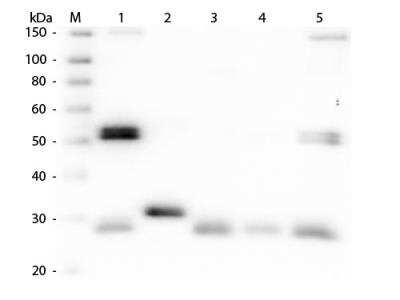
Sheep anti-Rat IgG (H+L) Secondary Antibody [HRP] [NBP2-22109] - Western Blot analysis using Sheep anti-Rat IgG (H+L) Secondary antibody [HRP] (50ng/lane). Lane M: Molecular Ladder Lane 1: Rat IgG whole molecule Lane 2: Rat IgG F(c) fragment Lane 3: Rat IgG Fab fragment Lane 4: Rat IgM whole molecule Lane 5: Rat Serum Primary antibody: at 1:1000 for 60min at RT. Secondary antibody: Donkey anti-Sheep IgG (Peroxidase) at 1:40,000 in blocking buffer for 30min at RT. Block: Blocking buffer for 30min at RT
Applications for Sheep anti-Rat IgG (H+L) Secondary Antibody [HRP]
Application
Recommended Usage
ELISA
1:5000-1:100000
Immunohistochemistry
1:500-1:2500
Western Blot
1:1000-1:10000
Application Notes
ELISA: Assayed against 1ug of Rat IgG in a standard capture ELISA using ABTS as a substrate for 30 minutes at RT. Optimal working dilutions to be determined by researcher.
Formulation, Preparation, and Storage
Purification
Immunogen affinity purified
Formulation
PBS, pH 7.2 with 10mg/ml BSA (IgG and protease free)
Preservative
0.01% Gentamicin Sulfate
Concentration
2 mg/ml
Shipping
The product is shipped with polar packs. Upon receipt, store it immediately at the temperature recommended below.
Stability & Storage
Store at 4C in the dark.
Background: IgG (H+L)
The 4 IgG subclasses, sharing 95% amino acid identity, include IgG1, IgG2, IgG3, and IgG4 for humans and IgG1, IgG2a, IgG2b, and IgG3 for mice. The relative abundance of each human subclass is 60% for IgG1, 32% for IgG2, 4% for IgG3, and 4% for IgG4. In an IgG deficiency, there may be a shortage of one or more subclasses (4).
References
1. Painter RH. (1998) Encyclopedia of Immunology (Second Edition). Elsevier. 1208-1211
2. Chapter 9 - Antibodies. (2012) Immunology for Pharmacy. Mosby 70-78
3. Schroeder H, Cavacini, L. (2010) Structure and Function of Immunoglobulins. J Allergy Clin Immunol. 125(2 0 2): S41-S52. PMID: 20176268
4. Vidarsson G, Dekkers G, Rispens T. (2014) IgG subclasses and allotypes: from structure to effector functions. Front Immunol. 5:520. PMID: 25368619
Additional IgG (H+L) Products
Product Documents for Sheep anti-Rat IgG (H+L) Secondary Antibody [HRP]
Product Specific Notices for Sheep anti-Rat IgG (H+L) Secondary Antibody [HRP]
To avoid repeated freezing and thawing, aliquot reconstituted stock solution and store at -20C. Dilute required amount only prior to immediate use. Further dilutions can be made in assay buffer. Note: Sodium azide is a potent inhibitor of peroxidase and should not be added to HRP conjugates. For maximum recovery of product, centrifuge the original vial after thawing and prior to removing the cap. and prior to removing the cap.
This product is for research use only and is not approved for use in humans or in clinical diagnosis. Secondary Antibodies are guaranteed for 1 year from date of receipt.
Loading...
Loading...
Loading...
Loading...
Loading...