
Recombinant Human Liver Glycogen Phosphorylase His-tag, CF

R&D Systems, part of Bio-Techne | Catalog # 11787-PL

Catalog #
Availability
Size / Price
Qty
Loading...
11787-PL-020

Key Product Details

Source

HEK293

Accession #

Conjugate

Unconjugated

Applications

Enzyme Activity

Product Specifications

Source

Human embryonic kidney cell, HEK293-derived human PYGL protein
Ala2 - Asn847, with an N-terminal Met and 6-His tag

Purity

>95%, by SDS-PAGE visualized with Silver Staining and quantitative densitometry by Coomassie® Blue Staining.

Endotoxin Level

<0.10 EU per 1 μg of the protein by the LAL method.

N-terminal Sequence Analysis

Protein identity confirmed by mass spectrometry.

Predicted Molecular Mass

98 kDa

SDS-PAGE

85-94 kDa, under reducing conditions.

Activity

Measured by its ability to hydrolyze alpha-D-Glucose 1 -phosphate.
The specific activity is >400 pmol/min/μg, as measured under the described conditions.

Scientific Data Images for Recombinant Human Liver Glycogen Phosphorylase His-tag, CF

Recombinant Human Liver Glycogen Phosphorylase His-tag Enzyme Activity.

Recombinant Human Liver Glycogen Phosphorylase His-tag (Catalog # 11787-PL) is measured by its ability to hydrolyze alpha-D-Glucose 1-phosphate.
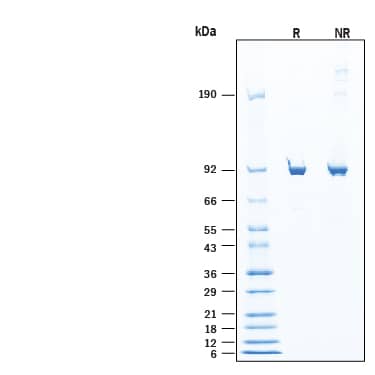
Recombinant Human Liver GlycogenPhosphorylase His-tag SDS-PAGE.

2 μg/lane of Recombinant Human Liver GlycogenPhosphorylase His-tag (Catalog # 11787-PL) was resolved with SDS-PAGE under reducing (R) and non-reducing (NR) conditions and visualized by Coomassie® Blue staining, showing bands at 85-94 kDa, under reducing conditions.

Formulation, Preparation and Storage

11787-PL
Formulation Supplied as a 0.2 μm filtered solution in Tris, NaCl, Glycerol and TCEP.
Shipping The product is shipped with polar packs. Upon receipt, store it immediately at the temperature recommended below.
Stability & Storage Use a manual defrost freezer and avoid repeated freeze-thaw cycles.
  • 6 months from date of receipt, -20 to -70 °C as supplied.
  • 3 months, -20 to -70 °C under sterile conditions after opening.

Background: PYGL

Recombinant human liver glycogen phosphorylase (PYGL) is a cytoplasmic liver isoform of glycogen phosphorylase from a family of three mammalian isoforms expressed in liver, muscle, or brain tissue that differ in their activation regulation (1, 2). PYGL catalyzes the cleavage of alpha‑1,4‑glycosidic bonds in glycogen to release glucose‑1‑phosphate and represents the rate‑limiting step of hepatic glycogenolysis and a key control point in maintaining blood glucose during fasting (1). In diabetic subjects, glycogenolysis remains an important contributor to hepatic glucose output even when blood glucose levels are high, establishing a potential role for phosphorylase inhibitors in diabetes therapy (3, 4). PYGL is biologically active as a homodimer where each 846-residue monomer comprises N‑ and C‑terminal domains that form the catalytic clefts at the homodimeric interface (4). The C-terminal domain contains a cofactor binding site for covalently bound pyridoxal cofactor. The N-terminal domain contains a glycogen storage allosteric site and several additional regulatory sites such as the phosphorylation site that regulates conformation of loops that control access of the substrate to the active site and an AMP-activator site that stabilizes the allosterically regulated active conformation when AMP is bound and the inactive conformation when other phosphoryl ligands are bound (1, 4). The regulation of PYGL activity via multiple allosteric sites presents opportunities for druggable pocket exploitation with small‑molecule ligands and manipulation of phosphorylation state by phosphorylase kinase and protein phosphatase 1 (1, 4). Given the critical role it plays in gluconeogenesis, PYGL is implicated as a metabolism-related oncogenic biomarker and potential target of interest in several cancers including glioblastoma, renal cell carcinoma, pancreatic, lung, and head and neck squamous cell carcinoma as its upregulation is correlated with poor survival due to its enhancement of malignancy, role in signaling through glycogen level regulation including O‑GlcNAcylation, and contributions to chemotherapy resistance (2, 5-9).  Targeting PYGL could be an effective therapeutic strategy in several cancers and also enhance the efficacy of immunotherapies due to its role in regulation of metabolism and immune suppression (2, 6, 8, 9). Finally, pathogenic splice‑site variants and highly conserved missense variants of PYGL that result in deficiency cause an autosomal recessive disorder of metabolism known as Glycogen storage disease type VI (GSD‑VI) or Hers disease, that can lead to liver cirrhosis and other complications (10, 11).

References

  1. Agius, L. (2015) Mol. Aspects Med. 46:34. 
  2. Zois, C.E. et al. (2022) Cell Death & Disease 13:573.
  3. Kantsadi, A. et al. (2016) Eur. J. Med. Chem. 123:737. 
  4. Rath, V.L. et al. (2000) Chem. Biol. 7:677. 
  5. Chen, Y‑F. et al. (2022) Glycobiology 32:101.  
  6. He, X.L. et al. (2023) Med. Oncol. 40:211. 
  7. Ji, Q. et al. (2023) Int. J. Biol. Sci. 19:1894. 
  8. Li, M. et al. (2024) Heliyon. 10:e28295. 
  9. Chen, X. et al. (2025) BMC Cancer. 25:773. 
  10. Burwinkel, B. et al. (1998) Am. J. Hum. Genet. 62:785. 
  11. Grunert, S.C. et al. (2021) Genes (Basel). 12:1205.

Long Name

Glycogen phosphorylase, liver form

Alternate Names

EC 2.4.1.1, glycogen phosphorylase, liver form, GSD6, phosphorylase, glycogen, liver, phosphorylase, glycogen; liver

Entrez Gene IDs

5836 (Human)

Gene Symbol

PYGL

UniProt

Additional PYGL Products

Product Documents for Recombinant Human Liver Glycogen Phosphorylase His-tag, CF

Certificate of Analysis

To download a Certificate of Analysis, please enter a lot number in the search box below.

Note: Certificate of Analysis not available for kit components.

Product Specific Notices for Recombinant Human Liver Glycogen Phosphorylase His-tag, CF

For research use only

Loading...
Loading...
Loading...
Loading...