
Recombinant Human IL-10 Protein Best Seller
R&D Systems, part of Bio-Techne | Catalog # 217-IL
Analyzed by SEC-MALS

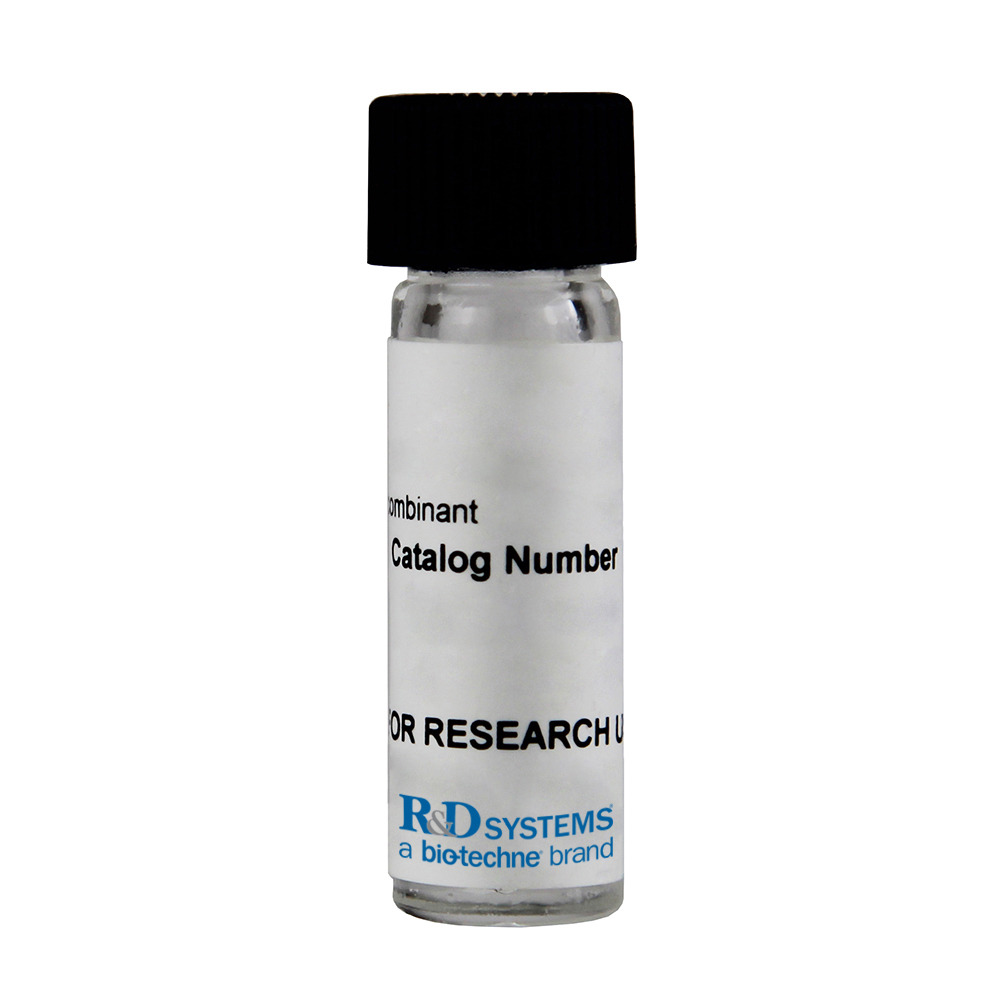
Key Product Details
- R&D Systems Sf 21 (baculovirus)-derived Recombinant Human IL-10 Protein (217-IL)
- Quality control testing to verify active proteins with lot specific assays by in-house scientists
- All R&D Systems proteins are covered with a 100% guarantee
Source
Sf 21 (baculovirus)
Accession #
Structure / Form
Noncovalently-linked homodimer
Conjugate
Unconjugated
Applications
Bioactivity
Product Specifications
Source
Spodoptera frugiperda, Sf 21 (baculovirus)-derived human IL-10 protein
Ser19-Asn178
Ser19-Asn178
Purity
>97%, by SDS-PAGE visualized with Silver Staining and quantitative densitometry by Coomassie® Blue Staining.
Endotoxin Level
<0.10 EU per 1 μg of the protein by the LAL method.
N-terminal Sequence Analysis
Ser19
Predicted Molecular Mass
18.6 kDa
Activity
Measured in a cell proliferation assay using MC/9-2 mouse mast cells. Thompson-Snipes, L. et al. (1991) J. Exp. Med. 173:507.
The ED50 for this effect is 0.075-0.750 ng/mL.
The ED50 for this effect is 0.075-0.750 ng/mL.
Reviewed Applications
Read 8 reviews rated 4.9 using 217-IL in the following applications:
Formulation, Preparation and Storage
Carrier Free
What does CF mean?CF stands for Carrier Free (CF). We typically add Bovine Serum Albumin (BSA) as a carrier protein to our recombinant proteins. Adding a carrier protein enhances protein stability, increases shelf-life, and allows the recombinant protein to be stored at a more dilute concentration. The carrier free version does not contain BSA.
What formulation is right for me?In general, we advise purchasing the recombinant protein with BSA for use in cell or tissue culture, or as an ELISA standard. In contrast, the carrier free protein is recommended for applications, in which the presence of BSA could interfere.
Carrier: 217-IL
| Formulation | Lyophilized from a 0.2 μm filtered solution in PBS with BSA as a carrier protein. |
| Reconstitution | Reconstitute at 50 μg/mL in sterile PBS containing at least 0.1% human or bovine serum albumin. |
| Shipping | The product is shipped at ambient temperature. Upon receipt, store it immediately at the temperature recommended below. |
| Stability & Storage | Use a manual defrost freezer and avoid repeated freeze-thaw cycles.
|
Carrier Free: 217-IL/CF
| Formulation | Lyophilized from a 0.2 μm filtered solution in PBS. |
| Reconstitution | Reconstitute at 50 µg/mL in sterile PBS. |
| Shipping | The product is shipped at ambient temperature. Upon receipt, store it immediately at the temperature recommended below. |
| Stability & Storage | Use a manual defrost freezer and avoid repeated freeze-thaw cycles.
|
Background: IL-10
IL‑19, IL‑20, IL‑22, IL‑24, and IL‑26/AK155 (1, 2). IL‑10 is secreted by many activated hematopoietic cell types as well as hepatic stellate cells, keratinocytes, and placental cytotrophoblasts (2‑5). Mature human IL‑10 shares 72%‑86% amino acid sequence identity with bovine, canine, equine, feline, mouse, ovine, porcine, and rat IL‑10. Whereas human IL‑10 is active on mouse cells, mouse IL‑10 does not act on human cells (6, 7). IL‑10 is a 178 amino acid molecule that contains two intrachain disulfide bridges and is expressed as a 36 kDa noncovalently associated homodimer (6, 8, 9). The IL‑10 dimer binds to two IL‑10 R alpha/IL‑10 R1 chains, resulting in recruitment of two IL‑10 R beta/IL‑10 R2 chains and activation of a signaling cascade involving JAK1, TYK2, and STAT3 (10). IL‑10 R beta does not bind IL‑10 by itself but is required for signal transduction (1). IL‑10 R beta also associates with IL‑20 R alpha, IL‑22R alpha, or IL‑28 R alpha to form the receptor complexes for IL‑22, IL‑26, IL‑28, and IL‑29
(11‑13). IL‑10 is a critical molecule in the control of viral infections and allergic and autoimmune inflammation (14‑16). It promotes phagocytic uptake and Th2 responses but suppresses antigen presentation and Th1 proinflammatory responses (2).
References
- Pestka, S. et al. (2004) Annu. Rev. Immunol. 22:929.
- Sabat, R. et al. (2010) Cytokine Growth Factor Rev. 21:331.
- Mathurin, P. et al. (2002) Am. J. Physiol. Gastrointest. Liver Physiol. 282:G981.
- Grewe, M. et al. (1995) J. Invest. Dermatol. 104:3.
- Szony, B.J. et al. (1999) Mol. Hum. Reprod. 5:1059.
- Vieira, P. et al. (1991) Proc. Natl. Acad. Sci. 88:1172.
- Hsu, D.-H. et al. (1990) Science 250:830.
- Windsor, W.T. et al. (1993) Biochemistry 32:8807.
- Syto, R. et al. (1998) Biochemistry 37:16943.
- Kotenko, S.V. et al. (1997) EMBO J. 16:5894.
- Kotenko, S.V. et al. (2000) J. Biol. Chem. 276:2725.
- Hor, S. et al. (2004) J. Biol. Chem. 279:33343.
- Sheppard, P. et al. (2003) Nat. Immunol. 4:63.
- Fitzgerald, D.C. et al. (2007) Nat. Immunol. 8:1372.
- Wu, K. et al. (2007) Cell. Mol. Immunol. 4:269.
- Blackburn, S.D. and E.J. Wherry (2007)Trends Microbiol. 15:143.
Long Name
Interleukin 10
Alternate Names
CSIF, GVHDS, IL10, IL10A, TGIF
Entrez Gene IDs
Gene Symbol
IL10
UniProt
Additional IL-10 Products
Product Documents for Recombinant Human IL-10 Protein
Product Specific Notices for Recombinant Human IL-10 Protein
For research use only
Loading...
Loading...
Loading...
Loading...