
Recombinant Human HMGB1/HMG-1 His-tag Protein, CF New
R&D Systems, part of Bio-Techne | Catalog # 11803-HM

Key Product Details
Product Specifications
Source
E. coli-derived human HMGB1/HMG-1 protein
Met1-Asp215, with a C-terminal 6-His tag
Met1-Asp215, with a C-terminal 6-His tag
Purity
>95%, by SDS-PAGE visualized with Silver Staining and quantitative densitometry by Coomassie® Blue Staining.
Endotoxin Level
<0.10 EU per 1 μg of the protein by the LAL method.
N-terminal Sequence Analysis
Gly2
Predicted Molecular Mass
26 kDa
SDS-PAGE
28-32 kDa, under reducing conditions.
Activity
Measured by its binding ability in a functional ELISA.
Recombinant Human HMGB1/HMG‑1 His-tag binds to Recombinant Human RAGE Fc Chimera Protein (Catalog # 1145-RG) with an ED50 of 0.040-0.400 μg/mL.
Recombinant Human HMGB1/HMG‑1 His-tag binds to Recombinant Human RAGE Fc Chimera Protein (Catalog # 1145-RG) with an ED50 of 0.040-0.400 μg/mL.
Scientific Data Images for Recombinant Human HMGB1/HMG-1 His-tag Protein, CF
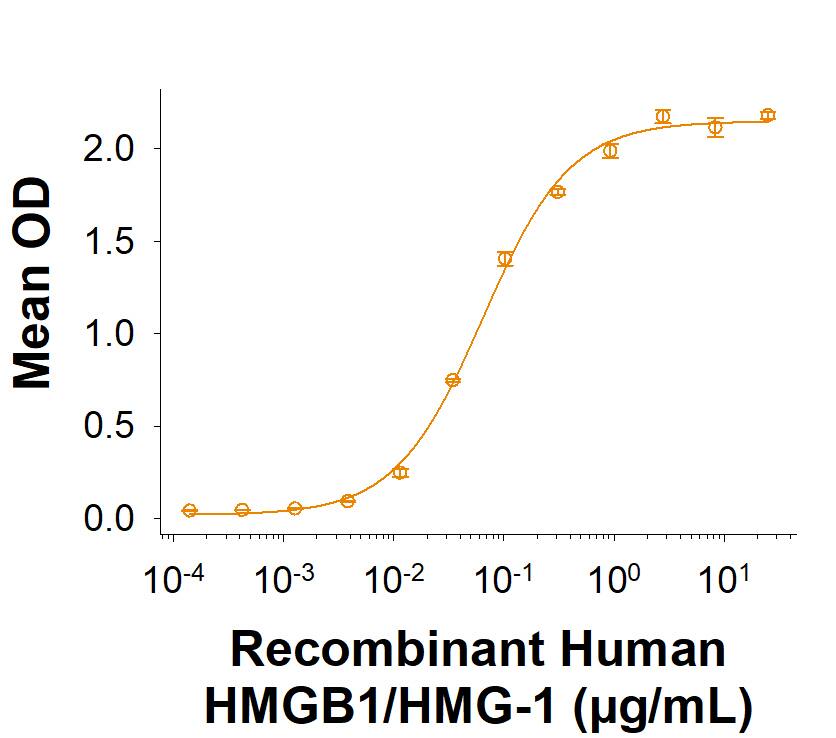
Recombinant Human HMGB1/HMG‑1 His-tag Protein Binding Activity.
Measured by its binding ability in a functional ELISA. Recombinant Human HMGB1/HMG‑1 His-tag Protein (Catalog # 11803-HM) binds to Recombinant Human RAGE Fc Chimera Protein (1145-RG) with an ED50 of 0.040-0.400 μg/mL.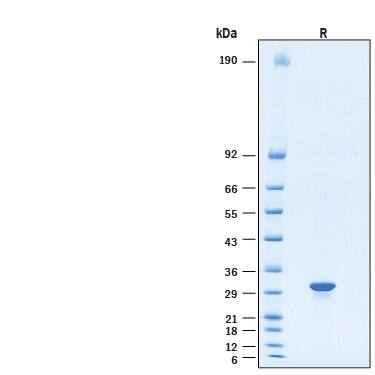
Recombinant Human HMGB1/HMG‑1 His-tag Protein SDS-PAGE.
2 μg/lane of Recombinant Human HMGB1/HMG‑1 His-tag Protein (Catalog # 11803-HM) was resolved with SDS-PAGE under reducing (R) condition and visualized by Coomassie® Blue staining, showing bands at 28-32 kDa.Formulation, Preparation and Storage
11803-HM
| Formulation | Lyophilized from a 0.2 μm filtered solution in PBS with Trehalose. |
| Reconstitution | Reconstitute at 200 μg/mL in water. |
| Shipping | The product is shipped at ambient temperature. Upon receipt, store it immediately at the temperature recommended below. |
| Stability & Storage | Use a manual defrost freezer and avoid repeated freeze-thaw cycles.
|
Background: HMGB1/HMG-1
References
- Yanai, H. et al. (2012) Trends Immunol. 33:633.
- Yang, H. et al. (2013) J. Leukoc. Biol. 93:865.
- Harris, H.E. et al. (2012) Nat. Rev. Rheumatol. 8:195.
- Degryse, B. and M. de Virgilio (2003) FEBS Lett. 553:11.
- Wen, L. et al. (1989) Nucleic Acids Res. 17:1197.
- Yang, H. et al. (2021) Mol. Med. 27:58.
- Venereau, E. et al. (2012) J. Exp. Med. 209:1519.
- Bianchi, M.E. and A. Agresti (2005) Curr. Opin. Genet. Dev. 15:496.
- Bonaldi, T. et al. (2003) EMBO J. 22:5551.
- Diener, K.R. et al. (2013) Immunol. Cell Biol. 91:443.
- Fang, P. et al. (2012) Mol. Neurobiol. 45:499.
- de Souza, A.W. et al. (2012) Autoimmun. Rev. 11:909.
- Bae, J.S. (2012) Arch. Pharm. Res. 35:1511.
Long Name
High Mobility Group Protein 1
Alternate Names
HMG-1, HMG1
Entrez Gene IDs
3146 (Human)
Gene Symbol
HMGB1
UniProt
Additional HMGB1/HMG-1 Products
Product Documents for Recombinant Human HMGB1/HMG-1 His-tag Protein, CF
Product Specific Notices for Recombinant Human HMGB1/HMG-1 His-tag Protein, CF
For research use only
Loading...
Loading...
Loading...
Loading...