
Recombinant Human GOT1 His-tag Protein, CF
R&D Systems, part of Bio-Techne | Catalog # 11696-G1

Key Product Details
- R&D Systems E. coli-derived Recombinant Human GOT1 His-tag Protein (11696-G1)
- Quality control testing to verify active proteins with lot specific assays by in-house scientists
- All R&D Systems proteins are covered with a 100% guarantee
Product Specifications
Source
E. coli-derived human GOT1 protein
Ala2-Gln413, with an N-terminal Met and 6-His tag
Ala2-Gln413, with an N-terminal Met and 6-His tag
Purity
>95%, by SDS-PAGE visualized with Silver Staining and quantitative densitometry by Coomassie® Blue Staining.
Endotoxin Level
<0.10 EU per 1 μg of the protein by the LAL method.
N-terminal Sequence Analysis
Met
Predicted Molecular Mass
47 kDa
SDS-PAGE
38-42 kDa under reducing conditions.
Activity
Measured by its ability to produce L-glutamate from L-aspartate in a coupled reaction.
The specific activity is >15,000 pmol/min/μg, as measured under the described conditions.
Scientific Data Images for Recombinant Human GOT1 His-tag Protein, CF
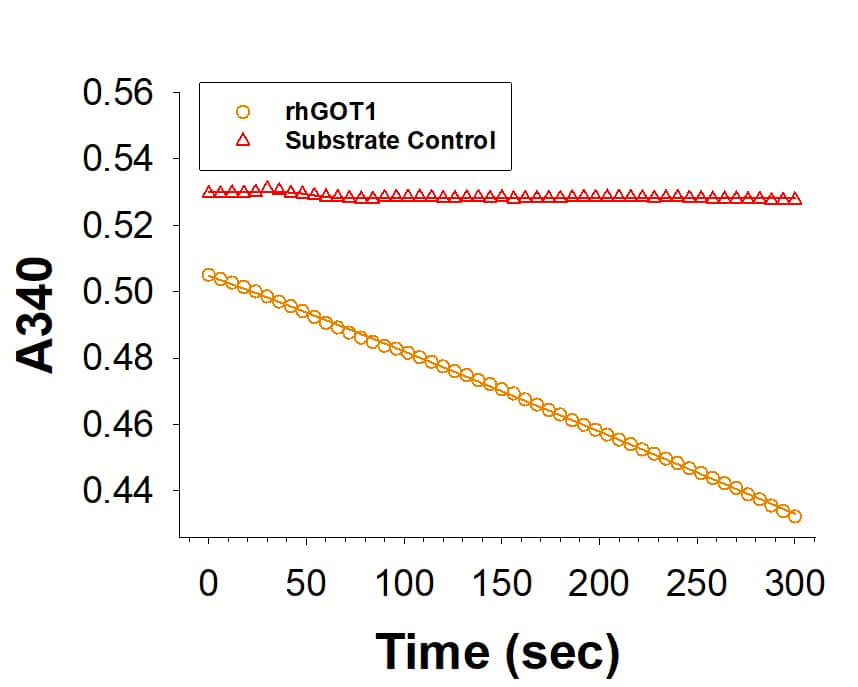
Recombinant Human GOT1 His-tag Protein Enzyme Activity.
Recombinant Human GOT1 His-tag Protein (Catalog # 11696-G1) is measured by its ability to produce L-glutamate from L-aspartate in a coupled reaction.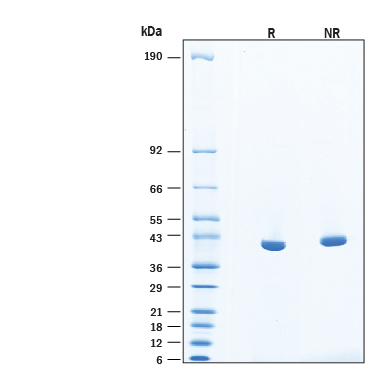
Recombinant Human GOT1 His-tag Protein SDS-PAGE.
2 μg/lane of Recombinant Human GOT1 His-tag Protein (Catalog # 11696-G1) was resolved with SDS-PAGE under reducing (R) and non-reducing (NR) conditions and visualized by Coomassie® Blue staining, showing bands at 38-42 kDa under reducing conditions.Formulation, Preparation and Storage
11696-G1
| Formulation | Supplied as a 0.2 μm filtered solution in Tris and NaCl. |
| Shipping | The product is shipped with polar packs. Upon receipt, store it immediately at the temperature recommended below. |
| Stability & Storage | Use a manual defrost freezer and avoid repeated freeze-thaw cycles.
|
Background: GOT1
References
- Peng, H. et al. (2024) Front. Oncol. 14:1519046.
- Ladue, J.S. et al. (1954) Science. 120:497.
- Song, Z. et al. (2022) Eur. J. Pharmacol. 917:174754.
- Doyle, J.M. et al. (1990) Biochem. J. 270:651.
- Malashkevich, V.N. et al. (1995) J. Mol. Biol. 247:111.
- Feld, F.M. et al. (2015) Oncotarget 6:4516.
- Yang, Y. (2016) Biochem. Biophys. Res. Commun. 473:1295.
- Hong, C. et al. (2017) Cancer Chemother. Pharmacol. 79:835.
- Cheng, Z. et al. (2020) Front. Oncol. 10:379.
- Singh, A.N. et al. (2020) Front. Oncol. 10:493.
- Siwo, G.H. et al. (2024) preprint. doi: 10.1101/2024.03.01.582939.
- Monami, M. et al. (2008) Metabolism 57:387.
- Holt, M.C. et al. (2018) Biochemistry 57:6604.
- Wang, Q. et al. (2019) Bioorg. Chem. 93:103315.
Long Name
Glutamic-oxaloacetic transaminase 1
Alternate Names
AST1, ASTQTL1, SGOT
Gene Symbol
GOT1
UniProt
Additional GOT1 Products
Product Documents for Recombinant Human GOT1 His-tag Protein, CF
Product Specific Notices for Recombinant Human GOT1 His-tag Protein, CF
For research use only
Loading...
Loading...
Loading...
Loading...