
Recombinant Human FGF basic/FGF2/bFGF GMP Protein, CF GMP Best Seller
R&D Systems, part of Bio-Techne | Catalog # BT-FGFB-GMP

Key Product Details
- FGF basic Manufactured in Bio-Techne's new GMP facility
- Lot-to-lot consistency
- Stringent guidelines for patient safety
- Scalability necessary to support successful therapeutics
- Learn more about manufacturing in our new GMP facility
- Test it in your process! Request a sample of GMP FGF basic
- A DMF is on file for this protein
Product Specifications
Source
E. coli-derived human FGF basic/FGF2/bFGF protein
Ala135 - Ser288
Produced using non-animal reagents in an animal-free laboratory.Manufactured and tested under cGMP guidelines.
Ala135 - Ser288
Produced using non-animal reagents in an animal-free laboratory.Manufactured and tested under cGMP guidelines.
Purity
>97%, by SDS-PAGE with quantitative densitometry by Coomassie® Blue Staining. The primary molecular weight by mass spectrometry is 17112 Da ± 10 Da.
Endotoxin Level
<0.01 EU per 1 μg of the protein by the LAL method.
N-terminal Sequence Analysis
Ala135-Ala-Gly-Ser-Ile-Thr-Thr-Leu-Pro-Ala
Ala136-Gly-Ser-Ile-Thr-Thr-Leu-Pro-Ala-Leu
Predicted Molecular Mass
17 kDa
SDS-PAGE
18 kDa, under reducing conditions.
Activity
Measured in a cell proliferation assay using NR6R-3T3 mouse fibroblast cells. Raines, E.W. et al. (1985) Methods Enzymol. 109:749.
The ED50 for this effect is 0.100-1.00 ng/mL.
The ED50 for this effect is 0.100-1.00 ng/mL.
The specific activity of Recombinant Human FGF basic/FGF2 GMP is >8.0 x 10⁵ IU/mg, which is calibrated against the human FGF basic/FGF2 WHO International Standard (NIBSC code: 90/712).
Host Cell Protein
<0.100 ng per μg of protein when tested by ELISA.
Mycoplasma
Negative for Mycoplasma.
Host Cell DNA
<0.00150 ng per µg of protein when tested by PCR.
Scientific Data Images for Recombinant Human FGF basic/FGF2/bFGF GMP Protein, CF

Recombinant Human FGF basic/FGF2 GMP Protein Bioactivity.
GMP-grade Recombinant Human FGF basic/FGF2 Protein (Catalog # BT-FGFB-GMP) as measured in a cell proliferation assay using NR6R-3T3 mouse fibroblast cell line. The ED50 for this effect is 0.100-1.00 ng/mL. Three independent lots were tested for activity and plotted on the same graph to show lot-to-lot consistency of GMP FGF basic/FGF2.
Equivalent Bioactivity of GMP and Animal-Free grades of Recombinant Human FGF basic/FGF2.
Equivalent bioactivity of GMP (Catalog # BT-FGFB-GMP) and Animal-Free (BT-FGFB-AFL) grades of Recombinant Human FGF basic/FGF2 as measure in a cell proliferation assay using NR6R-3T3 mouse fibroblast cell line (orange and green, respectively).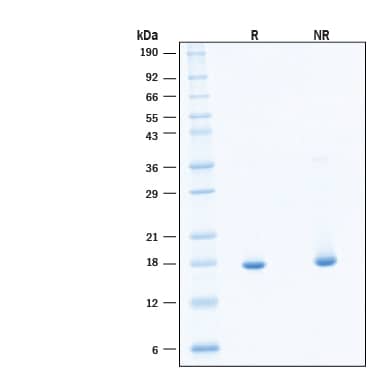
Recombinant Human FGF basic/FGF2/bFGF GMP Protein SDS-PAGE.
2 μg/lane of Recombinant Human FGF basic/FGF2/bFGF GMP Protein (Catalog # BT-FGFB-GMP) was resolved with SDS-PAGE under reducing (R) and non-reducing (NR) conditions and visualized by Coomassie® Blue staining, showing bands at 18 kDa, under reducing conditions.Formulation, Preparation and Storage
BT-FGFB-GMP
| Formulation | Lyophilized from a 0.2 μm filtered solution in HEPES and Sodium Sulfate with Trehalose. |
| Reconstitution | Reconstitute 25 μg size at 250 μg/mL and all other sizes at 500 μg/mL in sterile water. |
| Shipping | The product is shipped with polar packs. Upon receipt, store it immediately at the temperature recommended below. |
| Stability & Storage | Use a manual defrost freezer and avoid repeated freeze-thaw cycles.
|
Background: FGF basic/FGF2/bFGF
FGF basic (also known as FGF2 and HBGF-2) is an 18-34 kDa, heparin-binding member of the FGF superfamily of molecules (1-3). Superfamily members are characterized by the presence of a centrally placed beta-trefoil structure. FGF acidic (FGF-1) and FGF basic (FGF2) were the first two identified FGFs, and the designations acidic and basic refer to their relative isoelectric points. Human FGF basic is 288 amino acids (aa) in length. There are multiple start sites, four of which utilize atypical CUG codons, and one that initiates at an AUG start site (4 - 6). The four CUG start sites generate high molecular weight (HMW) FGF basic. There is a 34 kDa, 288 aa form, a 24 kDa, 210 aa form, a 22.5 kDa, 201 aa form, and a 22 kDa, 196 aa form. All are retained intracellularly, undergo extensive methylation, and possess one or more nuclear localization signals (NLS) (7-9). The AUG initiating form is 18 kDa and 155 aa in length. There is no signal sequence (ss). It is, however, secreted directly through the plasma membrane via a mechanism that appears to be dependent upon tertiary structure (10). In place of a ss, there is purportedly a 9 aa N-terminal prosegment that precedes a 146 aa mature segment (11). Early isolations of 18 kDa bovine FGF basic yielded 146 aa molecules, an effect attributed to the presence of acid proteases (12). The molecule contains a heparin-binding site (aa residues 128-144), and undergoes phosphorylation at Ser117 (13). There is also an ill-defined C-terminal NLS that may be more “functional” (or 3-dimensional) than structural (7). Human 146 aa FGF basic is 97% aa identical to mouse FGF basic (14).
References
- Sorenson, V. et al. (2006) BioEssays 28:504.
- Kardami, E. et al. (2004) Cardiovasc. Res. 63:458.
- Nugent, M.A. and R.V. Lozzo (2000) Int. J. Biochem. Cell Biol. 32:115.
- Abraham, J.A. et al. (1986) EMBO J. 5:2523.
- Prats, H. et al. (1989) Proc. Natl. Acad. Sci. USA 86:1836.
- Arnaud, E. et al. (1999) Mol. Cell. Biol. 19:505.
- Foletti, A. et al. (2003) Cell. Mol. Life Sci. 60:2254.
- Arese, M. et al. (1999) Mol. Biol. Cell 10:1429.
- Pintucci, G. et al. (1996) Mol. Biol. Cell 7:1249.
- Nickel, W. (2005) Traffic 6:607.
- SwissProt # P09038.
- Klagsbrun, M. et al. (1987) Proc. Natl. Acad. Sci. USA 84:1839.
- Bailly, K. et al. (2000) FASEB J. 14:333.
- Hebert, J.M. et al. (1990) Dev. Biol. 138:454.
Long Name
Fibroblast Growth Factor basic
Alternate Names
bFGF, FGF-2, FGF2, HBGF-2, Prostatropin
Gene Symbol
FGF2
UniProt
Additional FGF basic/FGF2/bFGF Products
Product Documents for Recombinant Human FGF basic/FGF2/bFGF GMP Protein, CF
Manufacturing Specifications
GMP ProteinsR&D Systems, a Bio-Techne Brand's GMP proteins are produced according to relevant sections of the following documents: USP Chapter 1043, Ancillary Materials for Cell, Gene and Tissue-Engineered Products and Eu. Ph. 5.2.12, Raw Materials of Biological Origin for the Production of Cell-based and Gene Therapy Medicinal Products.
R&D Systems' quality focus includes:
- Designed, manufactured and tested under an ISO 9001:2015 and ISO 13485:2016 certified quality system
- Documented and controlled manufacturing process
- Control of documentation and process changes by QA
- Personnel training programs
- Raw material inspection and vendor qualification/monitoring program
- Validated equipment, processes and test methods
- Equipment calibration and maintenance schedules using a Regulatory Asset Manager
- Facility/Utilities maintenance, contamination controls, safety and pest control programs
- Material review process for variances
- Robust product stability program following relevant ICH guidelines
- N-terminal amino acid analysis
- SDS-PAGE purity analysis
- Molecular weight analysis via mass spectrometry
- Endotoxin assessment per USP <85> and Ph. Eur. 2.6.14 guidelines
- Bioassay analysis
- Microbial testing per USP <71> and Ph. Eur. 2.6.1 guidelines
- Host cell protein assessment
- Host cell DNA assessment
- Mycoplasma assessment
Production records and facilities are available for examination by appropriate personnel on-site at R&D Systems in Minneapolis and St. Paul, Minnesota USA.
R&D Systems sells GMP grade products for preclinical or clinical ex vivo use. They are not for in vivo use. Please read the following End User Terms prior to using this product.
Animal-Free Manufacturing Conditions
Our dedicated controlled-access animal-free laboratories ensure that at no point in production are the products exposed to potential contamination by animal components or byproducts. Every stage of manufacturing is conducted in compliance with R&D Systems' stringent Standard Operating Procedures (SOPs). Production and purification procedures use equipment and media that are confirmed animal-free.
Production
- All molecular biology procedures use animal-free media and dedicated labware.
- Dedicated fermentors are utilized in committed animal-free areas.
- Protein purification columns are animal-free.
- Bulk proteins are filtered using animal-free filters.
- Purified proteins are stored in animal-free containers.
Product Specific Notices for Recombinant Human FGF basic/FGF2/bFGF GMP Protein, CF
Full terms and conditions of sale can be found online in the Protein Sciences Segment T&Cs at: Terms & Conditions.
For preclinical, or clinical ex vivo use
Loading...
Loading...
Loading...
Loading...