
Recombinant Human FGF-4 Heat Stable Protein, CF New
R&D Systems, part of Bio-Techne | Catalog # BT-FGF4HS

Key Product Details
Source
E. coli
Conjugate
Unconjugated
Applications
Bioactivity
Product Specifications
Source
E. coli-derived human FGF-4 protein
Proprietary, engineered based on P08620
Proprietary, engineered based on P08620
Purity
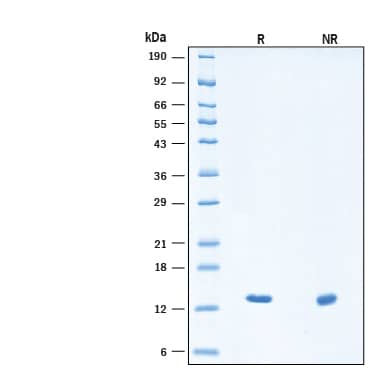
>95%, by SDS-PAGE visualized with Silver Staining and quantitative densitometry by Coomassie® Blue Staining.
Endotoxin Level
<0.10 EU per 1 μg of the protein by the LAL method.
SDS-PAGE
12-15 kDa, under reducing conditions.
Activity
Measured by its ability to activate SRE-SEAP reporter in HEK293 human embryonic kidney cells. The ED50 for this effect is 0.100-1.00 ng/mL.
Scientific Data Images for Recombinant Human FGF-4 Heat Stable Protein, CF
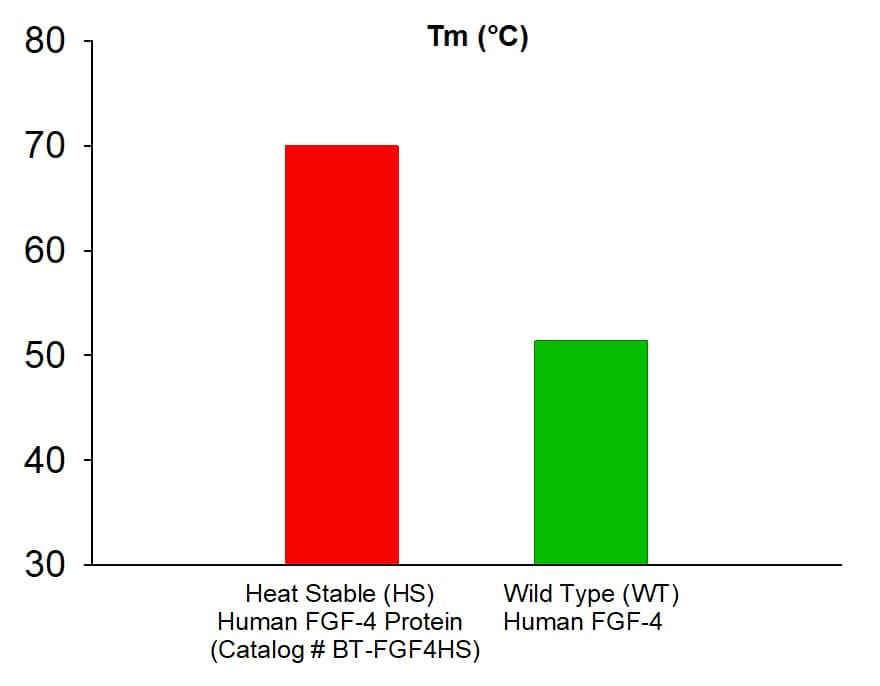
Melting Temperature Comparison of Heat Stable (HS) and Wild-Type (WT) Recombinant Human FGF-4.
Recombinant Human FGF-4 Heat Stable Protein (Catalog # BT-FGF4HS) exhibits a higher melting temperature (Tm) than wild-type human FGF-4. Thermal stability was assessed by Differential Scanning Fluorimetry (DSF).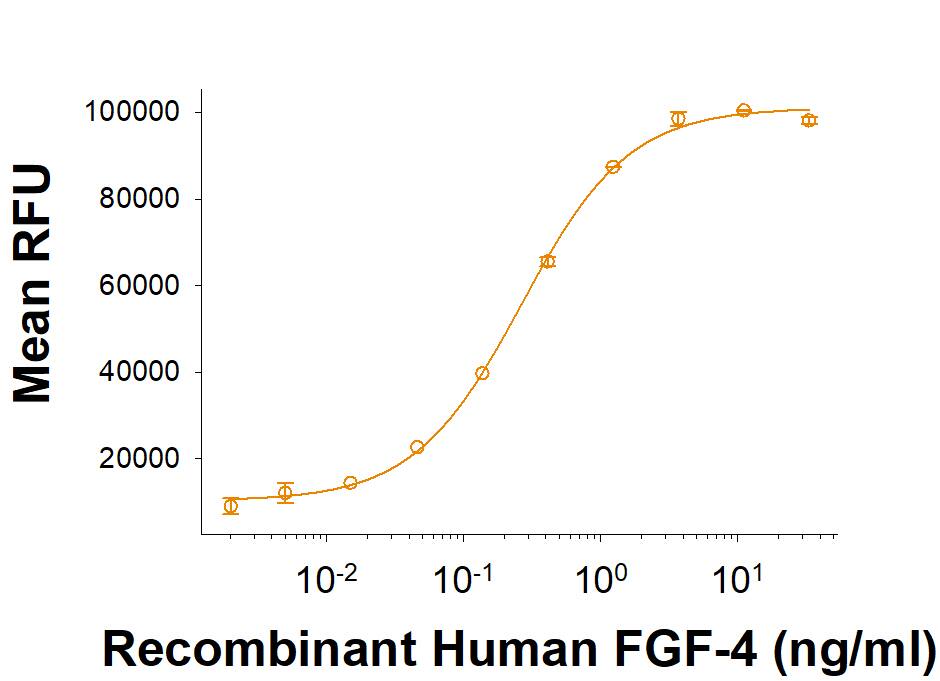
Recombinant Human FGF‑4 Protein Bioactivity.
Measured by its ability to activate SRE-SEAP reporter in HEK293 human embryonic kidney cells. The ED50 for this effect is 0.100-1.00 ng/mL.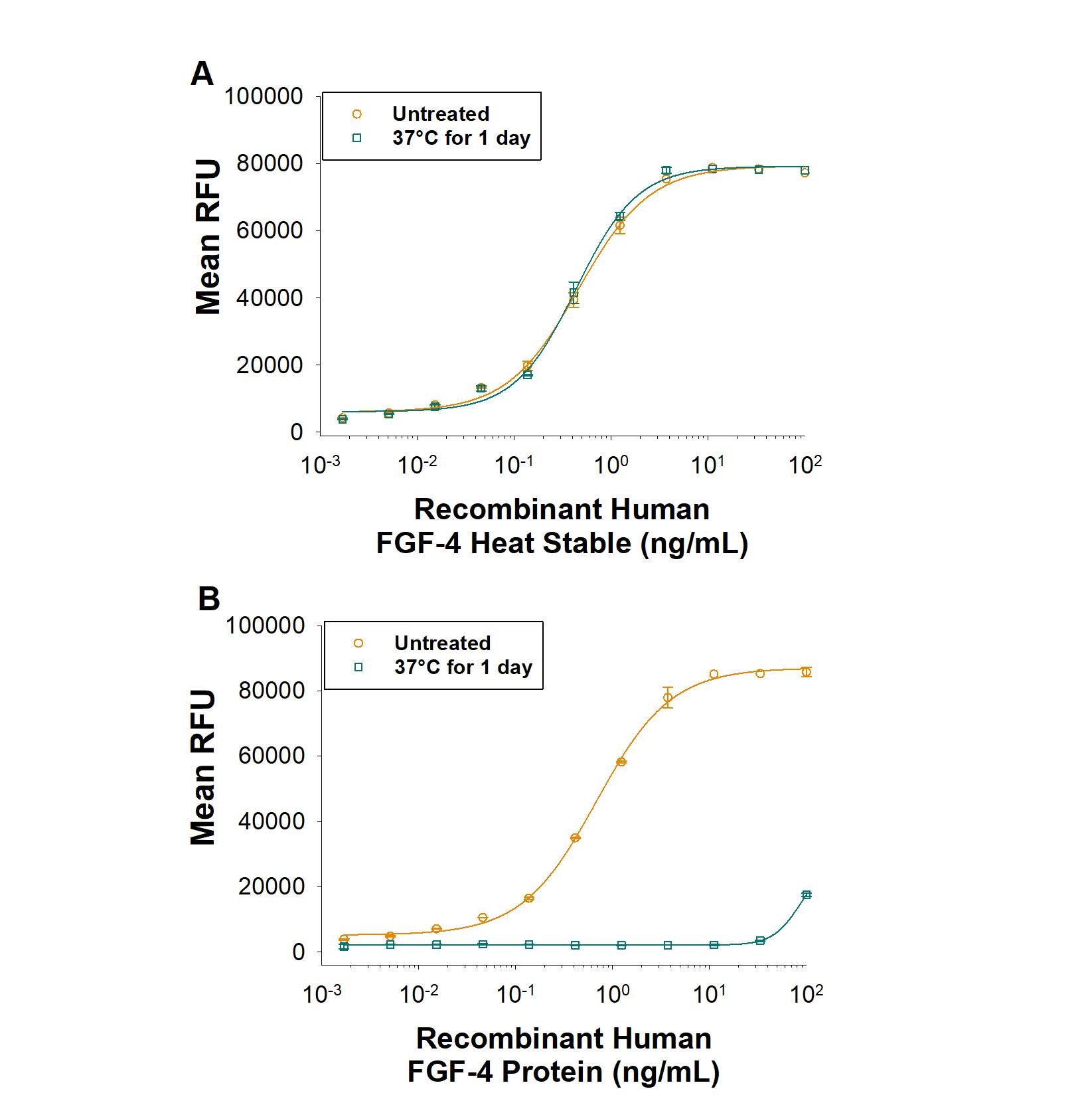
Recombinant Human FGF‑4Heat Stable Protein Bioactivity.
Recombinant human FGF-4 protein activates SEAP reporter activity in HEK293 human embryonic kidney cells stably transfected with the secreted alkaline phosphatase (SEAP) reporter gene. (A) Recombinant human FGF-4 heat-stable (Catalog # BT-FGF4HS) or (B) recombinant human FGF-4 (7460-F4) were either untreated or incubated at 37 °C for 1 day in culture media. The heat-stable (HS) FGF-4 retained comparable bioactivity after incubation compared with the untreated HS protein, indicating increased thermal stability. In contrast, the wild-type (WT) FGF-4 protein showed a significant loss of activity following heat-stress incubation. suggesting less thermal stability.Formulation, Preparation and Storage
BT-FGF4HS
| Formulation | Lyophilized from a 0.2 μm filtered solution in MOPS, Na2SO4 and EDTA with Trehalose. |
| Reconstitution | Reconstitute at 500 µg/mL in water. |
| Shipping | The product is shipped at ambient temperature. Upon receipt, store it immediately at the temperature recommended below. |
| Stability & Storage | Use a manual defrost freezer and avoid repeated freeze-thaw cycles.
|
Background: FGF-4
FGF‑4 (fibroblast growth factor‑4), also known as FGF-K or K‑FGF (Kaposi's sarcoma-associated FGF), is a 25 kDa secreted, heparin‑binding member of the FGF family (1, 2). The human FGF‑4 cDNA encodes 206 amino acids (aa) with a 33 aa signal sequence and a 173 aa mature protein with an FGF homology domain that contains a heparin binding region near the C‑terminus (2). Mature human FGF‑4 (aa 71‑206) shares 91%, 82%, 94% and 91% aa identity with mouse, rat, canine and bovine FGF‑4, respectively. Human FGF‑4 has been shown to exhibit cross species activity. Expression of FGF-4 and its receptors, FGF R1c, 2c, 3c and 4, is spatially and temporally regulated during embryonic development (1, 3). Its expression in the mouse trophoblast inner cell mass promotes expression of FGF R2, and is required for maintenance of the trophectoderm and primitive endoderm (3‑5). Later in mouse development, FGF‑4 works together with FGF‑8 to mediate the activities of the apical ectodermal ridge, which direct the outgrowth and patterning of vertebrate limbs (3, 6‑9). FGF-4 is proposed to play a physiologically relevant role in human embryonic stem cell self-renewal. It promotes stem cell proliferation, but may also aid differentiation depending on context and concentration, and is often included in embryonic stem cell media in vitro (10‑12). A C‑terminally truncated 15 kDa isoform that opposes full‑length FGF‑4 and promotes differentiation is endogenously expressed in human embryonic stem cells. FGF‑4 is mitogenic for fibroblasts and endothelial cells in vitro and has autocrine transforming potential (13). It is a potent angiogenesis promoter in vivo and has been investigated as therapy for coronary artery disease (14). Advances in predictive analytics have allowed us to design more reliable and efficient growth factor reagents for complex cell culture systems. Our Heat Stable FGF4 incorporates precise point mutations that increase structural stability without compromising biological activity. This enhanced stability supports more consistent culture conditions and reduces the need for repeated growth factor additions—ideal for workflows such as intestinal organoid generation, where dependable FGF4 signaling drives reproducible results.
References
- Reuss, B. and O. von Bohlen und Halbach (2003) Cell Tiss. Res. 313:139.
- Hebert, J.M. et al. (1990) Dev. Biol. 138:454.
- Niswander, L. and G.R. Martin (1992) Development 114:755.
- Feldman, B. et al. (1995) Science 267:246.
- Goldin, S.N. and V.E. Papaioannou (2003) Genesis 36:40.
- Sun, X. et al. (2002) Nature 418:501.
- Boulet, A.M. et al. (2004) Dev. Biol. 273:361.
- Yu, K and D.M. Ornitz (2008) Development 135:483.
- Mariani, F.V. et al. (2008) Nature 453:401.
- Johannesson, M. et al. (2009) PLoS ONE 4:e4794.
- Kunath, T. et al. (2007) Development 134:2895.
- Mayshar, Y. et al. (2008) Stem Cells 26:767.
- Hajitou, A. et al. (1998) Oncogene 17:2059.
- Flynn, A. and T. O’Brien (2008) IDrugs 11:283.
Long Name
Fibroblast Growth Factor 4
Alternate Names
FGF4, HBGF-4, HST-1, KFGF, KS3
Gene Symbol
FGF4
Additional FGF-4 Products
Product Documents for Recombinant Human FGF-4 Heat Stable Protein, CF
Product Specific Notices for Recombinant Human FGF-4 Heat Stable Protein, CF
For research use only
Loading...
Loading...
Loading...
Loading...