
Recombinant Human Apolipoprotein E3/ApoE3 Protein, CF New
R&D Systems, part of Bio-Techne | Catalog # 11781-AE

Key Product Details
Product Specifications
Source
Human embryonic kidney cell, HEK293-derived human Apolipoprotein E3/ApoE3 protein
Lys19-His318
Lys19-His318
Purity
>90%, by SDS-PAGE visualized with Silver Staining and quantitative densitometry by Coomassie® Blue Staining.
Endotoxin Level
<0.10 EU per 1 μg of the protein by the LAL method.
N-terminal Sequence Analysis
Lys19
Predicted Molecular Mass
34 kDa
SDS-PAGE
34-40 kDa, under reducing conditions.
Activity
Measured by its binding ability in a functional ELISA.
Recombinant Human Apolipoprotein E3/ApoE3 binds to Recombinant Human VLDLR Protein (Catalog # 8444-VL) with an ED50 of 0.0250‑0.300 μg/mL.
Recombinant Human Apolipoprotein E3/ApoE3 binds to Recombinant Human VLDLR Protein (Catalog # 8444-VL) with an ED50 of 0.0250‑0.300 μg/mL.
Scientific Data Images for Recombinant Human Apolipoprotein E3/ApoE3 Protein, CF
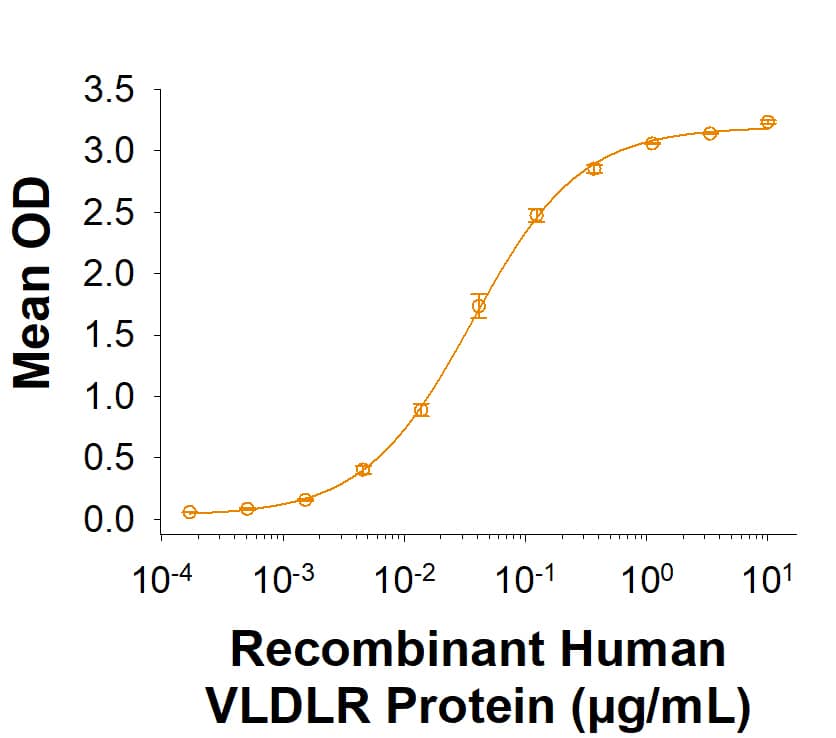
Recombinant Human Apolipoprotein E3/ApoE3 Protein Bioactivity.
Measured by its binding ability in a functional ELISA. Recombinant Human Apolipoprotein E3/ApoE3 Protein binds to Recombinant Human VLDLR Protein (8444-VL) with an ED50 of 0.0250-0.300 μg/mL.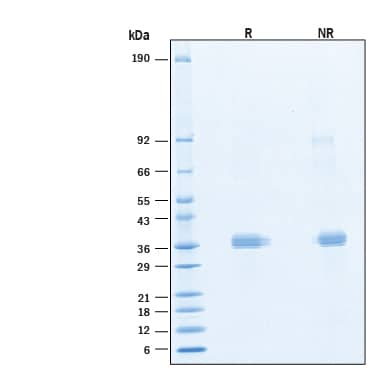
Recombinant Human Apolipoprotein E3/ApoE3 Protein SDS-PAGE.
2 μg/lane of Recombinant Human Apolipoprotein E3/ApoE3 Protein (Catalog # 11781-AE) was resolved with SDS-PAGE under reducing (R) and non-reducing (NR) conditions and visualized by Coomassie® Blue staining, showing bands at 34-40 kDa, under reducing conditions.Formulation, Preparation and Storage
11781-AE
| Formulation | Lyophilized from a 0.2 μm filtered solution in MOPS, NaCl and TCEP with Trehalose. |
| Reconstitution | Reconstitute at 200 μg/mL in water. |
| Shipping | The product is shipped at ambient temperature. Upon receipt, store it immediately at the temperature recommended below. |
| Stability & Storage | Use a manual defrost freezer and avoid repeated freeze-thaw cycles.
|
Background: Apolipoprotein E3/ApoE3
References
- Zhang X, et al. (2023) Cells 12:410.
- Horn JVC, et al. (2023) Mol Cell Biochem 478: 173.
- Murphy KB, et al. (2025). Nat Commun 16:4883.
- Mahley RW, et al. (2012) J Lipid Res 53: 539.
- Liu CC, et al. (2013) Nat Rev Neurol 9: 106.
Alternate Names
AD2
Gene Symbol
APOE
UniProt
Additional Apolipoprotein E3/ApoE3 Products
Product Documents for Recombinant Human Apolipoprotein E3/ApoE3 Protein, CF
Product Specific Notices for Recombinant Human Apolipoprotein E3/ApoE3 Protein, CF
For research use only
Loading...
Loading...
Loading...
Loading...