
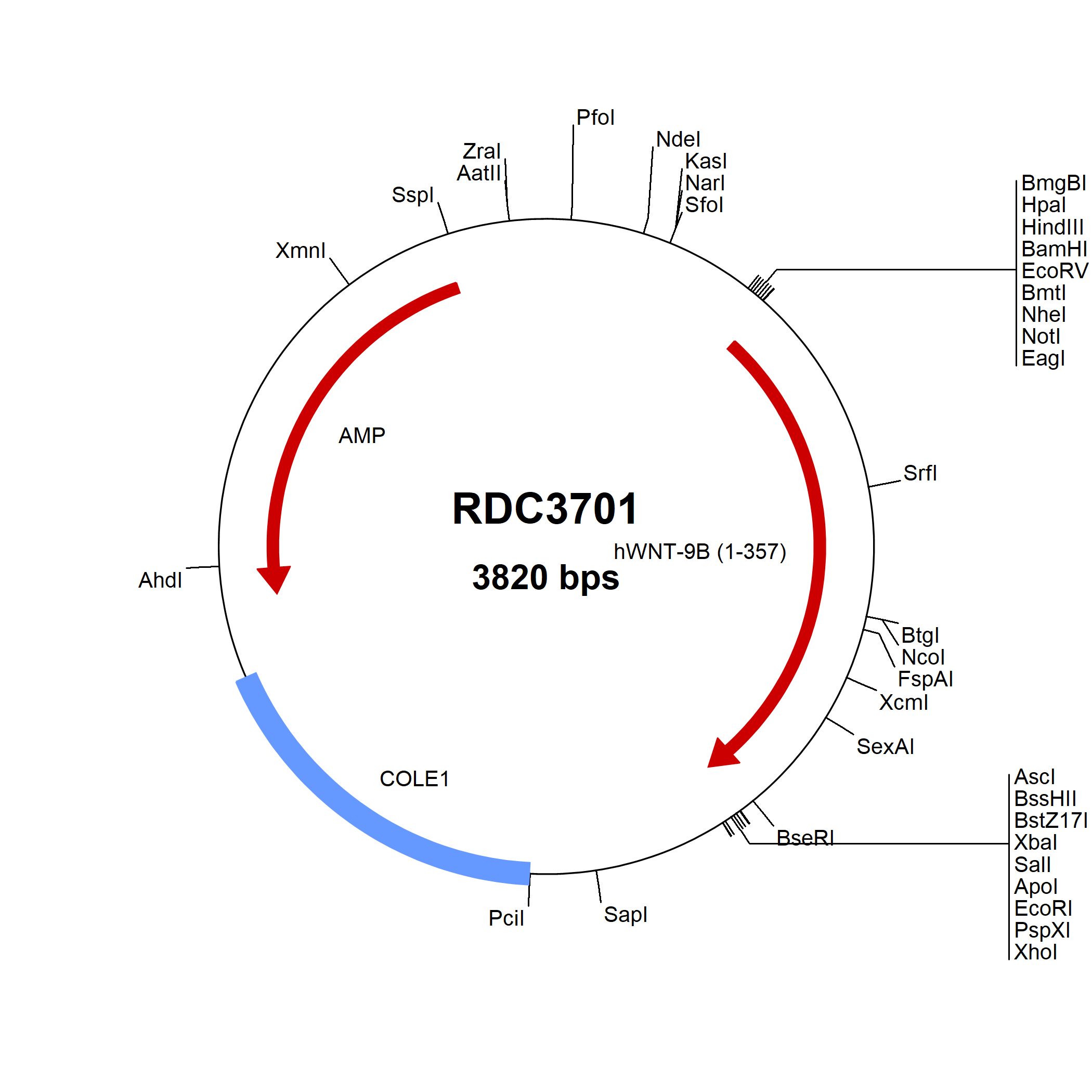
Human Wnt-9b (NP_003387.1) VersaClone cDNA
R&D Systems, part of Bio-Techne | Catalog # RDC3701

Key Product Details
Species
Human
Accession Number
Formulation, Preparation, and Storage
Shipping
The product is shipped at ambient temperature. Upon receipt, store it immediately at the temperature recommended below.
Storage
Store the unopened product at -20 to -70 °C. Use a manual defrost freezer and avoid repeated freeze-thaw cycles. Do not use past expiration date.
Background: Wnt-9b
Wnt-9b (also called Wnt-14b or Wnt-15) is a presumably secreted, glycosylated member of the Wnt family of developmental proteins. Wnt-9b is expressed in late embryos and in adult kidney, with lesser amounts in brain and liver. Wnt-9b is also expressed in crypt epithelial cells of the human intestine. Mature mouse Wnt-9b shows 93% and 98% amino acid (aa) identity with mature human and rat Wnt-9b, respectively. Wnt-9b shares 63% aa identity with Wnt-9a.
The Wnts make up a large family of secreted proteins with roles in pattern formation, cell fate decision, axon guidance, and tumor formation. Wnt family members vary in length between 350 and 400 aa, possess 22 to 24 conserved cysteines, are highly hydrophobic, and show 20 - 85% aa identity within the Wnt family. In general, there are three signaling pathways associated with Wnt-receptor interaction. The first is commonly called the canonical pathway and ultimately culminates in beta-Catenin accumulation and TCF/LEF-1-mediated gene transcription. The other two less well-defined non-canonical pathways include the Wnt/Ca2+ pathway and the planar cell polarity (PCP) pathway.
Long Name
Wingless-type MMTV Integration Site Family, Member 9b
Alternate Names
Wnt-14b, Wnt-15, Wnt9b
Gene Symbol
WNT9B
UniProt
Additional Wnt-9b Products
Product Documents for Human Wnt-9b (NP_003387.1) VersaClone cDNA
Product Specific Notices for Human Wnt-9b (NP_003387.1) VersaClone cDNA
For research use only
Loading...
Loading...
Loading...