
TLR8 Antibody (44C143) [Alexa Fluor™ Plus 680]
Novus Biologicals, part of Bio-Techne | Catalog # NBP2-24917AFP680
Clone 44C143 was used by HLDA to establish CD designation.

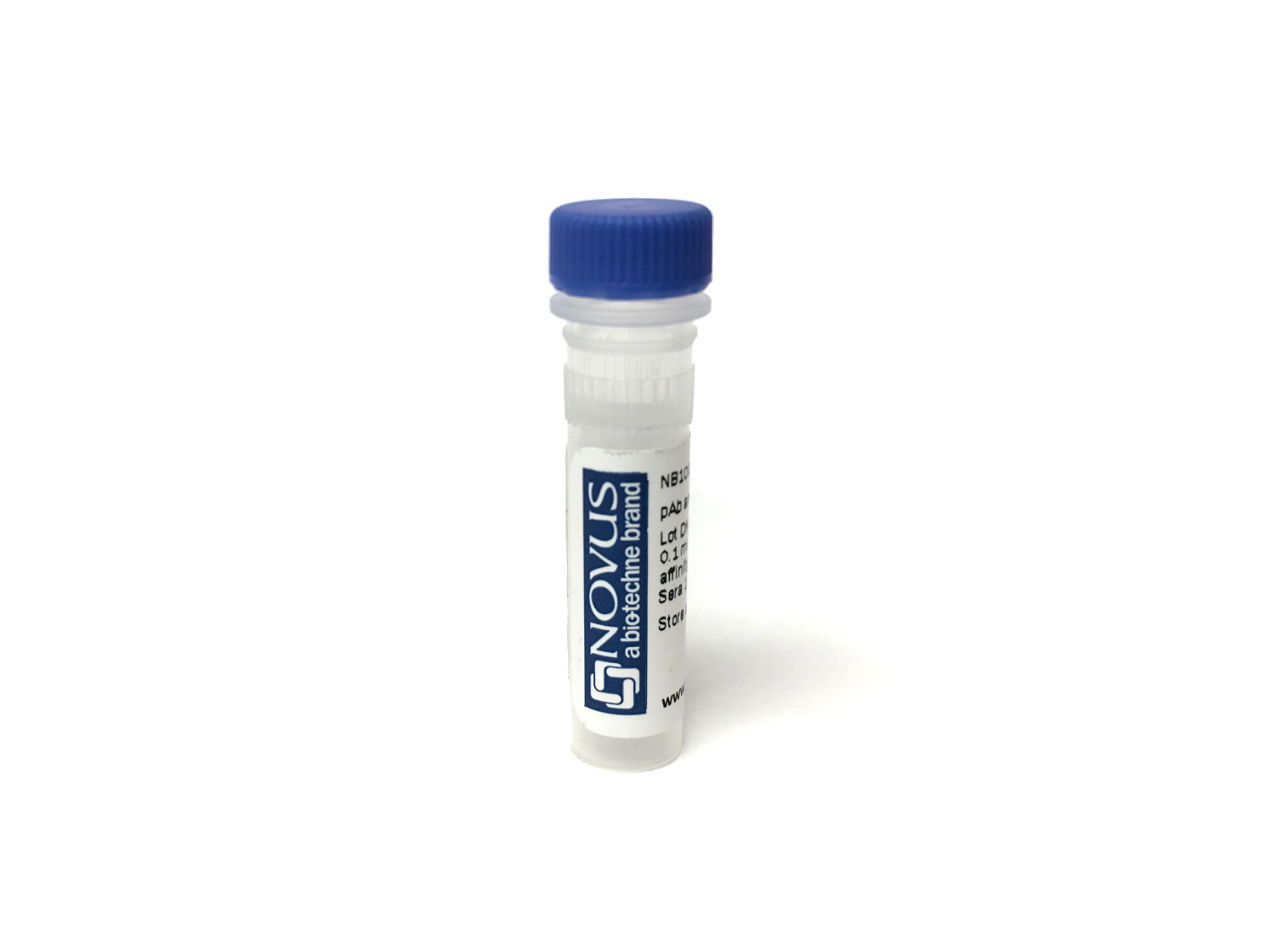
Conjugate
Catalog #
Key Product Details
Species Reactivity
Human, Mouse, Rabbit
Applications
Immunohistochemistry, Immunohistochemistry-Paraffin, Western Blot, Flow Cytometry, Flow (Cell Surface), Flow (Intracellular), Immunocytochemistry/ Immunofluorescence, Dot Blot, CyTOF-ready
Label
Alexa Fluor Plus 680 (Excitation = 687 nm, Emission = 704 nm)
Antibody Source
Monoclonal Mouse IgG1 kappa Clone # 44C143
Concentration
Please see the vial label for concentration. If unlisted please contact technical services.
Product Specifications
Immunogen
This antibody was developed against a KLH-conjugated synthetic peptide of human TLR8, within amino acids 750-850.
Clonality
Monoclonal
Host
Mouse
Isotype
IgG1 kappa
Description
This conjugate is made on demand and is not held in inventory. Each order represents a unique lot. All conjugates are generated using validated conjugation protocols and meet strict degree of labeling (F/P) specifications; additional information is available upon request. The antibody concentration is provided on the individual product label.
For specialized conjugation needs, like large quantities, specific concentrations, and defined F/P ratios, bulk and custom antibody conjugation services are available.
For specialized conjugation needs, like large quantities, specific concentrations, and defined F/P ratios, bulk and custom antibody conjugation services are available.
Applications for TLR8 Antibody (44C143) [Alexa Fluor™ Plus 680]
Application
Recommended Usage
CyTOF-ready
Optimal dilutions of this antibody should be experimentally determined.
Dot Blot
Optimal dilutions of this antibody should be experimentally determined.
Flow (Cell Surface)
Optimal dilutions of this antibody should be experimentally determined.
Flow (Intracellular)
Optimal dilutions of this antibody should be experimentally determined.
Flow Cytometry
Optimal dilutions of this antibody should be experimentally determined.
Immunocytochemistry/ Immunofluorescence
Optimal dilutions of this antibody should be experimentally determined.
Immunohistochemistry
Optimal dilutions of this antibody should be experimentally determined.
Immunohistochemistry-Paraffin
Optimal dilutions of this antibody should be experimentally determined.
Western Blot
Optimal dilutions of this antibody should be experimentally determined.
Application Notes
Recommended applications are based on validated applications from the unconjugated base product NBP2-24917. This conjugated antibody is not kept in inventory and is made to order using validated conjugation protocols.
Spectra Viewer
Plan Your Experiments
Use our spectra viewer to interactively plan your experiments, assessing multiplexing options. View the excitation and emission spectra for our fluorescent dye range and other commonly used dyes.
Spectra Viewer
Formulation, Preparation, and Storage
Purification
Protein G purified
Formulation
50mM Sodium Borate
Preservative
0.05% Sodium Azide
Concentration
Please see the vial label for concentration. If unlisted please contact technical services.
Shipping
The product is shipped with polar packs. Upon receipt, store it immediately at the temperature recommended below.
Stability & Storage
Store at 4C in the dark.
Background: TLR8
TLR8 is highly similar to TLR7 and both pathways are mediated by the adapter protein MyD88 to signal through IFN regulatory factor 7 (IRF7) and nuclear factor (NF)-kappaB (1-3,5). However, TLR7 recognizes guanosine and GU-rich ssRNA, while TLR8 recognizes uridine and AU-rich sequences (2,5). TLR7/TLR8 agonists, including derivatives of the immunostimulatory imiquimod, have been shown to be a promising cancer therapy capable of providing anticancer signals to antigen presenting cells (APCs), with many agonists being tested in both pre-clinical and clinical trials (6). Similarly, studies suggest that agonists for TLR8, in combination with other individual TLR agonists and antagonists, may also be useful for treating inflammatory allergic diseases, such as allergic rhinitis (7).
References
1. Sakaniwa, K., & Shimizu, T. (2020). Targeting the innate immune receptor TLR8 using small-molecule agents. Acta crystallographica. Section D, Structural biology, 76(Pt 7). https://doi.org/10.1107/S2059798320006518
2. Cervantes, J. L., Weinerman, B., Basole, C., & Salazar, J. C. (2012). TLR8: the forgotten relative revindicated. Cellular & molecular immunology. https://doi.org/10.1038/cmi.2012.38
3. Ohto, U., Tanji, H., & Shimizu, T. (2014). Structure and function of toll-like receptor 8. Microbes and infection. https://doi.org/10.1016/j.micinf.2014.01.007
4. Uniprot (Q9NR97)
5. Jannuzzi, G. P., de Almeida, J., Paulo, L., de Almeida, S. R., & Ferreira, K. S. (2020). Intracellular PRRs Activation in Targeting the Immune Response Against Fungal Infections. Frontiers in cellular and infection microbiology. https://doi.org/10.3389/fcimb.2020.591970
6. Frega, G., Wu, Q., Le Naour, J., Vacchelli, E., Galluzzi, L., Kroemer, G., & Kepp, O. (2020). Trial Watch: experimental TLR7/TLR8 agonists for oncological indications. Oncoimmunology. https://doi.org/10.1080/2162402X.2020.1796002
7. Golshiri-Isfahani, A., Amizadeh, M., & Arababadi, M. K. (2018). The roles of toll like receptor 3, 7 and 8 in allergic rhinitis pathogenesis. Allergologia et immunopathologia. https://doi.org/10.1016/j.aller.2017.09.026
Long Name
Toll-like Receptor 8
Alternate Names
CD288
Gene Symbol
TLR8
Additional TLR8 Products
Product Documents for TLR8 Antibody (44C143) [Alexa Fluor™ Plus 680]
Product Specific Notices for TLR8 Antibody (44C143) [Alexa Fluor™ Plus 680]
This product is provided under an intellectual property license from Life Technologies Corporation. The transfer of this product is conditioned on the buyer using the purchased product solely in research conducted by the buyer, excluding contract research or any fee for service research, and the buyer must not (1) use this product or its components for (a) diagnostic, therapeutic or prophylactic purposes; (b) testing, analysis or screening services, or information in return for compensation on a per-test basis; or (c) manufacturing or quality assurance or quality control, and/or (2) sell or transfer this product or its components for resale, whether or not resold for use in research. For information on purchasing a license to this product for purposes other than as described above, contact Life Technologies Corporation, 5781 Van Allen Way, Carlsbad, CA 92008 USA or outlicensing@thermofisher.com. This conjugate is made on demand. Actual recovery may vary from the stated volume of this product. The volume will be greater than or equal to the unit size stated on the datasheet.
This product is for research use only and is not approved for use in humans or in clinical diagnosis. Primary Antibodies are guaranteed for 1 year from date of receipt.
Loading...
Loading...
Loading...
Loading...
Loading...