
TGF-beta Antibody (1D11.16.8) - Azide and BSA Free
Novus Biologicals, part of Bio-Techne | Catalog # NBP2-47736

![Immunohistochemistry: TGF-beta Antibody (1D11.16.8) - Azide and BSA Free [NBP2-47736]](https://resources.bio-techne.com/images/products/TGF-beta-Antibody-1D11-16-8-Azide-and-BSA-Free-Immunohistochemistry-NBP2-47736-img0002.jpg "Immunohistochemistry: TGF-beta Antibody (1D11.16.8) - Azide and BSA Free [NBP2-47736]")
Conjugate
Catalog #
Forumulation
Catalog #
Key Product Details
Species Reactivity
Human, Mouse, Rat, Bovine, Canine, Hamster, Monkey
Applications
Immunohistochemistry, Immunohistochemistry-Paraffin, Sandwich ELISA, ELISA Capture (Matched Antibody Pair), Neutralization, Immunocytochemistry/ Immunofluorescence, Functional, Inhibition Activity
Label
Unconjugated
Antibody Source
Monoclonal Mouse IgG1 kappa Clone # 1D11.16.8
Format
Azide and BSA Free
Concentration
1.0 mg/ml
Product Specifications
Immunogen
Bovine bone-derived TGF-beta 1 and TGF-beta 2
Localization
Cytoplasm and extracellular (secreted)
Specificity
This MAb recognizes TGF beta 1, 2 and 3. Three TGF betas have been identified in mammals. TGFbeta1, TGFbeta2 and TGFbeta3 are each synthesized as precursor proteins that are very similar in that each is cleaved to yield a 112 amino acid polypeptide that remains associated with the latent portion of the molecules. Biologically active TGFbeta requires dimerization of the monomers (usually homodimers) and release of the latent peptide portion. Overall, the mature region of the TGFbeta3 protein has approximately 80% identity to the mature region of both TGFbeta1 and TGFbeta2. However, the NH2 terminals or precursor regions of their molecules share only 27% sequence identity. TGFbeta's inhibit the growth of epithelial cells and stimulate the growth of mesenchymal cells.
Clonality
Monoclonal
Host
Mouse
Isotype
IgG1 kappa
Theoretical MW
13 kDa.
Disclaimer note: The observed molecular weight of the protein may vary from the listed predicted molecular weight due to post translational modifications, post translation cleavages, relative charges, and other experimental factors.
Disclaimer note: The observed molecular weight of the protein may vary from the listed predicted molecular weight due to post translational modifications, post translation cleavages, relative charges, and other experimental factors.
Scientific Data Images for TGF-beta Antibody (1D11.16.8) - Azide and BSA Free
Immunohistochemistry: TGF-beta Antibody (1D11.16.8) - Azide and BSA Free [NBP2-47736]
Immunohistochemistry: TGF-beta Antibody (1D11.16.8) - Azide and BSA Free [NBP2-47736] - TGF-beta was detected in immersion fixed paraffin-embedded human skin using 25 ug/mL Mouse Anti-TGF-beta Monoclonal Antibody (Clone 1D11.16.8) overnight at 4 degrees C. Tissues was stained using the Anti-Mouse HRP-DAB Cell and Tissue Staining Kit (brown; Catalog # CTS002) and counterstained with Haematoxylin (blue).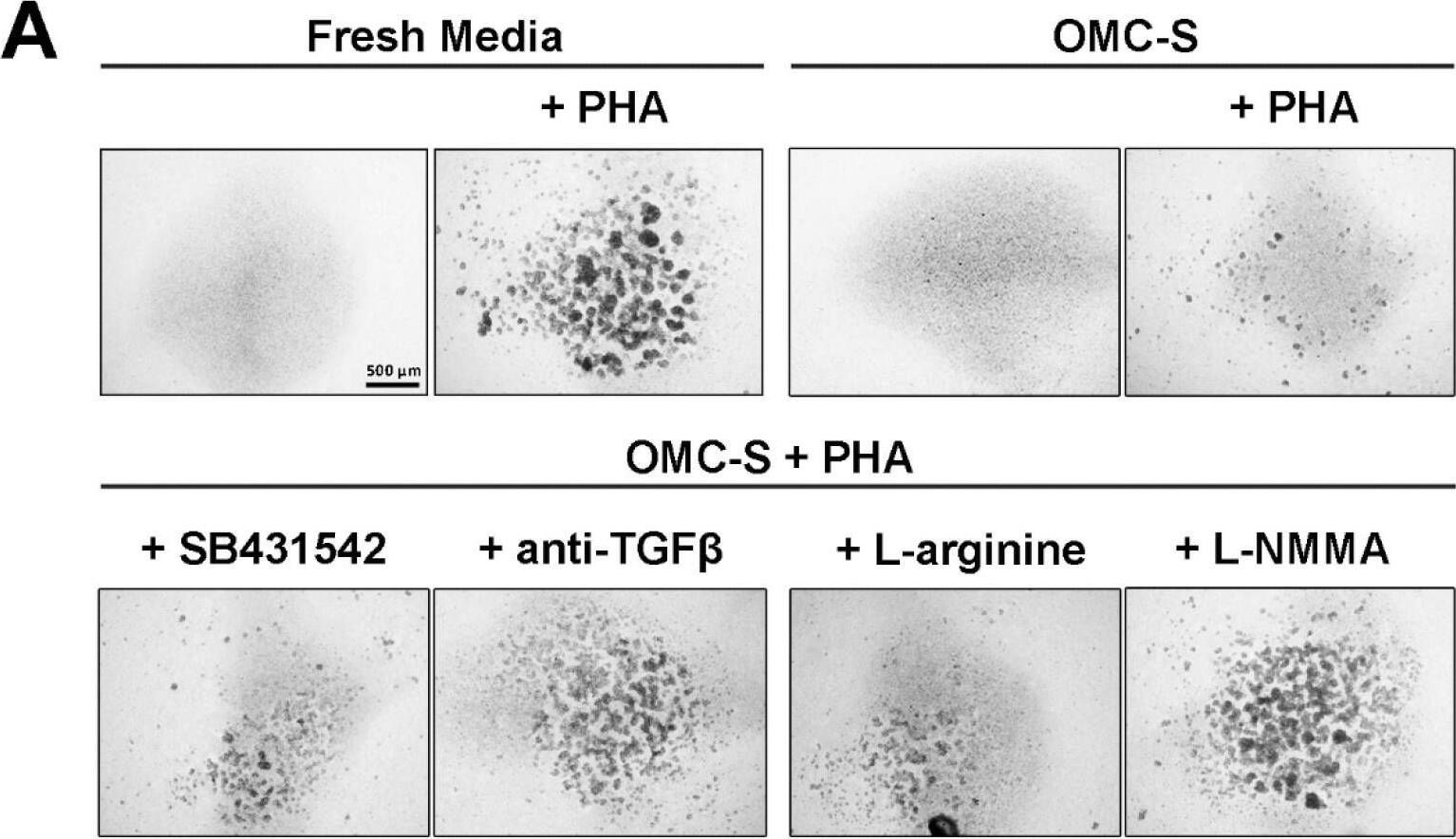
Flow Cytometry: TGF-beta Antibody (1D11.16.8) - Azide and BSA Free [NBP2-47736] -
Lymphosuppression of OMC-derived secretome is partially mediated through TGF beta, L-arginine, and induction of nitric oxide synthase (NOS) in lymphocytes. (A). Upper panels, low-magnification (2×) images of mouse lymph nodes (LN) lymphocytes cultured for 48 h in fresh media or OMC-derived secretome (OMC-S), with or without 25 ug/mL phytohemagglutinin (PHA). Scale bar: 500 um. Lower panel, images of mouse LN lymphocytes cultured in the presence of OMC-S + PHA supplemented with 50 uM SB-431542 (selective inhibitor of ALK5/TGF-beta 1 Receptor), 1 ug/mL of a mouse monoclonal anti-TGF- beta1, beta2, and beta3 antibody, 1 mM L-arginine, or 100 uM L-NMMA (specific inhibitor of nitric oxide synthase). (B) Quantification of lymphocyte agglutination in response to the various experimental culture conditions by measuring mean particle size surface (um2). Results shown are mean +/- s.e.m from (n = 3) distinct batches of OMC-S from ALIC1, SEV3, and SEV4. Statistical differences between experimental conditions were calculated using one way ANOVA. * is for p ≤ 0.05; ** for p ≤ 0.01; *** p ≤ 0.001. Image collected and cropped by CiteAb from the following open publication (https://pubmed.ncbi.nlm.nih.gov/35682603), licensed under a CC-BY license. Not internally tested by Novus Biologicals.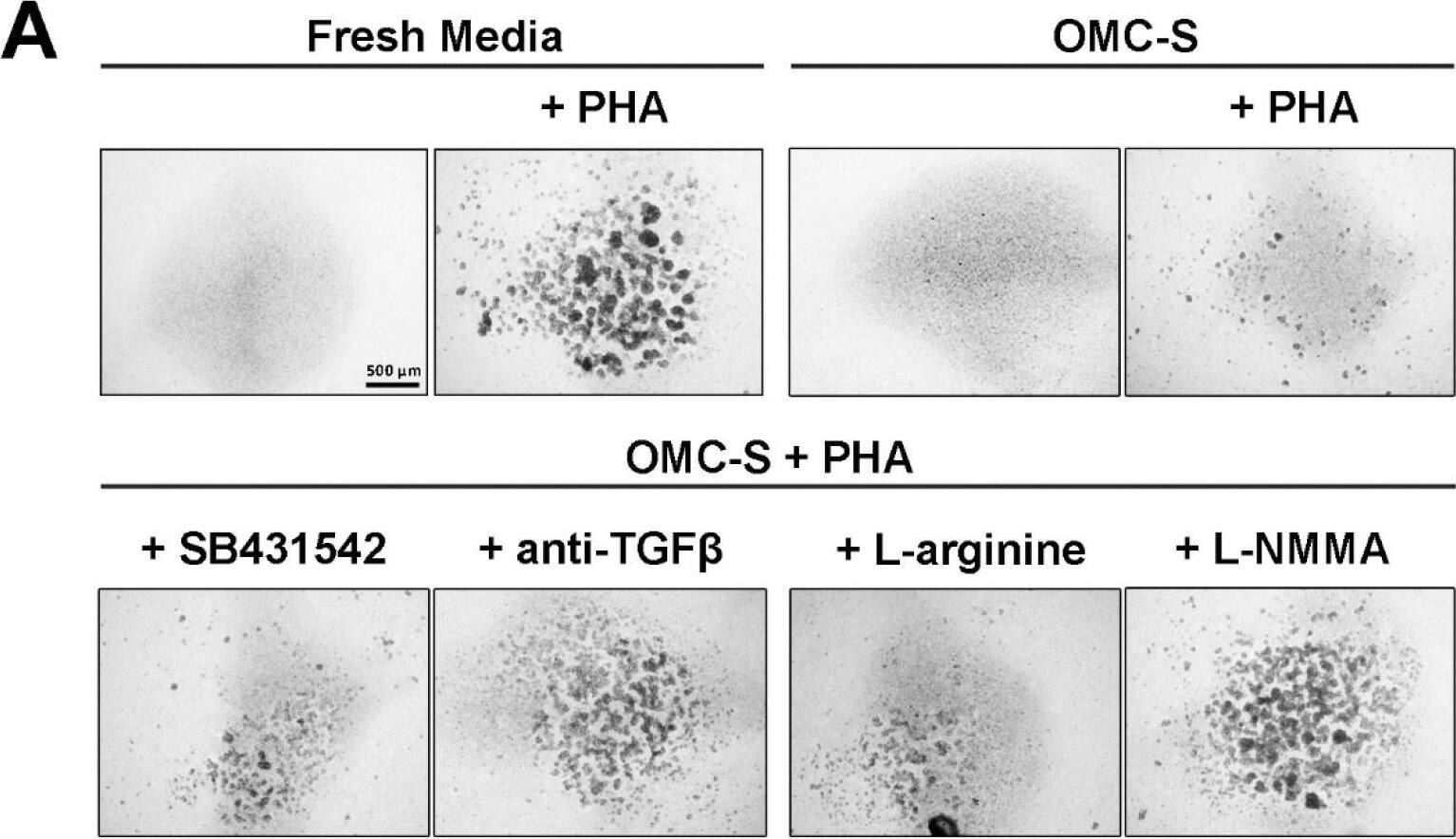
Flow Cytometry: TGF-beta Antibody (1D11.16.8) - Azide and BSA Free [NBP2-47736] -
Lymphosuppression of OMC-derived secretome is partially mediated through TGF beta, L-arginine, and induction of nitric oxide synthase (NOS) in lymphocytes. (A). Upper panels, low-magnification (2×) images of mouse lymph nodes (LN) lymphocytes cultured for 48 h in fresh media or OMC-derived secretome (OMC-S), with or without 25 ug/mL phytohemagglutinin (PHA). Scale bar: 500 um. Lower panel, images of mouse LN lymphocytes cultured in the presence of OMC-S + PHA supplemented with 50 uM SB-431542 (selective inhibitor of ALK5/TGF-beta 1 Receptor), 1 ug/mL of a mouse monoclonal anti-TGF- beta1, beta2, and beta3 antibody, 1 mM L-arginine, or 100 uM L-NMMA (specific inhibitor of nitric oxide synthase). (B) Quantification of lymphocyte agglutination in response to the various experimental culture conditions by measuring mean particle size surface (um2). Results shown are mean +/- s.e.m from (n = 3) distinct batches of OMC-S from ALIC1, SEV3, and SEV4. Statistical differences between experimental conditions were calculated using one way ANOVA. * is for p ≤ 0.05; ** for p ≤ 0.01; *** p ≤ 0.001. Image collected and cropped by CiteAb from the following open publication (https://pubmed.ncbi.nlm.nih.gov/35682603), licensed under a CC-BY license. Not internally tested by Novus Biologicals.Applications for TGF-beta Antibody (1D11.16.8) - Azide and BSA Free
Application
Recommended Usage
Immunocytochemistry/ Immunofluorescence
8-25 ug/ml
Immunohistochemistry-Paraffin
0.5 - 1.0ug/ml
Application Notes
Hu-chromosome location: 19q13.1 (beta1); 1q41 (beta2); 14q24 (beta3). Order Ab without BSA/Azide for Functional Assay and Cytokine Neutralization
Formulation, Preparation, and Storage
Purification
Protein A or G purified
Formulation
PBS
Format
Azide and BSA Free
Preservative
No Preservative
Concentration
1.0 mg/ml
Shipping
The product is shipped with polar packs. Upon receipt, store it immediately at the temperature recommended below.
Stability & Storage
Store at 4C short term. Aliquot and store at -20C long term. Avoid freeze-thaw cycles.
Background: TGF-beta
TGF-beta 1 (Transforming Growth Factor beta 1) is a pleiotrophic cytokine that regulates immune function, proliferation, and epithelial-mesenchymal transition. TGF-beta 1 associates with LAP to form a latent complex. It can be is activated from latency by plasmin, matrix metalloproteases, thrombospondin 1, and a subset of integrins. TGF-beta 1 signals through complexes of TGF-beta RII with TGF-beta RI/ALK-5 or ALK-1. TGF-beta signaling is modulated by the accessory receptors TGF-beta RIII/Betaglycan and Endoglin/CD105.
Long Name
Transforming Growth Factor beta
Alternate Names
TGFbeta
Gene Symbol
TGFB1
Additional TGF-beta Products
Product Documents for TGF-beta Antibody (1D11.16.8) - Azide and BSA Free
Product Specific Notices for TGF-beta Antibody (1D11.16.8) - Azide and BSA Free
This product is for research use only and is not approved for use in humans or in clinical diagnosis. Primary Antibodies are guaranteed for 1 year from date of receipt.
Loading...
Loading...
Loading...
Loading...