
SUMO-interacting Motif (SIM) Antibody - BSA Free
Novus Biologicals, part of Bio-Techne | Catalog # NBP3-30373

Key Product Details
Species Reactivity
Human
Applications
Immunoprecipitation
Label
Unconjugated
Antibody Source
Polyclonal Rabbit IgG
Format
BSA Free
Concentration
Please see the vial label for concentration. If unlisted please contact technical services.
Product Specifications
Immunogen
between 25 and 75
Clonality
Polyclonal
Host
Rabbit
Isotype
IgG
Scientific Data Images for SUMO-interacting Motif (SIM) Antibody - BSA Free
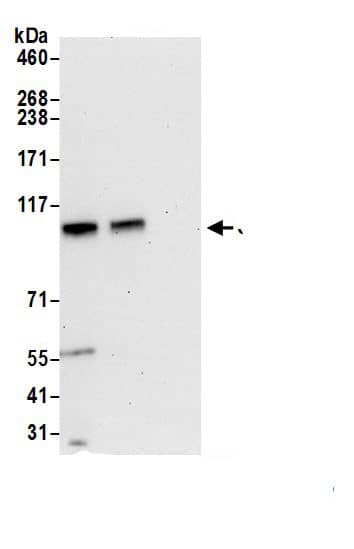
Immunoprecipitation:SUMO-interacting Motif (SIM) AntibodyNBP3-30373] -
Immunoprecipitation:SUMO-interacting Motif (SIM) AntibodyNBP3-30373] -Detection of human SIMC1 by western blot of immunoprecipitates. Samples: Whole cell lysate (1.0 mg per IP reaction; 20% of IP loaded) from 293T cells prepared using NETN lysis buffer. Antibodies: Affinity purified rabbit anti-SIMC1 antibody (NBP3-30373 lot 1) used for IP at 6 µg per reaction. SIMC1 was also immunoprecipitated by rabbit anti-SIMC1 antibody BL23153. For blotting immunoprecipitated SIMC1, NBP3-30373 was used at 0.4 mg/ml. Detection: Chemiluminescence with an exposure time of 30 seconds.Applications for SUMO-interacting Motif (SIM) Antibody - BSA Free
Application
Recommended Usage
Immunoprecipitation
Optimal dilutions of this antibody should be experimentally determined.
Formulation, Preparation, and Storage
Purification
Affinity purified
Formulation
Tris-citrate/phosphate pH 7 -8.
Format
BSA Free
Preservative
0.09% Sodium Azide
Concentration
Please see the vial label for concentration. If unlisted please contact technical services.
Shipping
The product is shipped with polar packs. Upon receipt, store it immediately at the temperature recommended below.
Stability & Storage
Store at 4C. Do not freeze.
Background: SUMO-interacting Motif (SIM)
Small Ubiquitin-like Modifiers (SUMOs) are a family of small, related proteins that are enzymatically attached to target proteins by a process termed SUMOylation. This post-translational modification regulates many cellular processes including DNA transcription and repair, cell cycle progression, protein intracellular trafficking, and nuclear receptor activities. SUMO binding and/or interaction with proteins is mediated by short amino acid consensus sequences termed SUMO-interacting motifs (SIMs). To date, all SIMs appear to contain a hydrophobic core sequence that is either preceded or succeeded by an acidic region composed of either glutamate or aspartate residues or phosphorylated serine or threonine residues. The hydrophobic core of SIMs has been shown to interact with the alpha-helix and beta2-strand surfaces on SUMO proteins while the negatively charged residues surrounding the hydrophobic core appear to influence binding affinities and dictate binding preferences for the various SUMO isoforms. SIMs have been identified in numerous types of proteins including SUMO ligases (E3), transcription factors, and transcriptional repressors.
Alternate Names
SUMOinteracting Motif
Gene Symbol
SIMC1
Additional SUMO-interacting Motif (SIM) Products
Product Documents for SUMO-interacting Motif (SIM) Antibody - BSA Free
Product Specific Notices for SUMO-interacting Motif (SIM) Antibody - BSA Free
This product is for research use only and is not approved for use in humans or in clinical diagnosis. Primary Antibodies are guaranteed for 1 year from date of receipt.
Loading...
Loading...
Loading...
Loading...