
SCAP Antibody (HL2796)
Novus Biologicals, part of Bio-Techne | Catalog # NBP3-48733
Recombinant Monoclonal Antibody

Key Product Details
Species Reactivity
Human, Mouse, Rat
Applications
Immunohistochemistry, Immunohistochemistry-Paraffin, Western Blot
Label
Unconjugated
Antibody Source
Recombinant Monoclonal Rabbit IgG Clone # HL2796
Concentration
Concentrations vary lot to lot. See vial label for concentration. If unlisted please contact technical services.
Product Specifications
Immunogen
Recombinant protein of human SCAP.
Clonality
Monoclonal
Host
Rabbit
Isotype
IgG
Scientific Data Images for SCAP Antibody (HL2796)
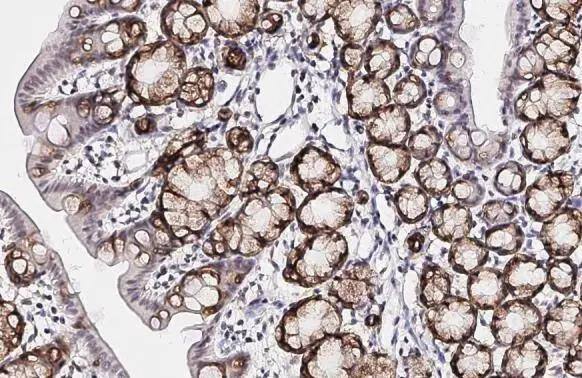
Immunohistochemistry-Paraffin: SCAP Antibody (HL2796) [NBP3-48733] -
SCAP antibody [HL2796] detects SCAP protein at cytoplasm by immunohistochemical analysis.Sample: Paraffin-embedded mouse colon.
SCAP stained by SCAP antibody [HL2796] (NBP3-48733) diluted at 1:100.
Antigen Retrieval: Citrate buffer, pH 6.0, 15 min
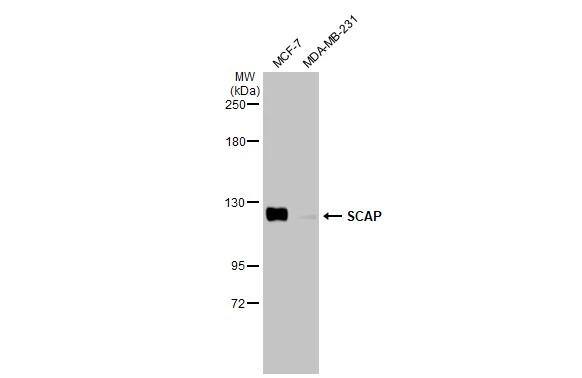
Western Blot: SCAP Antibody (HL2796) [NBP3-48733] -
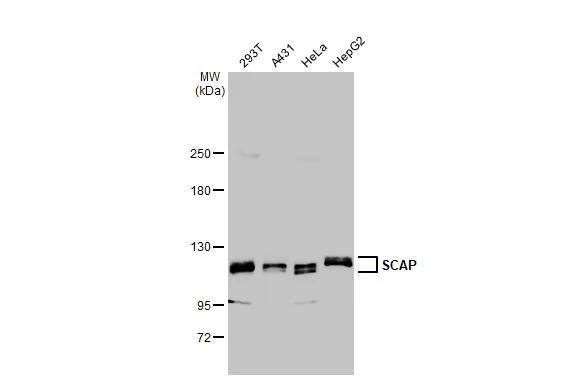
Various whole cell extracts (30 ug) were separated by 5% SDS-PAGE, and the membrane was blotted with SCAP antibody [HL2796] (NBP3-48733) diluted at 1:1000. The HRP-conjugated anti-rabbit IgG antibody was used to detect the primary antibody.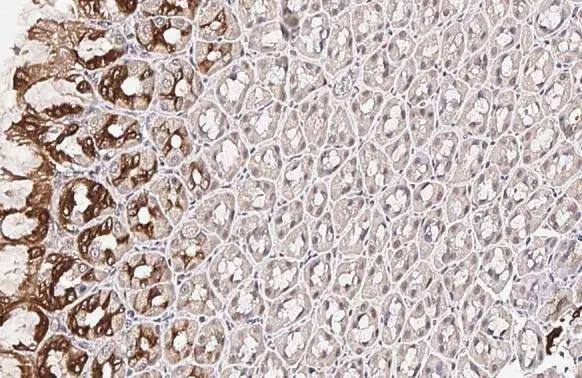
Immunohistochemistry-Paraffin: SCAP Antibody (HL2796) [NBP3-48733] -
SCAP antibody [HL2796] detects SCAP protein at cytoplasm by immunohistochemical analysis.Sample: Paraffin-embedded rat stomach.
SCAP stained by SCAP antibody [HL2796] (NBP3-48733) diluted at 1:100.
Antigen Retrieval: Citrate buffer, pH 6.0, 15 min
Applications for SCAP Antibody (HL2796)
Application
Recommended Usage
Western Blot
1:500-1:3000
Formulation, Preparation, and Storage
Purification
Protein A purified
Formulation
PBS
Preservative
No Preservative
Concentration
Concentrations vary lot to lot. See vial label for concentration. If unlisted please contact technical services.
Shipping
The product is shipped with polar packs. Upon receipt, store it immediately at the temperature recommended below.
Stability & Storage
Store at 4C short term. Aliquot and store at -20C long term. Avoid freeze-thaw cycles.
Background: SCAP
References
1. Lee, S. H., Lee, J. H., & Im, S. S. (2020). The cellular function of SCAP in metabolic signaling. Experimental & molecular medicine, 52(5), 724-729. https://doi.org/10.1038/s12276-020-0430-0
2. Cheng, X., Li, J., & Guo, D. (2018). SCAP/SREBPs are Central Players in Lipid Metabolism and Novel Metabolic Targets in Cancer Therapy. Current topics in medicinal chemistry, 18(6), 484-493. https://doi.org/10.2174/1568026618666180523104541
3. Brown, M. S., Radhakrishnan, A., & Goldstein, J. L. (2018). Retrospective on Cholesterol Homeostasis: The Central Role of Scap. Annual review of biochemistry, 87, 783-807. https://doi.org/10.1146/annurev-biochem-062917-011852
4. Moon Y. A. (2017). The SCAP/SREBP Pathway: A Mediator of Hepatic Steatosis. Endocrinology and metabolism (Seoul, Korea), 32(1), 6-10. https://doi.org/10.3803/EnM.2017.32.1.6
Alternate Names
KIAA0199, PSEC0227, SREBF chaperone, SREBP cleavage-activating protein, sterol regulatory element binding protein cleavage-activating protein
Gene Symbol
SCAP
Additional SCAP Products
Product Documents for SCAP Antibody (HL2796)
Product Specific Notices for SCAP Antibody (HL2796)
This product is for research use only and is not approved for use in humans or in clinical diagnosis. Primary Antibodies are guaranteed for 1 year from date of receipt.
Loading...
Loading...
Loading...
Loading...