
Rat RAGE/AGER Antibody
R&D Systems, part of Bio-Techne | Catalog # AF1616

Scientific images may be resized, cropped, or adjusted for brightness or contrast for presentation purposes. These updates are limited to presentation and do not affect the underlying scientific interpretation of the data. Where available, additional source data may be provided upon request.
Conjugate
Catalog #
Key Product Details
Species Reactivity
Validated:
Rat
Cited:
Mouse, Rat
Applications
Validated:
Western Blot, ELISA Capture (Matched Antibody Pair), Blockade of Receptor-ligand Interaction
Cited:
Immunohistochemistry-Frozen, Western Blot
Label
Unconjugated
Antibody Source
Polyclonal Goat IgG
Product Specifications
Immunogen
Mouse myeloma cell line NS0-derived recombinant rat RAGE
Gln24-Ala342
Accession # Q63495
Gln24-Ala342
Accession # Q63495
Specificity
Detects
rat RAGE in ELISAs. In direct ELISA, approximately 40%
cross-reactivity with recombinant mouse Rage, less than 20%
cross-reactivity with recombinant human RAGE and <5% cross reactivity
recombinant canine RAGE is observed.
Clonality
Polyclonal
Host
Goat
Isotype
IgG
Endotoxin Level
<0.10 EU per 1 μg of the antibody by the LAL method.
Scientific Data Images for Rat RAGE/AGER Antibody
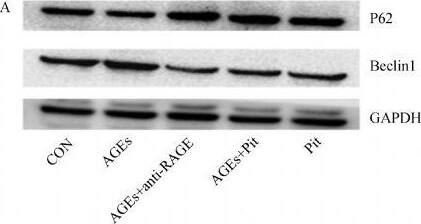
Detection of Rat RAGE by Western Blot
The effect of pitavastatin on AGEs-induced autophagy. Image collected and cropped by CiteAb from the following open publication (https://pubmed.ncbi.nlm.nih.gov/29089470), licensed under a CC-BY license. Not internally tested by R&D Systems.
Rat RAGE ELISA Standard Curve
Recombinant Rat RAGE/AGER Fc Chimera (1616-RG) was serially diluted and captured by Goat Anti-Rat RAGE/AGER Antigen Affinity-purified Polyclonal Antibody (Catalog # AF1616) coated on a Clear Polystyrene Microplate (DY990). Goat Anti-Rat RAGE/AGER Antigen Affinity-purified Polyclonal Antibody (Catalog # AF1616) was biotinylated and incubated with the protein captured on the plate. Detection of the standard curve was achieved by incubating Streptavidin-HRP (DY998).
Rat RAGE ELISA Standard Curve
Recombinant Rat RAGE/AGER Fc Chimera (1616-RG) was serially diluted and captured by Goat Anti-Rat RAGE/AGER Antigen Affinity-purified Polyclonal Antibody (Catalog # AF1616) coated on a Clear Polystyrene Microplate (DY990). Goat Anti-Rat RAGE/AGER Antigen Affinity-purified Polyclonal Antibody (Catalog # AF1616) was biotinylated and incubated with the protein captured on the plate. Detection of the standard curve was achieved by incubating Streptavidin-HRP (DY998).Applications for Rat RAGE/AGER Antibody
Application
Recommended Usage
Blockade of Receptor-ligand Interaction
In a functional ELISA, 5-25 µg/mL of this antibody will block 50% of the binding of 5 μg/mL of biotinylated AGE-BSA to immobilized Recombinant Rat RAGE Fc Chimera (Catalog # 1616-RG) coated at 5 µg/mL (100 µL/well). At 166 μg/mL, this antibody will block >90% of the binding.
Western Blot
0.1 µg/mL
Sample: Recombinant Rat RAGE Fc Chimera (Catalog # 1616-RG)
Sample: Recombinant Rat RAGE Fc Chimera (Catalog # 1616-RG)
Rat RAGE Sandwich Immunoassay
Please Note: Optimal dilutions of this antibody should be experimentally determined.
Reviewed Applications
Read 1 review rated 5 using AF1616 in the following applications:
Formulation, Preparation, and Storage
Purification
Antigen Affinity-purified
Reconstitution
Reconstitute at 0.2 mg/mL in sterile PBS. For liquid material, refer to CoA for concentration.
Formulation
Lyophilized from a 0.2 μm filtered solution in PBS with Trehalose. See Certificate of Analysis for details.
*Small pack size (-SP) is supplied either lyophilized or as a 0.2 µm filtered solution in PBS.
*Small pack size (-SP) is supplied either lyophilized or as a 0.2 µm filtered solution in PBS.
Shipping
Lyophilized product is shipped at ambient temperature. Liquid small pack size (-SP) is shipped with polar packs. Upon receipt, store immediately at the temperature recommended below.
Stability & Storage
Use a manual defrost freezer and avoid repeated freeze-thaw cycles.
- 12 months from date of receipt, -20 to -70 °C as supplied.
- 1 month, 2 to 8 °C under sterile conditions after reconstitution.
- 6 months, -20 to -70 °C under sterile conditions after reconstitution.
Background: RAGE/AGER
Advanced glycation endproducts (AGE) are adducts formed by the non-enzymatic glycation or oxidation of macromolecules (1). AGE forms during aging and its formation is accelerated under pathophysiologic states such as diabetes, Alzheimer’s disease, renal failure and immune/inflammatory disorders. Receptor for Advanced Glycation Endoproducts (RAGE), named for its ability to bind AGE, is a multiligand receptor belonging to the immunoglobulin (Ig) superfamily. Besides AGE, RAGE binds amyloid beta-peptide, S100/calgranulin family proteins, high mobility group B1 (HMGB1, also know as amphoterin) and leukocyte integrins (1, 2).
The human RAGE gene encodes a 404 amino acid (aa) residues type I transmembrane glycoprotein with a 22 aa signal peptide, a 319 aa extracellular domain containing an Ig-like V-type domain and two Ig-like Ce-type domains, a 21 aa transmembrane domain and a 40 aa cytoplasmic domain (3). The V-type domain and the cytoplasmic domain are important for ligand binding and for intracellular signaling, respectively. Two alternative splice variants, lacking the V‑type domain or the cytoplasmic tail, are known (1, 4). RAGE is highly expressed in the embryonic central nervous system (5). In adult tissues, RAGE is expressed at low levels in multiple tissues including endothelial and smooth muscle cells, mononuclear phagocytes, pericytes, microglia, neurons, cardiac myocytes and hepatocytes (6). The expression of RAGE is upregulated upon ligand interaction. Depending on the cellular context and interacting ligand, RAGE activation can trigger differential signaling pathways that affect divergent pathways of gene expression (1, 7). RAGE activation modulates varied essential cellular responses (including inflammation, immunity, proliferation, cellular adhesion and migration) that contribute to cellular dysfunction associated with chronic diseases such as diabetes, cancer, amyloidoses and immune or inflammatory disorders (1).
References
- Schmidt, A. et al. (2001) J. Clin. Invest. 108:949.
- Chavakis, T. et al. (2003) J. Exp. Med. 198:507.
- Neeper, M. et al. (1992) J. Biol. Chem. 267:14998.
- Yonekura, H. et al. (2003) Biochem. J. 370:1097.
- Hori, O. et al. (1995) J. Biol. Chem. 270:25752.
- Brett, J. et al. (1993) Am. J. Pathol. 143:1699.
- Valencia, J.V. et al. (2004) Diabetes 53:743.
Long Name
Receptor for Advanced Glycation End Products
Alternate Names
AGER, SCARJ1
Gene Symbol
AGER
UniProt
Additional RAGE/AGER Products
Product Documents for Rat RAGE/AGER Antibody
Product Specific Notices for Rat RAGE/AGER Antibody
For research use only
Loading...
Loading...
Loading...
Loading...
Loading...