
PABPC4 Antibody
Novus Biologicals, part of Bio-Techne | Catalog # NB100-74594

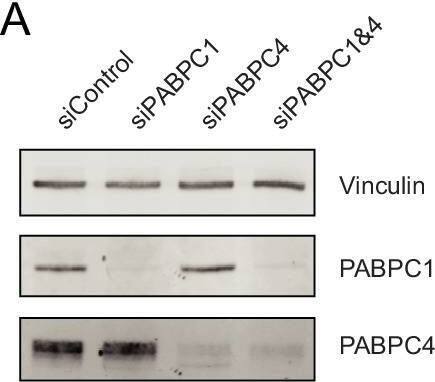
![Western Blot: PABPC4 Antibody [NB100-74594]](https://resources.bio-techne.com/images/products/PABPC4-Antibody-Western-Blot-NB100-74594-img0006.jpg "Western Blot: PABPC4 Antibody [NB100-74594]")
Key Product Details
Validated by
Independent Antibodies, Biological Validation
Species Reactivity
Validated:
Human, Mouse
Cited:
Human
Applications
Validated:
Immunohistochemistry, Immunohistochemistry-Paraffin, Western Blot, Immunoprecipitation
Cited:
Western Blot, Immunoprecipitation
Label
Unconjugated
Antibody Source
Polyclonal Rabbit IgG
Concentration
0.2 mg/ml
Product Specifications
Immunogen
The immunogen recognized by this antibody maps to a region between residue 594 and 644 of human Poly(A)-binding protein 4 using the numbering given in entry NP_003810.1 (GeneID 8761).
Localization
Cytoplasmic
Clonality
Polyclonal
Host
Rabbit
Isotype
IgG
Scientific Data Images for PABPC4 Antibody
![Immunohistochemistry-Paraffin: PABPC4 Antibody [NB100-74594]](https://resources.bio-techne.com/images/products/PABPC4-Antibody-Immunohistochemistry-Paraffin-NB100-74594-img0007.jpg "Immunohistochemistry-Paraffin: PABPC4 Antibody [NB100-74594]")
Immunohistochemistry-Paraffin: PABPC4 Antibody [NB100-74594]
Immunohistochemistry-Paraffin: PABPC4 Antibody [NB100-74594] - Sample: FFPE section of human colon carcinoma. Antibody: Affinity purified rabbit anti- PABP4 used at a dilution of 1:200 (1ug/ml). Detection: DAB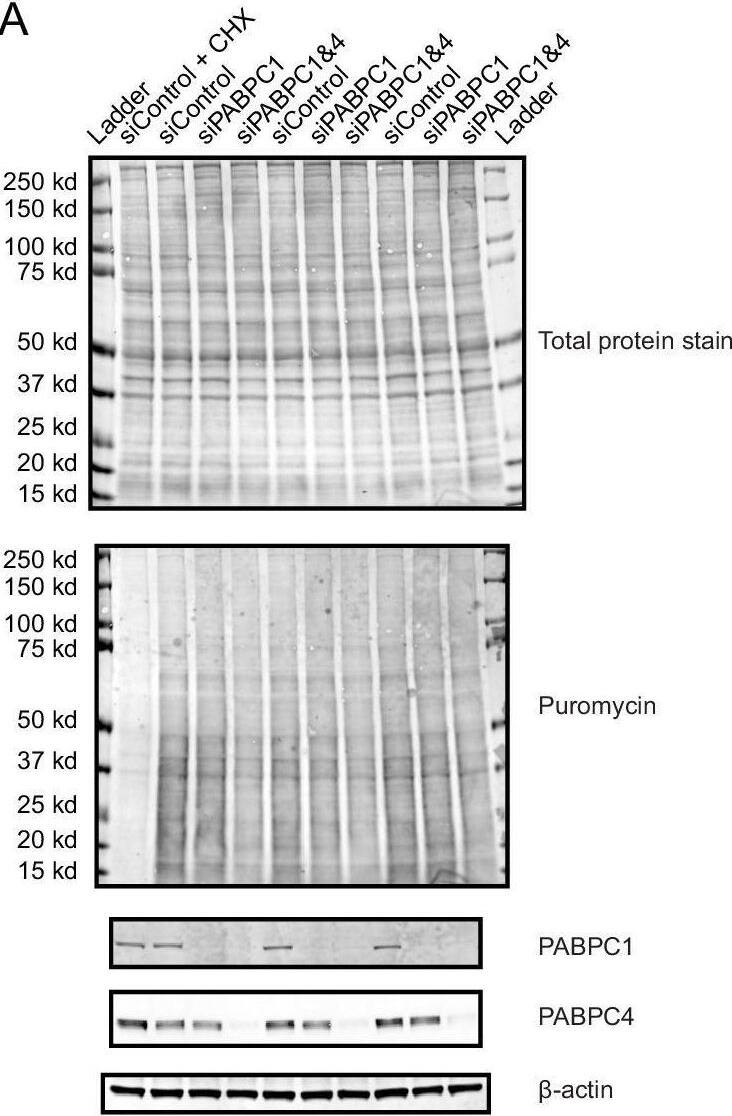
Western Blot: PABPC4 Antibody [NB100-74594] -
Depletion of PABPC in mammalian cell lines has minimal effect on TE.(A) The effect of PABPC knockdown on protein synthesis in HeLa cells. Cells transfected with the indicated siRNAs were cultured for 48 hr, then treated with puromycin before harvesting for western-blot analysis. In a control sample, cycloheximide (CHX) was added prior to puromycin treatment. At the top is the membrane showing total protein levels. In the middle is the same membrane probed for puromycin to detect nascent protein synthesis. At the bottom are the results of the same membrane probed for the indicated proteins. (B) The effect of PABPC knockdown on polysomes in HeLa cells. At the top are polysome-gradient profiles from HeLa cells transfected with either control siRNAs or siRNAs targeting PABPC1 and PABPC4. At the bottom are northern blots analyzing RNA collected from gradient fractions shown at the top, probing for four cytoplasmic mRNAs and one mitochondrial mRNA (MT-CYB). (C) The early effects of rapid PABPC1 degradation on mRNA abundance (left), ribosome-footprint abundance (middle) and TE (right) in HCT116 PABPC1-AID cells. At the top, values from cells treated with IAA for 0.5 hr are compared to those from cells not treated with IAA. In the middle, values from cells treated with IAA for 1 hr are compared to those from cells not treated with IAA. At the bottom, values from cells treated with IAA for 3 hr are compared to those from cells not treated with IAA. For each gene, values for mRNA and ribosome-footprint reads per kilobase are plotted after normalizing to values for mitochondrial mRNAs. These results are summarized Figure 6F. Image collected and cropped by CiteAb from the following open publication (https://pubmed.ncbi.nlm.nih.gov/34213414), licensed under a CC-BY license. Not internally tested by Novus Biologicals.Applications for PABPC4 Antibody
Application
Recommended Usage
Immunohistochemistry
1:100-1:500
Immunohistochemistry-Paraffin
1:100-1:500
Immunoprecipitation
2-5ug/mg lysate
Western Blot
1:2000-1:10000
Application Notes
Epitope retrieval with citrate buffer pH6.0 is recommended for FFPE tissue sections.
Formulation, Preparation, and Storage
Purification
Immunogen affinity purified
Formulation
TBS and 0.1% BSA
Preservative
0.09% Sodium Azide
Concentration
0.2 mg/ml
Shipping
The product is shipped with polar packs. Upon receipt, store it immediately at the temperature recommended below.
Stability & Storage
Store at 4C. Do not freeze.
Background: PABPC4
Alternate Names
APP1FLJ43938, APP-1PABP-4, Inducible poly(A)-binding protein, IPABP, iPABPpoly(A)-binding protein, cytoplasmic 4 (inducible form), PABP4Activated-platelet protein 1, poly(A) binding protein, cytoplasmic 4 (inducible form), Poly(A)-binding protein 4, polyadenylate-binding protein 4
Gene Symbol
PABPC4
UniProt
Additional PABPC4 Products
Product Documents for PABPC4 Antibody
Product Specific Notices for PABPC4 Antibody
This product is for research use only and is not approved for use in humans or in clinical diagnosis. Primary Antibodies are guaranteed for 1 year from date of receipt.
Loading...
Loading...
Loading...
Loading...