
Mouse Wnt-9b Antibody
R&D Systems, part of Bio-Techne | Catalog # AF3669

Conjugate
Catalog #
Key Product Details
Species Reactivity
Validated:
Mouse
Cited:
Human, Mouse
Applications
Validated:
Immunohistochemistry, Western Blot
Cited:
Immunohistochemistry, Western Blot
Label
Unconjugated
Antibody Source
Polyclonal Goat IgG
Product Specifications
Immunogen
E. coli-derived recombinant mouse Wnt-9b
Ala46-Glu90, Lys228-Tyr298
Accession # O35468
Ala46-Glu90, Lys228-Tyr298
Accession # O35468
Specificity
Detects mouse Wnt-9b in direct ELISAs and Western blots. In Western blots, less than 5% cross-reactivity with recombinant human (rh) Wnt‑2, rhWnt-9a, recombinant mouse (rm) Wnt‑1, rmWnt-2b, rmWnt-3a, rmWnt-4, rmWnt‑5a, rmWnt-5b, rmWnt-11, and rmWnt-16 is observed.
Clonality
Polyclonal
Host
Goat
Isotype
IgG
Scientific Data Images for Mouse Wnt-9b Antibody
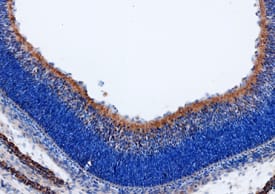
Wnt‑9b in Mouse Embryo.
Wnt-9b was detected in imm-ersion fixed frozen sections of mouse embryo (13 d.p.c.) using Goat Anti-Mouse Wnt-9b Antigen Affinity-purified Poly-clonal Antibody (Catalog # AF3669) at 15 µg/mL overnight at 4 °C. Tissue was stained using the Anti-Goat HRP-DAB Cell & Tissue Staining Kit (brown; Catalog # CTS008) and counter-stained with hematoxylin (blue). Specific staining was localized to the retina. View our protocol for Chromogenic IHC Staining of Frozen Tissue Sections.
Detection of Wnt-9b by Western Blot
Identification of a panel of breast cancer cell lines with emergent anoikis-resistant cancer stem cell populations. (A) A panel of seven breast cancer anoikis-resistant cell lines was evaluated for cancer stem cell markers CD44, CD24, and Sox2 following culturing in either a monolayer (day 0) or non-adherent suspension condition for up to seven days using immunoblotting. Total protein expression for CD44 and Sox2 was increased over the seven days of culturing relative to the monolayer condition. CD24 was decreased in the MCF7 and T47D cell lines, and low expression was maintained in the MB-231 cell line. Immunoblot images are representative of 3 biological replicates. (B) The surface expression of CD44 and CD24 was analyzed using multispectral imaging flow cytometry (MIFC), and the CD44+CD24− population was quantified from the bivariate graph (C). The data shown are the percentages of CD44+CD24− cells out of the total population. Bivariate charts were gated on the isotype controls for each marker. (n = 3, * p < 0.05 relative to the monolayer culture (D0)). (D) MIFC images were taken of individual cells at each time point, and representative images for MB-231, MCF7, and T47D cells at days 0 (D0) and 7 (D7) of suspension culturing are shown. Assigned cell number of population is shown on the brightfield images. Image collected and cropped by CiteAb from the following open publication (https://www.mdpi.com/2227-9059/11/3/934), licensed under a CC-BY license. Not internally tested by R&D Systems.Applications for Mouse Wnt-9b Antibody
Application
Recommended Usage
Immunohistochemistry
5-15 µg/mL
Sample: Immersion fixed frozen sections of mouse embryo (E13 d.p.c.)
Sample: Immersion fixed frozen sections of mouse embryo (E13 d.p.c.)
Western Blot
0.1 µg/mL
Sample: Recombinant Mouse Wnt-9b (Catalog # 3669-WN)
Sample: Recombinant Mouse Wnt-9b (Catalog # 3669-WN)
Formulation, Preparation, and Storage
Purification
Antigen Affinity-purified
Reconstitution
Reconstitute at 0.2 mg/mL in sterile PBS. For liquid material, refer to CoA for concentration.
Formulation
Lyophilized from a 0.2 μm filtered solution in PBS with Trehalose. *Small pack size (SP) is supplied either lyophilized or as a 0.2 µm filtered solution in PBS.
Shipping
Lyophilized product is shipped at ambient temperature. Liquid small pack size (-SP) is shipped with polar packs. Upon receipt, store immediately at the temperature recommended below.
Stability & Storage
Use a manual defrost freezer and avoid repeated freeze-thaw cycles.
- 12 months from date of receipt, -20 to -70 °C as supplied.
- 1 month, 2 to 8 °C under sterile conditions after reconstitution.
- 6 months, -20 to -70 °C under sterile conditions after reconstitution.
Background: Wnt-9b
Mouse Wnt-9b, previously called Wnt-14b or Wnt-15, is one of about 19 vertebrate members of the Wingless-type MMTV integration site (Wnt) family of highly conserved, cysteine-rich secreted glycoproteins important for normal developmental processes (1‑3). Wnts mainly transduce signals by binding to receptors of the Frizzled family, in conjunction with a coreceptor of the low-density lipoprotein receptor-related protein family (LRP-5 or -6) (1, 2). The 359 aa mouse Wnt-9b precursor contains a 336 aa mature region with 24 conserved cysteines (3). Mature mouse Wnt-9b shares 93%, 98%, 92%, 92% and 91% aa identity with human, rat, canine, equine and bovine Wnt-9b, respectively. It is evolutionarily related to Wnt-9a and Wnt-3, which share 63% and 32% aa identity, respectively (4). Wnt-9b mRNA is expressed in late embryos and in adult kidney, with lesser amounts in brain and liver (3, 4). It appears to direct mesenchymal-to-epithelial transition in the kidney and other tissues (5). During kidney development, it is expressed in the ureteric bud and induces mesonephric and metanephric tubulogenesis, nephron development, and caudal extension of the Mullerian duct, acting upstream of Wnt-4 (5‑7). Induction is dependent on beta-catenin activity, implicating the canonical signaling pathway (7). Mice devoid of Wnt-9b die shortly after birth due to kidney agenesis, while low expression results in small kidneys with fewer nephrons (1, 5, 6). Mutations of Wnt-9b also cause incompletely penetrant cleft lip and palate in mice, indicating its involvement with facial midline morphogenesis (8, 9). It has weak transforming activity compared to other transforming Wnts (4).
References
- http://www.stanford.edu/group/nusselab/cgi-bin/wnt/.
- Logan, C. Y. and R. Nusse (2004) Annu. Rev. Cell Dev. Biol. 20:781.
- Kirikoshi, H. and M. Katoh (2002) Int. J. Mol. Med. 9:135.
- Qian, J. et al. (2003) Genomics 81:34.
- Carroll, T. J. et al. (2005) Dev. Cell 9:283.
- Merkel, C. E. et al. (2007) Pediatr. Nephrol. 22:1825.
- Park, J-S. et al. (2007) Development 134:2533.
- Lan, Y. et al. (2006) Dev. Dyn. 235:1448.
- Juriloff, D. M. and M. J. Harris (2008) Birth Defects Res. A Clin. Mol. Teratol. 82:63.
Long Name
Wingless-type MMTV Integration Site Family, Member 9b
Alternate Names
Wnt-14b, Wnt-15, Wnt9b
Gene Symbol
WNT9B
UniProt
Additional Wnt-9b Products
Product Documents for Mouse Wnt-9b Antibody
Product Specific Notices for Mouse Wnt-9b Antibody
For research use only
Loading...
Loading...
Loading...
Loading...
Loading...