
Mouse Plasma Kallikrein/KLKB1 Antibody
R&D Systems, part of Bio-Techne | Catalog # AF2498

Conjugate
Catalog #
Key Product Details
Species Reactivity
Validated:
Mouse
Cited:
Mouse
Applications
Validated:
Western Blot, Immunoprecipitation
Cited:
Immunohistochemistry-Paraffin, Western Blot
Label
Unconjugated
Antibody Source
Polyclonal Goat IgG
Product Specifications
Immunogen
Mouse myeloma cell line NS0-derived recombinant mouse Kallikrein/KLKB1
Gly20-Ala638
Accession # NP_032481
Gly20-Ala638
Accession # NP_032481
Specificity
Detects mouse Plasma Kallikrein/KLKB1 in direct ELISAs and Western blots. In direct ELISAs, less than 10% cross‑reactivity with recombinant human KLKB1 is observed.
Clonality
Polyclonal
Host
Goat
Isotype
IgG
Scientific Data Images for Mouse Plasma Kallikrein/KLKB1 Antibody
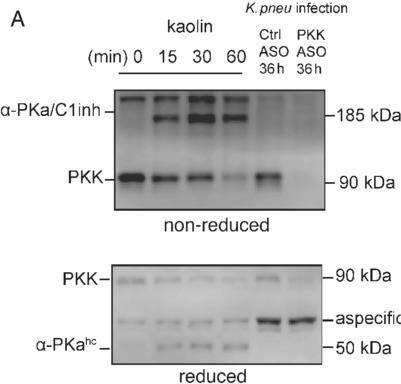
Detection of Plasma Kallikrein/KLKB1 by Western Blot
Klebsiella pneumoniae does not activate the contact system in vivo or in vitro. Mice were treated subcutaneously with PKK ASO (open bars) or control ASO (grey bars) twice weekly for 3 weeks; 4 days after final dose, mice were infected with K. pneumoniae via airways (t = 0) and euthanized at 12 or 36 h after infection. (A) Western blots showing full length PKK and the cleaved chain of alpha‐PKa in plasma obtained 36 h after infection using either reduced or non‐reduced samples; naive mouse plasmas pretreated with 100 μg/ml kaolin for the indicated time (15 min to 1 h) were used as positive controls. (B, C) K. pneumoniae, E. coli Ymel or E. coli Ymel‐1 was incubated in citrated plasma from healthy volunteers and bacterial bound PKK (B) and HK (C) proteins were detected by western blotting after reducing SDS‐PAGE. cHK, cleaved chains of HK; alpha‐PKahc, alpha‐PKa heavy chain. Image collected and cropped by CiteAb from the following open publication (https://pubmed.ncbi.nlm.nih.gov/31595971), licensed under a CC-BY license. Not internally tested by R&D Systems.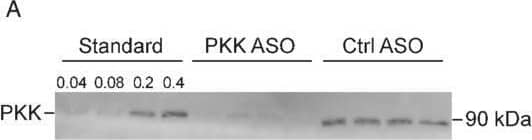
Detection of Plasma Kallikrein/KLKB1 by Western Blot
Inhibition of PKK expression by PKK ASO treatment. Mice were treated subcutaneously with PKK ASO (open bars) or control (Ctrl) ASO (grey bars) twice weekly for 3 weeks; 4 days after final dose, mice were infected with K. pneumoniae via the airways (t = 0). (A) Western blot of mouse plasma PKK (t = 0). Plasma (0.2 μl diluted in buffer; total volume 10 μl) from four PKK ASO‐ or four Ctrl ASO‐treated mice was loaded; ‘standard’ indicates volumes (μl) of plasma in buffer (total volume 10 μl) from one uninfected mouse (treated with Ctrl ASO). The blot shown is representative of three independent blots. (B) Klkb1 mRNA expression in livers of mice treated with PKK or Ctrl ASO at corresponding time points. (C) Plasma PKK activity. (D) Activated partial thromboplastin time (aPTT). (E) Prothrombin time (PT). Data are mean and SD for bar charts in B and C or medians for box and whisker plots in D and E, eight mice per group. **p < 0.01, ***p < 0.001 (versus Ctrl ASO at the same time point); φp < 0.05, φφp < 0.01, φφφp < 0.001 (versus t = 0 in the same treatment group). Image collected and cropped by CiteAb from the following open publication (https://pubmed.ncbi.nlm.nih.gov/31595971), licensed under a CC-BY license. Not internally tested by R&D Systems.Applications for Mouse Plasma Kallikrein/KLKB1 Antibody
Application
Recommended Usage
Immunoprecipitation
25 µg/mL
Sample: Conditioned cell culture medium spiked with Recombinant Mouse Plasma Kallikrein/KLKB1 (Catalog # 2498-SE), see our available Western blot detection antibodies
Sample: Conditioned cell culture medium spiked with Recombinant Mouse Plasma Kallikrein/KLKB1 (Catalog # 2498-SE), see our available Western blot detection antibodies
Western Blot
0.1 µg/mL
Sample: Recombinant Mouse Plasma Kallikrein/KLKB1 (Catalog # 2498-SE)
Sample: Recombinant Mouse Plasma Kallikrein/KLKB1 (Catalog # 2498-SE)
Formulation, Preparation, and Storage
Purification
Antigen Affinity-purified
Reconstitution
Reconstitute at 0.2 mg/mL in sterile PBS. For liquid material, refer to CoA for concentration.
Formulation
Lyophilized from a 0.2 μm filtered solution in PBS with Trehalose. *Small pack size (SP) is supplied either lyophilized or as a 0.2 µm filtered solution in PBS.
Shipping
Lyophilized product is shipped at ambient temperature. Liquid small pack size (-SP) is shipped with polar packs. Upon receipt, store immediately at the temperature recommended below.
Stability & Storage
Use a manual defrost freezer and avoid repeated freeze-thaw cycles.
- 12 months from date of receipt, -20 to -70 °C as supplied.
- 1 month, 2 to 8 °C under sterile conditions after reconstitution.
- 6 months, -20 to -70 °C under sterile conditions after reconstitution.
Background: Plasma Kallikrein/KLKB1
Plasma Kallikrein, a serine protease, is synthesized in the liver and circulates in the plasma by binding to high molecular weight (HMW) kininogen or as a free zymogen. Once activated by its physiological activator, factor XII, it displays endopeptidase activity towards peptide bonds after arginine (preferred) and lysine. It cleaves HMW kininogen, its major physiological substrate, to release the potent vasodilator peptide bradykinin. It is also able to cleave a number of inactive precursor proteins to generate active products, such as plasminogen and prourokinase. Thus, it plays an important role in blood pressure regulation, fibrinolysis, and neutrophil activation (1). Mouse Plasma Kallikrein precursor contains a signal peptide (residues 1 to 19) and a pro form sequence (residues 20 to 638). Upon activation, the pro form is converted to a heavy chain and a light chain, which is linked by disulfide bonds and the latter contains the catalytic domain (2). The mouse Plasma Kallikrein pro form was expressed in the NS0 cells with a foreign signal peptide. After being treated by thermolysin, the purified enzyme is active against a fluorogenic peptide substrate.
References
- Colman, R. (2004) in Handbook of Proteolytic Enzymes, Barrett, A.J. et al. eds. p. 1644.
- Seidah, N. et al. (1990) DNA and Cell Biology 9:737.
Alternate Names
KLKB1, Plasma Prekallikrein
Gene Symbol
KLKB1
UniProt
Additional Plasma Kallikrein/KLKB1 Products
Product Documents for Mouse Plasma Kallikrein/KLKB1 Antibody
Product Specific Notices for Mouse Plasma Kallikrein/KLKB1 Antibody
For research use only
Loading...
Loading...
Loading...
Loading...
Loading...