
Mouse NGFR/TNFRSF16 Antibody
R&D Systems, part of Bio-Techne | Catalog # AF1157


Conjugate
Catalog #
Key Product Details
Species Reactivity
Validated:
Mouse
Cited:
Human, Mouse, Rat, Porcine, Transgenic Mouse
Applications
Validated:
Immunohistochemistry, Western Blot
Cited:
Immunohistochemistry, Immunohistochemistry-Frozen, Western Blot, Neutralization, Flow Cytometry, Immunocytochemistry, ELISA Development (Detection)
Label
Unconjugated
Antibody Source
Polyclonal Goat IgG
Product Specifications
Immunogen
Mouse myeloma cell line NS0-derived recombinant mouse NGF R/TNFRSF16
Gly20-Asn243
Accession # Q9Z0W1
Gly20-Asn243
Accession # Q9Z0W1
Specificity
Detects mouse NGF R/TNFRSF16 in direct ELISAs and Western blots. In direct ELISAs and Western blots, approximately 5% cross-reactivity with recombinant human NGF R/TNFRSF16 is observed.
Clonality
Polyclonal
Host
Goat
Isotype
IgG
Scientific Data Images for Mouse NGFR/TNFRSF16 Antibody
Detection of Mouse NGF R/TNFRSF16 by Western Blot.
Western blot shows lysates of mouse uterus tissue. PVDF membrane was probed with 2 µg/mL of Goat Anti-Mouse NGF R/TNFRSF16 Antigen Affinity-purified Polyclonal Antibody (Catalog # AF1157) followed by HRP-conjugated Anti-Goat IgG Secondary Antibody (Catalog # HAF017). Specific bands were detected for NGF R/TNFRSF16 at approximately 60-75 kDa (as indicated). This experiment was conducted under reducing conditions and using Immunoblot Buffer Group 1.
NGF R/TNFRSF16 in Mouse Brain.
NGF R/TNFRSF16 was detected in perfusion fixed frozen sections of mouse brain (cortex) using 7 µg/mL Goat Anti-Mouse NGF R/TNFRSF16 Antigen Affinity-purified Polyclonal Antibody (Catalog # AF1157) overnight at 4 °C. Tissue was stained (red) and counterstained (green). View our protocol for Fluorescent IHC Staining of Frozen Tissue Sections.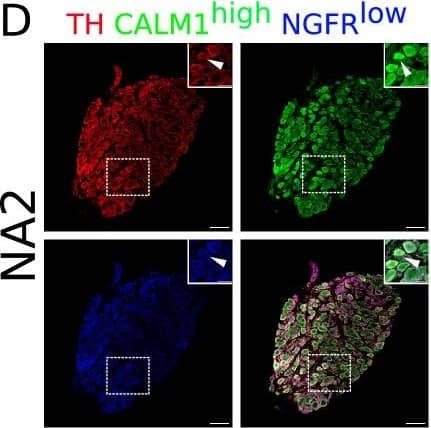
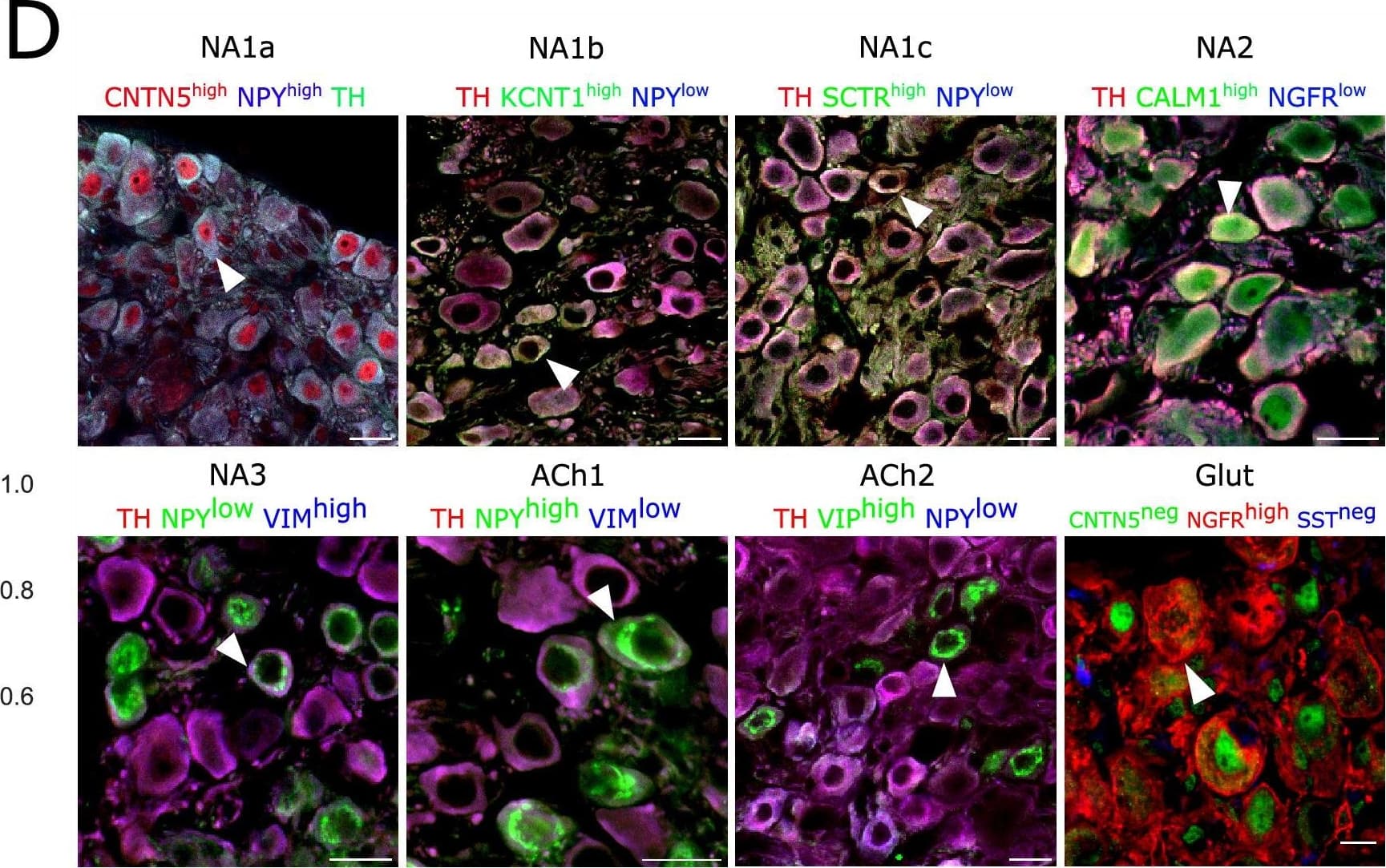
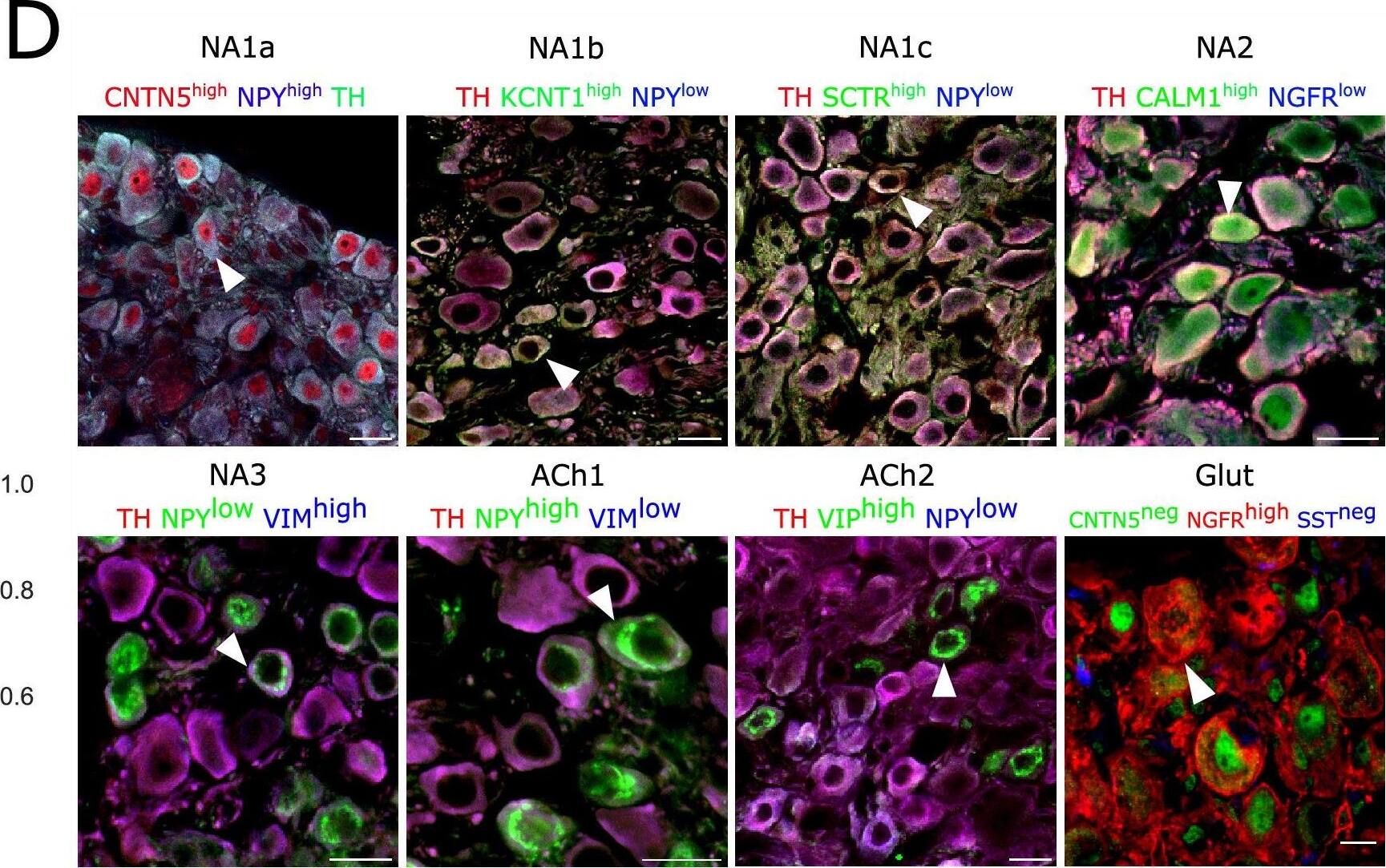
Detection of Mouse NGFR/TNFRSF16 by Immunohistochemistry
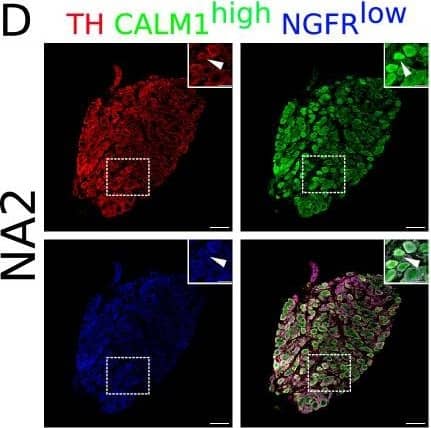
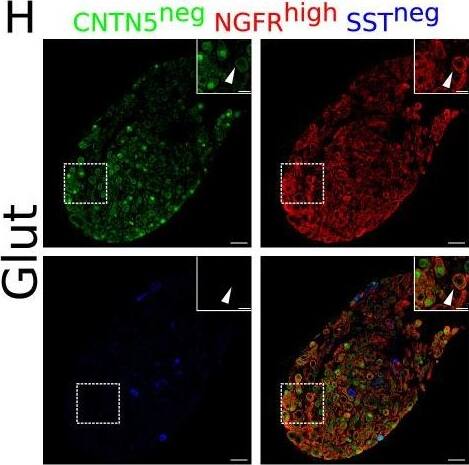
Immunohistochemistry validation of bilateral stellate ganglion neuronal subtypes identified from scRNAseq data analysis. Except NA2 and Glut, all other neuronal subtypes express either high or low Npy. NA1a, NA1b, NA1c neurons appeared numerically more compared to the NA2, NA3, ACh1, ACh2, and Glut. (A) NA1a neuronal subtypes in the stellate ganglia. NA1a neurons express high Cntn5 and Npy (Inset) and can be easily distinguished from the low Npy expressing neurons co-labeled with Cntn5high. (B) Stellate section contains neurons that stained for Kcnt1 and express either low or high Npy but the NA1b subtype can be distinguished by low Npy and high Kcnt1 expression (inset). (C) NA1c subtype similar to NA1b contains low Npy but higher Sctr labeled on the cell borders (inset). (D) NA2 neurons are differentiated from the Glut with expression of high Calm1 and low Ngfr while Glut neuronal subtype expresses low Calm1 and high Ngfr. (E) NA3 subtype can be separated from ACh1 based on low Npy and high Vimentin gene expression whereas ACh1 (F); express high Npy and low Vimentin. (G) ACh2 subtype was separated from others with low Npy and high Vip expression. (H) Gluts expressed high Ngfr expression and are negative for Cntn5 and Sst. In insets, all subtypes are marked for each group and their magnified view is shown in the upper right corner of the figure. n=6. Scale bars 50 and 20 µm. Image collected and cropped by CiteAb from the following open publication (https://pubmed.ncbi.nlm.nih.gov/37162194), licensed under a CC-BY license. Not internally tested by R&D Systems.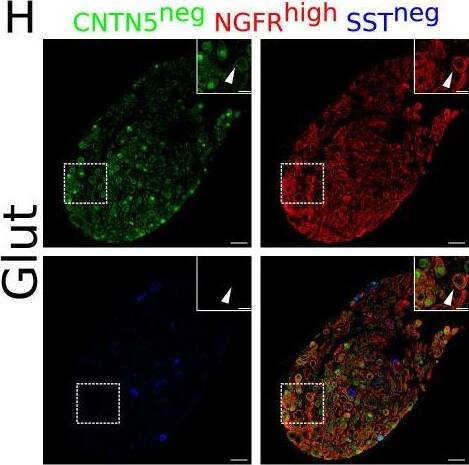
Applications for Mouse NGFR/TNFRSF16 Antibody
Application
Recommended Usage
Immunohistochemistry
5-15 µg/mL
Sample: Perfusion fixed frozen sections of mouse brain (cortex)
Sample: Perfusion fixed frozen sections of mouse brain (cortex)
Western Blot
2 µg/mL
Sample: Mouse uterus tissue
Sample: Mouse uterus tissue
Reviewed Applications
Read 6 reviews rated 4.7 using AF1157 in the following applications:
Formulation, Preparation, and Storage
Purification
Antigen Affinity-purified
Reconstitution
Reconstitute at 0.2 mg/mL in sterile PBS. For liquid material, refer to CoA for concentration.
Formulation
Lyophilized from a 0.2 μm filtered solution in PBS with Trehalose. *Small pack size (SP) is supplied either lyophilized or as a 0.2 µm filtered solution in PBS.
Shipping
Lyophilized product is shipped at ambient temperature. Liquid small pack size (-SP) is shipped with polar packs. Upon receipt, store immediately at the temperature recommended below.
Stability & Storage
Use a manual defrost freezer and avoid repeated freeze-thaw cycles.
- 12 months from date of receipt, -20 to -70 °C as supplied.
- 1 month, 2 to 8 °C under sterile conditions after reconstitution.
- 6 months, -20 to -70 °C under sterile conditions after reconstitution.
Background: NGFR/TNFRSF16
The low affinity nerve growth factor receptor (NGF R), also named p75 neurotrophin receptor, is a type I transmembrane protein that belongs to the tumor necrosis factor receptor family and has been designated TNFRSF16. NGF R cDNA encodes a 427 amino acid (aa) residue precursor protein with a 28 aa residue signal peptide, a 222 aa residue extracellular domain, a 22 aa residue transmembrane domain and a 155 aa residue intracellular domain. The extracellular region contains four cysteine-rich domains and binds NGF, BDNF, NT-3, and NT-4 approximately equally with low affinity. The cytoplasmic region of the receptor contains a subtype 2 death domain.
NGF R expression has been shown to occur widely during development and in the adult. Expression has been detected in both neuronal and non-neuronal cells. NGF R was originally reported to function as a positive regulator of TrkA activity. NGF R has also been shown to signal by itself. Depending on its cellular environment, NGF R has now been shown to regulate cell migration, gene expression and to mediate apoptosis. Recombinant NGF R Fc chimera binds NGF with high affinity and is a potent NGF antagonist. Naturally occurring truncated NGF R containing the extracellular domain and lacking the transmembrane or intracellular domain has been detected in vivo in urine, plasma, and in the amniotic fluid of humans and rats (1-3).
References
- Barker, P.A. and R.A. Murphy (1992) Molecular and Cellular Biochemistry 110:1.
- Bamji, A.X. et al. (1998) J. Cell Biol. 140:911.
- Feinstein, E. et al. (1995) Trends Biochem. Sci. 20:342.
Long Name
Nerve Growth Factor Receptor
Alternate Names
CD271, NGF R, p75 NTR, TNFRSF16
Gene Symbol
NGFR
UniProt
Additional NGFR/TNFRSF16 Products
Product Documents for Mouse NGFR/TNFRSF16 Antibody
Product Specific Notices for Mouse NGFR/TNFRSF16 Antibody
For research use only
Loading...
Loading...
Loading...
Loading...
Loading...