
Mouse GM-CSF R alpha APC-conjugated Antibody
R&D Systems, part of Bio-Techne | Catalog # FAB6130A


Conjugate
Catalog #
Key Product Details
Validated by
Biological Validation
Species Reactivity
Validated:
Mouse
Cited:
Human, Mouse
Applications
Validated:
Flow Cytometry
Cited:
Flow Cytometry
Label
Allophycocyanin (Excitation = 620-650 nm, Emission = 660-670 nm)
Antibody Source
Monoclonal Rat IgG2A Clone # 698423
Product Specifications
Immunogen
Mouse myeloma cell line NS0-derived recombinant mouse GM-CSF R alpha
Leu30-Pro327
Accession # Q00941
Leu30-Pro327
Accession # Q00941
Specificity
Detects mouse GM-CSF R alpha in direct ELISAs. In direct ELISAs, no cross-reactivity with recombinant human (rh) GM-CSF R alpha or rhGM‑CSF R beta is observed.
Clonality
Monoclonal
Host
Rat
Isotype
IgG2A
Scientific Data Images for Mouse GM-CSF R alpha APC-conjugated Antibody
Detection of GM‑CSF R alpha in J774A.1 Mouse Cell Line by Flow Cytometry.
J774A.1 mouse reticulum cell sarcoma macrophage cell line was stained with Rat Anti-Mouse GM-CSF Ra APC-conjugated Monoclonal Antibody (Catalog # FAB6130A, filled histogram) or isotype control antibody (Catalog # IC006A, open histogram). View our protocol for Staining Membrane-associated Proteins.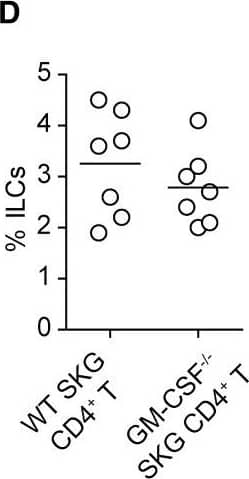
Detection of Mouse GM-CSFR alpha by Flow Cytometry
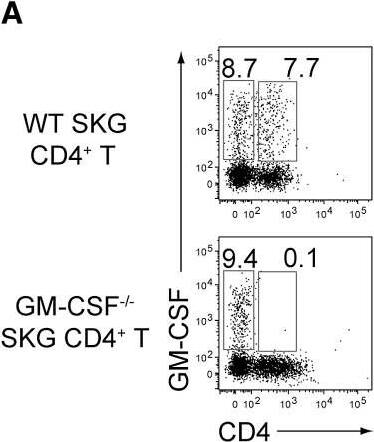
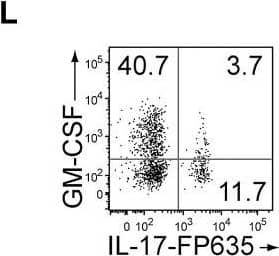
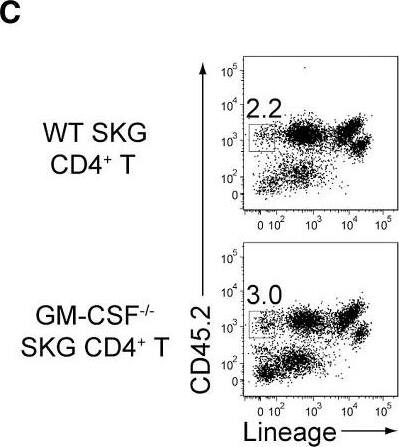
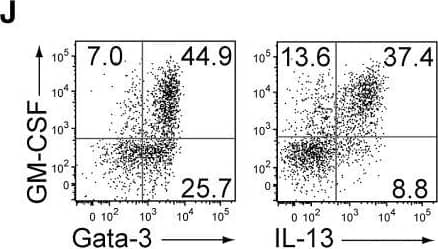
GM-CSF-Producing ILCs in Inflamed Joints(A) Flow cytometry analysis of GM-CSF expression by CD4+ T cells and CD4− cells among CD45+ joint infiltrating cells in Rag2−/− mice transferred with CD4+ T cells from WT or Csf2−/− SKG mice.(B) Quantitative RT-PCR analysis of Csf2, Il1b, and Tnf in CD11b+Ly-6G− (CD11b+), CD11b+Ly-6G+ (Ly-6G+), CD4+ T cells, and ILCs sorted from arthritic joints of mannan-treated SKG mice (n = 3). mRNA expression is presented relative to the expression of Hprt1.(C) Flow cytometry of joint infiltrating cells in Rag2−/− mice transferred with CD4+ T cells from WT or Csf2−/− SKG mice. Cells were stained for CD45.2 and lineage markers (a cocktail of CD3, CD4, CD8, CD11b, CD11c, CD19, and DX-5).(D) Proportion of ILCs in Rag2−/− mice transferred with CD4+ T cells as shown in (C). Each symbol represents an individual mouse. Horizontal bars indicate the means.(E) Total cell number of ILCs from healthy or inflamed joints of SKG mice (n = 3).(F) Flow cytometry of synovial ILCs (CD45.2+ lineage markers-negative Thy1.2+ cells as shown in C) for Ki-67 expression.(G) Flow cytometry of synovial ILCs (CD45.2+ lineage markers-negative Thy1.2+ cells as shown in C) for cell surface expression of IL-7Ra, CD25, CCR6, c-kit, IL-33Ra, CD44, and MHC2.(H) Flow cytometry of synovial ILCs (as shown in C) for intranuclear expression of the transcription factor T-bet, Gata-3, Ror gammat, and Foxp3.(I) Proportion of the transcription factor-expressing synovial ILCs (n = 3) as shown in (H).(J) Flow cytometry of synovial ILCs (as shown in C) for the expression of GM-CSF, Gata-3, and IL-13.(K) Total cell numbers of ILCs from healthy or inflamed joints of C57/BL6 (B6) mice with collagen antibody-induced arthritis (n = 3). Data are representative of two independent experiments.(L) Flow cytometry of synovial ILCs for the expression of GM-CSF and FP635 in arthritic Il17aCre R26RFP635 SKG mice.(M) Quantitative RT-PCR analysis of Csf2 and Bhlhe40 in splenic naive CD25−CD44loCD4+ T cells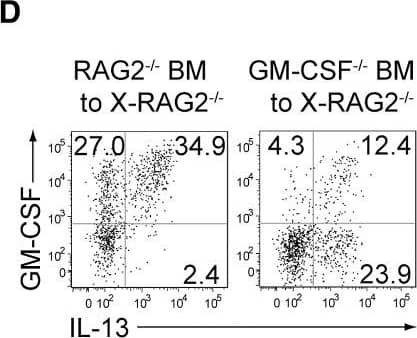
Detection of Mouse GM-CSFR alpha by Flow Cytometry
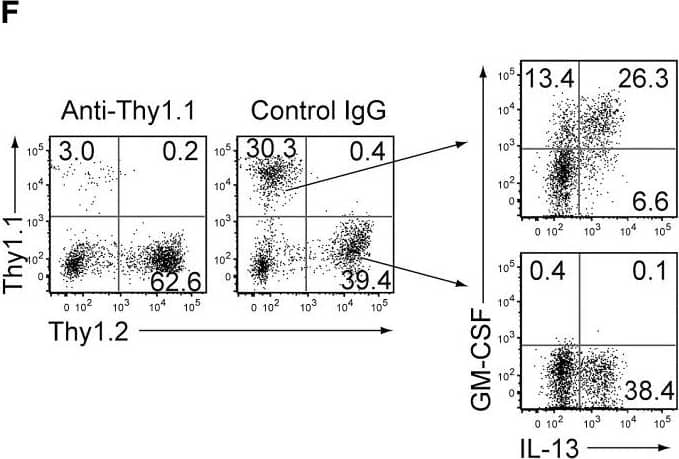
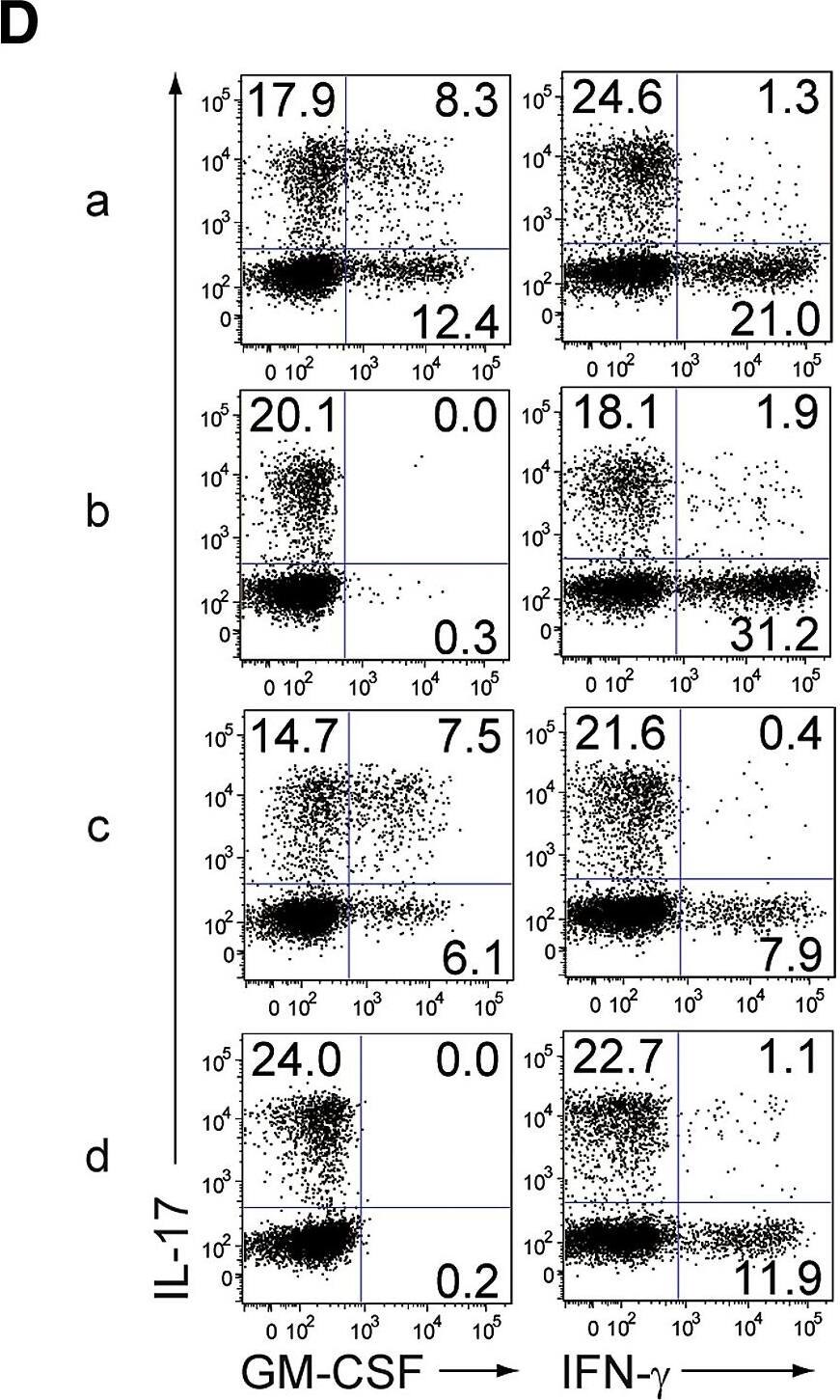
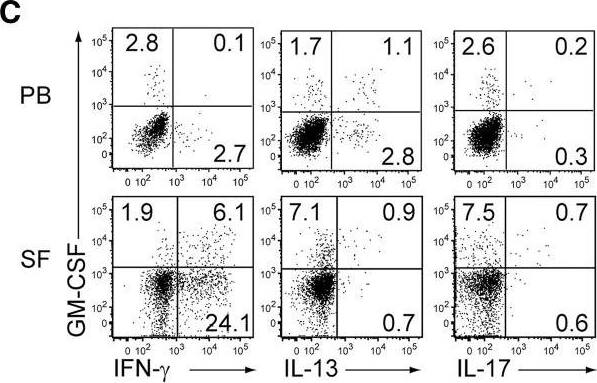
GM-CSF from ILCs and Radio-Resistant Stromal Cells Is Crucial for Autoimmune Arthritis(A) Preparation of experimental groups for assessing arthritogenic effects of GM-CSF from ILCs or radio-resistant stromal cells. Rag2−/− or Csf2−/−Rag2−/− mice were x-irradiated (X-Rag2−/− mice) and transferred with BM cells from Csf2−/− or WT Rag2−/− mice. The resulting four groups of BM chimeras were transferred with CD4+ T cells from Csf2−/− SKG mice 6 weeks after BM reconstitution and assessed for arthritis development 12 weeks later.(B) Arthritis scores of four groups of mice shown in (A).(C) Proportion of total synovial ILCs from x-irradiated Rag2−/− mice reconstituted with Csf2−/− or WT Rag2−/− BM cells.(D) Flow cytometry of synovial ILCs for the expression of GM-CSF and IL-13 in arthritic joints of BM chimeras shown in (C).(E) Proportion of GM-CSF+IL-13−, GM-CSF+IL-13+, and GM-CSF−IL-13+ synovial ILCs (n = 6 each) as shown in (D).(F and G) The effects of ILC depletion on arthritis development. Thy1.1+Rag2−/− mice were x-irradiated and transferred with BM cells from Thy1.1+Rag2−/− and Thy1.2+Csf2−/− SKG mice. The resulting BM chimeras were i.p. injected with 20 mg mannan 6 weeks later, followed by i.v. injection with 500 μg anti-Thy1.1 mAb or control Rat IgG every week. Flow cytometry of synovial ILCs for GM-CSF and IL-13 expression (F). Arthritis scores in each group of mice monitored every week (G). Vertical bars mean SD (n = 8 each).∗p < 0.05, ∗∗p < 0.01. Data are representative of three independent experiments in (D) and (F), and pooled from three experiments in (B), (C), (E), and (G). Horizontal bars indicate the means in (B), (C), and (E). Image collected and cropped by CiteAb from the following publication (https://linkinghub.elsevier.com/retrieve/pii/S1074761318301468), licensed under a CC-BY license. Not internally tested by R&D Systems.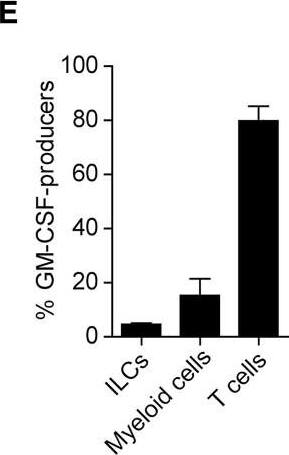
Applications for Mouse GM-CSF R alpha APC-conjugated Antibody
Application
Recommended Usage
Flow Cytometry
10 µL/106 cells
Sample: J774A.1 mouse reticulum cell sarcoma macrophage cell line
Sample: J774A.1 mouse reticulum cell sarcoma macrophage cell line
Spectra Viewer
Plan Your Experiments
Use our spectra viewer to interactively plan your experiments, assessing multiplexing options. View the excitation and emission spectra for our fluorescent dye range and other commonly used dyes.
Spectra Viewer
Formulation, Preparation, and Storage
Purification
Protein A or G purified from hybridoma culture supernatant
Formulation
Supplied in a saline solution containing BSA and Sodium Azide.
Shipping
The product is shipped with polar packs. Upon receipt, store it immediately at the temperature recommended below.
Stability & Storage
Protect from light. Do not freeze.
- 12 months from date of receipt, 2 to 8 °C as supplied.
Background: GM-CSF R alpha
Granulocyte macrophage colony stimulating factor receptor alpha (GM-CSF R alpha), also known as CD116, is a component of the receptor complex that mediates cellular responses to GM-CSF. GM-CSF promotes the differentiation and mobilization of granulocyte-macrophage, erythroid, megakaryocyte, and eosinophil progenitors. It enhances the activation of myeloid cell effector functions and plays a role in the development of Th1 biased immune responses, allergic inflammation, and autoimmunity (1-4). Mature mouse GM-CSF R alpha is an 80 kDa type I transmembrane glycoprotein that consists of a 298 amino acid (aa) extracellular domain (ECD) with two fibronectin type III domains and a juxtamembrane WSXWS motif, a 21 aa transmembrane segment, and a 40 aa cytoplasmic domain (5). Within the ECD, mouse GM-CSF R alpha shares approximately 33% and 58% aa sequence identity with human and rat GM-CSF R alpha, respectively. Soluble forms of the human receptor retain the ability to bind GM-CSF (6, 7). GM-CSF R alpha is expressed on hematopoietic stem cells, progenitor and differentiated cells in the myeloid lineage, vascular endothelial cells, placenta, and non‑hematopoietic solid tumor cells (8). GM-CSF R alpha associates with the common beta chain/CD131 ( betac), a 135 kDa transmembrane protein that is also the signal transducing component of the receptors for IL-3 and IL-5 (9, 10). Association with betac converts GM-CSF R alpha from a low affinity to a high affinity receptor for GM-CSF (9-11). The shared usage of betac underlies the synergism between GM-CSF, IL-3, and IL-5 in their effects on myeloid cell differentiation and activation (1, 2).
References
- Martinez-Moczygemba, M. and D.P. Huston (2003) J. Allergy Clin. Immunol. 112:653.
- Fleetwood, A.J. et al. (2005) Crit. Rev. Immunol. 25:405.
- Eksioglu, E.A. et al. (2007) Exp. Hematol. 35:1163.
- Cao, Y. (2007) J. Clin. Invest. 117:2362.
- Park, L.S. et al. (1992) Proc. Natl. Acad. Sci. 89:4295.
- Pelley, J.L. et al. (2007) Exp. Hematol. 35:1483.
- Raines, M.A. et al. (1991) Proc. Natl. Acad. Sci. 88:8203.
- Chiba, S. et al. (1990) Cell Regul. 1:327.
- Kitamura, T. et al. (1991) Proc. Natl. Acad. Sci. 88:5082.
- Hayashida, K. et al. (1990) Proc. Natl. Acad. Sci. 87:9655.
- Hoang, T. et al. (1993) J. Biol. Chem. 268:11881.
Long Name
Granulocyte Macrophage Growth Factor Receptor alpha
Alternate Names
CD116, CSF2R, CSF2RA, CSF2RY, GM-CSFRa, GMCSFR alpha
Gene Symbol
CSF2RA
UniProt
Additional GM-CSF R alpha Products
Product Documents for Mouse GM-CSF R alpha APC-conjugated Antibody
Product Specific Notices for Mouse GM-CSF R alpha APC-conjugated Antibody
For research use only
Loading...
Loading...
Loading...
Loading...
Loading...