
Mouse GDF-15 Antibody
R&D Systems, part of Bio-Techne | Catalog # AF6385

Scientific images may be resized, cropped, or adjusted for brightness or contrast for presentation purposes. These updates are limited to presentation and do not affect the underlying scientific interpretation of the data. Where available, additional source data may be provided upon request.
Conjugate
Catalog #
Key Product Details
Species Reactivity
Validated:
Mouse
Cited:
Mouse
Applications
Validated:
Immunohistochemistry
Cited:
Flow Cytometry, ELISA Capture
Label
Unconjugated
Antibody Source
Polyclonal Sheep IgG
Product Specifications
Immunogen
E. coli-derived recombinant mouse GDF-15
Ser189-Ala303
Accession # Q9Z0J7
Ser189-Ala303
Accession # Q9Z0J7
Specificity
Detects mouse GDF-15 in direct ELISAs.
Clonality
Polyclonal
Host
Sheep
Isotype
IgG
Scientific Data Images for Mouse GDF-15 Antibody
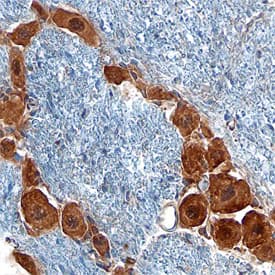
GDF‑15 in Mouse Brain.
GDF-15 was detected in perfusion fixed frozen sections of mouse brain (trigeminal ganglion) using Sheep Anti-Mouse GDF-15 Antigen Affinity-purified Polyclonal Antibody (Catalog # AF6385) at 15 µg/mL overnight at 4 °C. Tissue was stained using the Anti-Sheep HRP-DAB Cell & Tissue Staining Kit (brown; Catalog # CTS019) and counterstained with hematoxylin (blue). Specific staining was localized to neuronal cytoplasm. View our protocol for Chromogenic IHC Staining of Frozen Tissue Sections.Applications for Mouse GDF-15 Antibody
Application
Recommended Usage
Immunohistochemistry
5-15 µg/mL
Sample: Perfusion fixed frozen sections of mouse brain (trigeminal ganglion)
Sample: Perfusion fixed frozen sections of mouse brain (trigeminal ganglion)
Reviewed Applications
Read 1 review rated 5 using AF6385 in the following applications:
Formulation, Preparation, and Storage
Purification
Antigen Affinity-purified
Reconstitution
Sterile PBS to a final concentration of 0.2 mg/mL. For liquid material, refer to CoA for concentration.
Formulation
Lyophilized from a 0.2 μm filtered solution in PBS with Trehalose. *Small pack size (SP) is supplied either lyophilized or as a 0.2 µm filtered solution in PBS.
Shipping
Lyophilized product is shipped at ambient temperature. Liquid small pack size (-SP) is shipped with polar packs. Upon receipt, store immediately at the temperature recommended below.
Stability & Storage
Use a manual defrost freezer and avoid repeated freeze-thaw cycles.
- 12 months from date of receipt, -20 to -70 °C as supplied.
- 1 month, 2 to 8 °C under sterile conditions after reconstitution.
- 6 months, -20 to -70 °C under sterile conditions after reconstitution.
Background: GDF-15
GDF-15 (Growth/differentiation factor 15; also PTGF, PDF, PL-74 and NAG-1) is a 25-30 kDa homodimeric member of the TGF-beta superfamily of proteins. In rodent, GDF-15 is expressed in a diverse population of activated cell types, including hepatocytes, macrophages, Schwann cells, cardiomyocytes, osteoblasts, adipocytes, and epithelium of the small intestine and mammary gland. Functionally, GDF-15 has multiple effects, some tissue specific, including the induction of ACRP30 secretion from fat, an attenuation of the adverse effects of cardiac hypertrophy, and serving as a trophic factor for motor and sensory neurons. Mouse GDF-15 is synthesized as a 273 amino acid (aa) proprecursor that contains a cleavable 26 kDa, 158 aa glycosylated prodomain (aa 31-188) and a 12-14 kDa, 115 aa mature region (aa 189-303). In human, certain cells are noted to secrete an uncleaved 40 kDa proprecursor that, as a disulfide-linked homodimer, would run at about 80 kDa in nonreducing SDS-PAGE. Over aa 189-303, mouse GDF-15 shares 97% and 67% aa identity with rat and human GDF-15, respectively.
Long Name
Growth Differentiation Factor 15
Alternate Names
GDF15, MIC-1, NAG-1, PDF, PLAB, PTGF-beta
Gene Symbol
GDF15
UniProt
Additional GDF-15 Products
Product Documents for Mouse GDF-15 Antibody
Product Specific Notices for Mouse GDF-15 Antibody
For research use only
Loading...
Loading...
Loading...
Loading...
Loading...