
Mouse CXCL11/I-TAC Antibody
R&D Systems, part of Bio-Techne | Catalog # MAB572

Scientific images may be resized, cropped, or adjusted for brightness or contrast for presentation purposes. These updates are limited to presentation and do not affect the underlying scientific interpretation of the data. Where available, additional source data may be provided upon request.
Conjugate
Catalog #
Key Product Details
Species Reactivity
Validated:
Mouse
Cited:
Mouse
Applications
Validated:
Western Blot, Neutralization
Cited:
Immunohistochemistry, Neutralization, ELISA Capture
Label
Unconjugated
Antibody Source
Monoclonal Rat IgG2A Clone # 131327
Product Specifications
Immunogen
E. coli-derived recombinant mouse CXCL11/I-TAC
Phe22-Met100
Accession # Q9JHH5
Phe22-Met100
Accession # Q9JHH5
Specificity
Detects mouse CXCL11/I‑TAC in direct ELISAs and Western blots. In direct ELISAs, no cross-reactivity with recombinant mouse CXC1,
2, 6, 9, 10, CXCL12/SDF-1 alpha, 13, 14, recombinant
human CXCL1, 2, 3, 5, 6, 7, 8, 9, 10, 11, CXCL12/SDF-1 alpha, CXCL12/SDF-1 beta, 13, 14, 15, recombinant rat CXCL1, 2, CXCL3/CINC2 alpha, CXCL3/CINC-2 beta, 5, or recombinant porcine CXCL8 is observed.
Clonality
Monoclonal
Host
Rat
Isotype
IgG2A
Endotoxin Level
<0.10 EU per 1 μg of the antibody by the LAL method.
Scientific Data Images for Mouse CXCL11/I-TAC Antibody
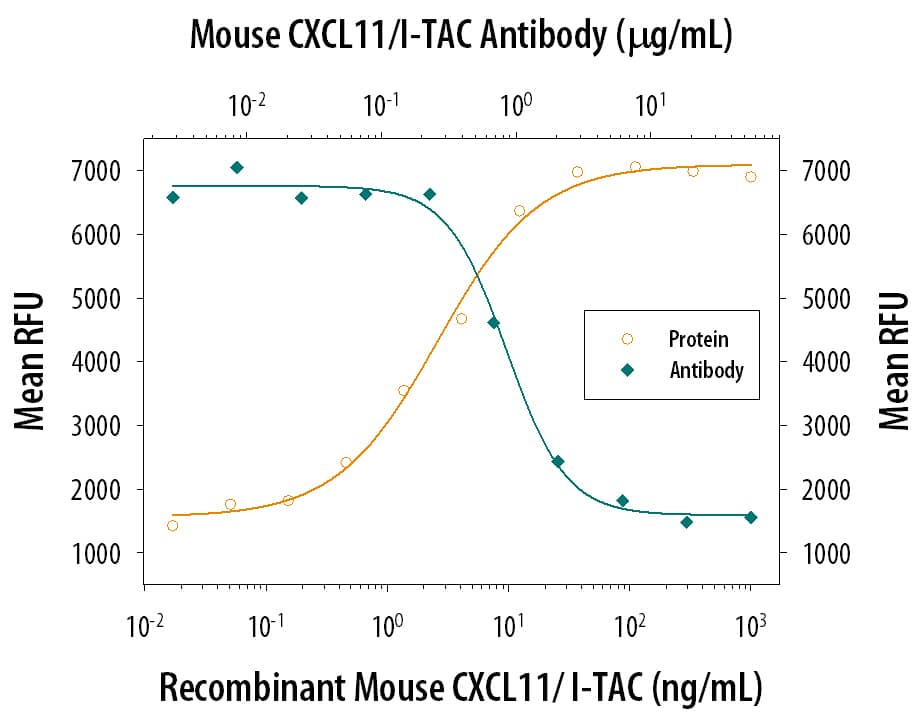
Chemotaxis Induced by CXCL11/I‑TAC and Neutral-ization by Mouse CXCL11/ I‑TAC Antibody.
Recombinant Mouse CXCL11/ I-TAC (Catalog # 572-MC) chemo-attracts the BaF3 mouse pro-B cell line transfected with human CXCR3 in a dose-dependent manner (orange line). The amount of cells that migrated through to the lower chemotaxis chamber was measured by Resazurin (Catalog # AR002). Chemotaxis elicited by Recombinant Mouse CXCL11/ I-TAC (50 ng/mL) is neutralized (green line) by increasing concentrations of Rat Anti-Mouse CXCL11/I-TAC Monoclonal Antibody (Catalog # MAB572). The ND50 is typically 0.4-2.0 µg/mL.Applications for Mouse CXCL11/I-TAC Antibody
Application
Recommended Usage
Western Blot
1 µg/mL
Sample: Recombinant Mouse CXCL11/I-TAC (Catalog # 572-MC)
Sample: Recombinant Mouse CXCL11/I-TAC (Catalog # 572-MC)
Neutralization
Measured by its ability to neutralize CXCL11/I‑TAC-induced chemotaxis in the BaF3 mouse pro‑B cell line transfected with human CXCR3. The Neutralization Dose (ND50) is typically 0.4-2.0 µg/mL in the presence of 50 ng/mL Recombinant Mouse CXCL11/I‑TAC.
Formulation, Preparation, and Storage
Purification
Protein A or G purified from hybridoma culture supernatant
Reconstitution
Reconstitute at 0.5 mg/mL in sterile PBS. For liquid material, refer to CoA for concentration.
Formulation
Lyophilized from a 0.2 μm filtered solution in PBS with Trehalose. *Small pack size (SP) is supplied either lyophilized or as a 0.2 µm filtered solution in PBS.
Shipping
Lyophilized product is shipped at ambient temperature. Liquid small pack size (-SP) is shipped with polar packs. Upon receipt, store immediately at the temperature recommended below.
Stability & Storage
Use a manual defrost freezer and avoid repeated freeze-thaw cycles.
- 12 months from date of receipt, -20 to -70 °C as supplied.
- 1 month, 2 to 8 °C under sterile conditions after reconstitution.
- 6 months, -20 to -70 °C under sterile conditions after reconstitution.
Background: CXCL11/I-TAC
CXCL11 (also known as I-TAC, SCYB9B, H174, IP-9, and beta-R1) is a member within the non-ELR CXC chemokine subgroup and has been designated CXCL11. CXCL11, together with MIG and IP-10, constitute a subset of chemokines that are ligands for CXCR3, a chemokine receptor that is primarily expressed on activated Th1 cells and NK cells. The three chemokines were also reported to act as antagonists for CCR3, a chemokine receptor that is preferentially expressed on activated Th2 cells. Mouse CXCL11 cDNA encodes a 100 amino acid (aa) precursor protein with a putative 21 aa signal peptide that is cleaved to yield a 79 aa mature protein. Mature mouse and human CXCL11 share 71% aa sequence identity. Mouse CXCL11 also shares 36% and 29% aa sequence identity with mouse IP-10 (CRG-2) and mouse MIG, respectively. The gene for mouse CXCL11 has been mapped to chromosome 5, in close proximity to the IP-10 and MIG genes. Mouse CXCL11 is induced in multiple tissues during endoxemia, with the greatest expression in lung, heart, small intestine, and kidney. The endotoxemia-induced mouse CXCL11 expression is strongly attenuated by treatment with glucocorticoid.
References
- Widney, D.P. et al. (2000) J. Immunol. 164:6322.
- Meyer, M. et al. (2000) Cytogenet. Cell Genet. 88:278.
- Loetscher, P. et al. (2001) J. Biol. Chem. Manuscript M005652200.
Alternate Names
beta-R1, H174, I-TAC, ITAC, SCYB9B
Gene Symbol
CXCL11
UniProt
Additional CXCL11/I-TAC Products
Product Documents for Mouse CXCL11/I-TAC Antibody
Product Specific Notices for Mouse CXCL11/I-TAC Antibody
For research use only
Loading...
Loading...
Loading...
Loading...
Loading...