
Mouse CCL6/C10 Antibody
R&D Systems, part of Bio-Techne | Catalog # AB-487-NA

Scientific images may be resized, cropped, or adjusted for brightness or contrast for presentation purposes. These updates are limited to presentation and do not affect the underlying scientific interpretation of the data. Where available, additional source data may be provided upon request.
Key Product Details
Species Reactivity
Mouse
Applications
Western Blot, Neutralization
Label
Unconjugated
Antibody Source
Polyclonal Goat IgG
Product Specifications
Immunogen
E. coli-derived recombinant mouse CCL6/C10
Gly22-Ala116
Accession # P27784
Gly22-Ala116
Accession # P27784
Specificity
Detects mouse CCL6/C10 in direct ELISAs and Western blots.
Clonality
Polyclonal
Host
Goat
Isotype
IgG
Endotoxin Level
<0.10 EU per 1 μg of the antibody by the LAL method.
Scientific Data Images for Mouse CCL6/C10 Antibody
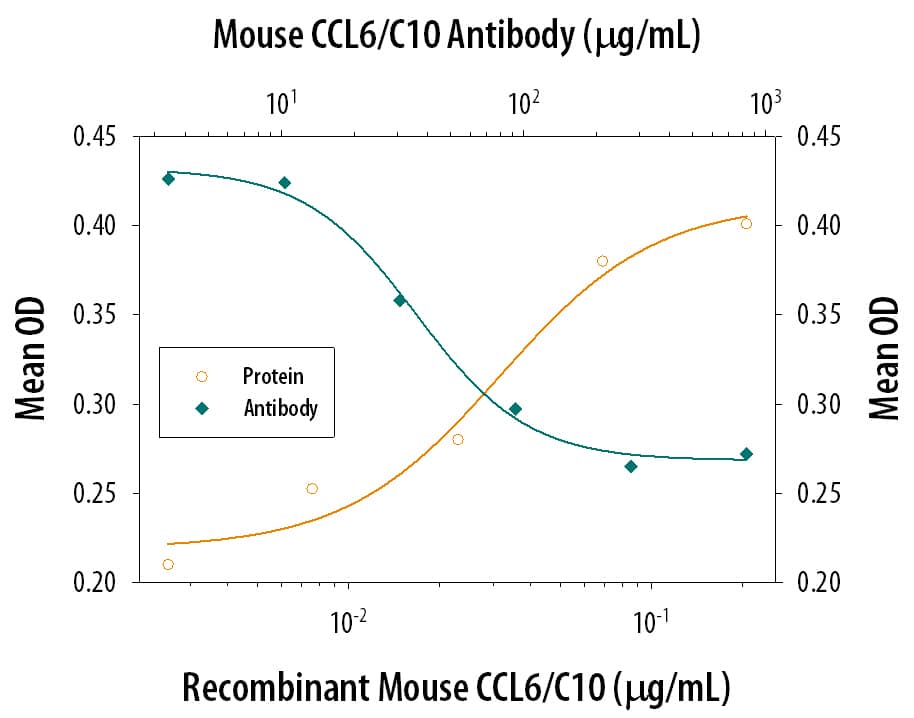
Chemotaxis Induced by CCL6/C10 and Neutralization by Mouse CCL6/C10 Antibody.
Recombinant Mouse CCL6/C10 (Catalog # 487-C) chemoattracts human monocytes in a dose-dependent manner (orange line). The amount of cells that migrated through the filter was measured by LeukoStat™ staining (Fisher Scientific) . Chemotaxis elicited by Recombinant Mouse CCL6/C10 (0.5 µg/mL) is neutralized (green line) by increasing concentrations of Goat Anti-Mouse CCL6/C10 Polyclonal Antibody (Catalog # AB-487-NA). The ND50 is typically 70-100 µg/mL.Applications for Mouse CCL6/C10 Antibody
Application
Recommended Usage
Western Blot
1 µg/mL
Sample: Recombinant Mouse CCL6/C10 (Catalog # 487-C)
Sample: Recombinant Mouse CCL6/C10 (Catalog # 487-C)
Neutralization
Measured by its ability to neutralize CCL6/C10-induced chemotaxis in human monocytes. The Neutralization Dose (ND50) is typically 70-100 µg/mL in the presence of 0.5 µg/mL Recombinant Mouse CCL6/C10.
Formulation, Preparation, and Storage
Purification
Protein A or G purified
Reconstitution
Reconstitute at 1 mg/mL in sterile PBS.
Formulation
Lyophilized from a 0.2 μm filtered solution in PBS with Trehalose.
Shipping
The product is shipped at ambient temperature. Upon receipt, store it immediately at the temperature recommended below.
Stability & Storage
Use a manual defrost freezer and avoid repeated freeze-thaw cycles.
- 12 months from date of receipt, -20 to -70 °C as supplied.
- 1 month, 2 to 8 °C under sterile conditions after reconstitution.
- 6 months, -20 to -70 °C under sterile conditions after reconstitution.
Background: CCL6/C10
Mouse CCL6, a member of the beta subfamily of chemokines, was initially identified as a transcript that is induced in bone marrow cells upon stimulation with GM-CSF. A human homologue for mouse CCL6 has not been identified. The mCCL6 cDNA encodes a 116 amino acid residue precursor protein with a hydrophobic signal peptide that is cleaved to yield a 95 amino acid residue mature protein. Compared to other chemokines, mCCL6 has a large N-terminal extension. The expression of CCL6 mRNA has been detected in mouse monocytes and neutrophils, where it is strongly induced upon GM-CSF stimulation. CCL6 expression has also been detected in an IL-2-dependent T cell line, where the expression is inhibited following T cell stimulation. Mouse CCL6 expression was also shown to be strongly induced by IL-4 in mouse macrophages. The gene for CCL6 has been mapped to mouse chromosome 11.
Alternate Names
C10, MRP-1, SCYA6
Gene Symbol
CCL6
UniProt
Additional CCL6/C10 Products
Product Documents for Mouse CCL6/C10 Antibody
Product Specific Notices for Mouse CCL6/C10 Antibody
For research use only
Loading...
Loading...
Loading...
Loading...
Loading...