
Mouse B7-H4 Biotinylated Antibody
R&D Systems, part of Bio-Techne | Catalog # BAF2154

Scientific images may be resized, cropped, or adjusted for brightness or contrast for presentation purposes. These updates are limited to presentation and do not affect the underlying scientific interpretation of the data. Where available, additional source data may be provided upon request.
Conjugate
Catalog #
Key Product Details
Species Reactivity
Validated:
Mouse
Cited:
Mouse
Applications
Validated:
Western Blot, Flow Cytometry
Cited:
Immunohistochemistry-Paraffin, Flow Cytometry
Label
Biotin
Antibody Source
Polyclonal Goat IgG
Product Specifications
Immunogen
Mouse myeloma cell line NS0-derived recombinant mouse B7-H4
Phe29-Pro258
Accession # Q7TSP5
Phe29-Pro258
Accession # Q7TSP5
Specificity
Detects mouse B7-H4 in Western blots. In Western blots, less than 1% cross-reactivity with recombinant mouse (rm) B7‑1, rmB7‑2, rmB7‑H1, rmB7‑H2, rmB7‑H3, and rmPD‑L2 is observed.
Clonality
Polyclonal
Host
Goat
Isotype
IgG
Scientific Data Images for Mouse B7-H4 Biotinylated Antibody
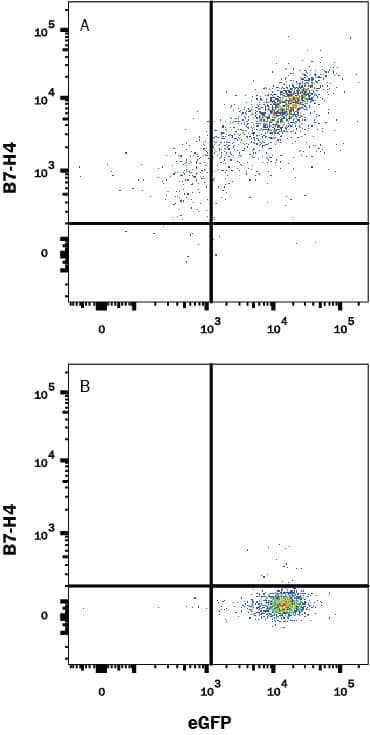
Detection of B7-H4 in HEK293 Human Cell Line Transfected with Mouse B7-H4 and eGFP by Flow Cytometry.
HEK293 human embryonic kidney cell line transfected with either (A) mouse B7-H4 or (B) irrelevant protein and eGFP was stained with Goat Anti-Human/Mouse B7-H4 Biotinylated Polyclonal Antibody (Catalog # BAF2154) followed by APC-conjugated Streptavidin (F0050). Quadrant markers were set based on Goat IgG control antibody staining (Catalog # BAF108). View our protocol for Staining Membrane-associated Proteins.Applications for Mouse B7-H4 Biotinylated Antibody
Application
Recommended Usage
Flow Cytometry
0.25 µg/106 cells
Sample: HEK293 Human Cell Line Transfected with Mouse B7-H4 and eGFP
Sample: HEK293 Human Cell Line Transfected with Mouse B7-H4 and eGFP
Western Blot
0.1 µg/mL
Sample: Recombinant Mouse B7-H4 (Catalog # 2154-B7)
Sample: Recombinant Mouse B7-H4 (Catalog # 2154-B7)
Formulation, Preparation, and Storage
Purification
Antigen Affinity-purified
Reconstitution
Reconstitute at 0.2 mg/mL in sterile PBS.
Formulation
Lyophilized from a 0.2 μm filtered solution in PBS with BSA as a carrier protein.
Shipping
The product is shipped at ambient temperature. Upon receipt, store it immediately at the temperature recommended below.
Stability & Storage
Use a manual defrost freezer and avoid repeated freeze-thaw cycles.
- 12 months from date of receipt, -20 to -70 °C as supplied.
- 1 month, 2 to 8 °C under sterile conditions after reconstitution.
- 6 months, -20 to -70 °C under sterile conditions after reconstitution.
Background: B7-H4
B7-H4, also known as B7x and B7S1, is a member of the B7 family of immune co-stimulatory proteins (1). Mature B7-H4 is a 50 kDa - 80 kDa glycosylated molecule with a 28 kDa protein core (2). Partial sensitivity to cleavage by PI-PLC suggests a possible GPI linkage of mouse B7-H4 to the cell membrane (3). The 230 amino acid (aa) extracellular region of B7-H4 contains one Ig-like V-set domain and one Ig-like C2-set domain which is followed by a hydrophobic C-terminal region (3 - 5). Within the ECD, mouse B7-H4 shares 90% and 99% aa sequence identity with human and rat B7-H4, respectively. It shares 21% - 29% aa sequence identity with B7-1, B7-2, B7-H1, B7-H2, B7-H3, and PD-L2. B7-H4 expression is induced on mitogen- or LPS-activated B cells, T cells, dendritic cells, monocytes, and macrophages (3, 4) and blocked by GM-CSF or IL-4 (6). It is also expressed on various normal epithelia and upregulated in several carcinomas and renal tubule epithelial cell lesions (2, 6 - 10). B7-H4 is expressed on the surface of macrophages but intracellularly in ovarian and breast cancer cells (2, 6 - 7). It is found in the serum and ascites fluid of cancer patients (11). B7-H4 binds an unidentified ligand on activated T cells which is distinct from BTLA, CD28, CTLA4, ICOS, and PD-1 (3 - 5, 12). Exposure to B7-H4 inhibits antigen-dependent induction of T cell proliferation and activation (3 - 5). Alternatively, B7-H4 expressing renal tubular epithelial cells promote T cell activation (8). Regulatory T cells, IL-6, and IL-10 induce B7-H4 expression on antigen presenting cells which fosters tumor growth by dampening the anti-tumor immune response (6, 13). B7-H4 also promotes the malignant transformation of epithelial cells by protecting them from apoptosis (2). Despite evidence for the involvement of B7-H4 in immune regulation, mice deficient in its expression do not show significant immune deficiencies, suggesting compensation by other molecules in vivo (14).
References
- Greenwald, R.J. et al. (2005) Annu. Rev. Immunol. 23:515.
- Salceda, S. et al. (2005) Exp. Cell Res. 306:128.
- Prasad, V.R. et al. (2003) Immunity 18:863.
- Sica, G.L. et al. (2003) Immunity 18:849.
- Zang, X. et al. (2003) Proc. Natl. Acad. Sci. 100:10388.
- Kryczek, I. et al. (2006) J. Exp. Med. 203:871.
- Tringler, B. et al. (2005) Clin. Cancer Res. 11:1842.
- Chen, Y. et al. (2006) Kidney Int. 70:2092.
- Choi, I.-H. et al. (2003) J. Immunol. 171:4650.
- Krambeck, A.E. et al. (2006) Proc. Natl. Acad. Sci. 103:10391.
- Simon, I. et al. (2006) Cancer Res. 66:1570.
- Sedy, J.R. et al. (2005) Nat. Immunol. 6:90.
- Kryczek, I. et al. (2006) J. Immunol. 177:40.
- Suh, W.-K. et al. (2006) Mol. Cell. Biol. 26:6403.
Long Name
B7 Homolog 4
Alternate Names
B7H4, B7S1, B7x, Vtcn1
Gene Symbol
VTCN1
UniProt
Additional B7-H4 Products
Product Documents for Mouse B7-H4 Biotinylated Antibody
Product Specific Notices for Mouse B7-H4 Biotinylated Antibody
For research use only
Loading...
Loading...
Loading...
Loading...
Loading...
Loading...