
MHC Class I Antibody (ER-MP42) - BSA Free
Novus Biologicals, part of Bio-Techne | Catalog # NB120-15680

Key Product Details
Species Reactivity
Validated:
Mouse
Cited:
Mouse
Applications
Validated:
Immunohistochemistry, Immunohistochemistry-Frozen, Western Blot, Flow Cytometry
Cited:
Western Blot, IF/IHC
Label
Unconjugated
Antibody Source
Monoclonal Rat IgG2A Clone # ER-MP42
Format
BSA Free
Concentration
1.0 mg/ml
Product Specifications
Immunogen
Balb/c macrophage precursor cell hybrids
Specificity
NB120-15680 recognizes a polymorphic determinant on the murine MHC (major histocompatibility complex) class I molecule. In the mouse, the MHC class I molecule is expressed on the cell surface of all nucleated cells but expression levels may differ according to cell type. Clone ER-MP42 specifically recognizes mouse strains with the haplotypes H-2Kv, H-2Dd and H-2k,q,s. Mouse strains with the haplotypes H-2p,r,w7,w22 show weak reactivity with this antibody.
Clonality
Monoclonal
Host
Rat
Isotype
IgG2A
Scientific Data Images for MHC Class I Antibody (ER-MP42) - BSA Free
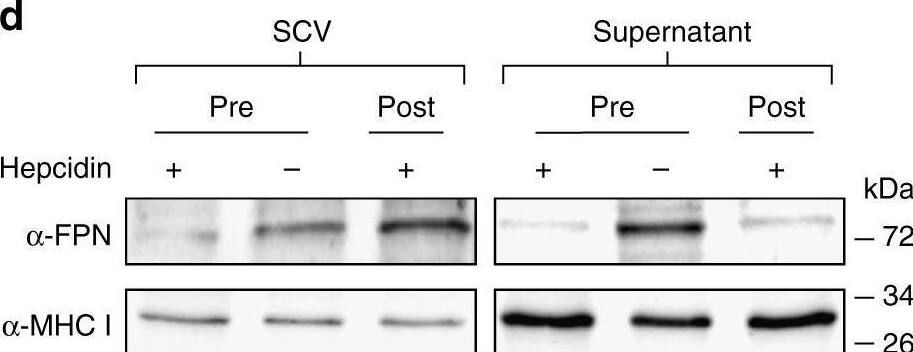
Western Blot: MHC Class I Antibody (ER-MP42) - BSA Free [NB120-15680] -
The presence of FPN in the SCV of Raw264.7 cells. a Raw264.7 cells pretreated with FeSO4 (0.1 mM) and/or hepcidin (1 μg/ml) for 3 h were infected with Salmonella (MOI, 100) and examined by confocal microscopy. Enlarged images of merge panels are shown in Supplementary Fig. 17. b The cells pretreated with PBS or hepcidin were infected with magnetized Salmonella (MOI, 100) for 2 h, and then SCV were isolated and Salmonella were analyzed by confocal microscopy. Staining for FPN is shown in green, and Salmonella in red. The isolated SCV were visualized by differential interphase contrast (DIC) imaging (scale bar 10 μm). Images are representatives of over 500 isolated SCVs per group from at least three independent experiments. c Raw264.7 cells pretreated with hepcidin were infected with magnetized Salmonella. FPN, Rab5, and annexin V in the SCV and the non-SCV fraction (supernatant) were examined by western blotting using specific antibodies. d Alternatively, Raw264.7 cells infected with Salmonella were treated with hepcidin for 2 h post infection and analyzed as in c Image collected and cropped by CiteAb from the following open publication (https://pubmed.ncbi.nlm.nih.gov/29844422), licensed under a CC-BY license. Not internally tested by Novus Biologicals.Applications for MHC Class I Antibody (ER-MP42) - BSA Free
Application
Recommended Usage
Flow Cytometry
1:100-1:200
Immunohistochemistry
1:10-1:500
Immunohistochemistry-Frozen
1:10-1:500
Application Notes
Flow Cytometry: Use 10ul of the suggested working dilution to label 106 cells in 100ul. Use in Western blot reported in scientific literature (PMID: 29844422).
Formulation, Preparation, and Storage
Purification
Protein G purified
Formulation
PBS
Format
BSA Free
Preservative
0.09% Sodium Azide
Concentration
1.0 mg/ml
Shipping
The product is shipped with polar packs. Upon receipt, store it immediately at the temperature recommended below.
Stability & Storage
Store at 4C short term. Aliquot and store at -20C long term. Avoid freeze-thaw cycles.
Background: MHC Class I
Alternate Names
DKFZp686P19218, EA1.2, EA2.1, HLA class I histocompatibility antigen, alpha chain E, HLA class I histocompatibility antigen, E alpha chain, HLA-6.2, HLAE, lymphocyte antigen, major histocompatibility complex, class I, E, MHC, MHC class I antigen E, MHC HLA-E alpha-1, MHC HLA-E alpha-2.1, QA1
Gene Symbol
HLA-E
Additional MHC Class I Products
Product Documents for MHC Class I Antibody (ER-MP42) - BSA Free
Product Specific Notices for MHC Class I Antibody (ER-MP42) - BSA Free
This product is for research use only and is not approved for use in humans or in clinical diagnosis. Primary Antibodies are guaranteed for 1 year from date of receipt.
Loading...
Loading...
Loading...
Loading...
Loading...