
Human ULBP-3 PE-conjugated Antibody Best Seller
R&D Systems, part of Bio-Techne | Catalog # FAB1517P

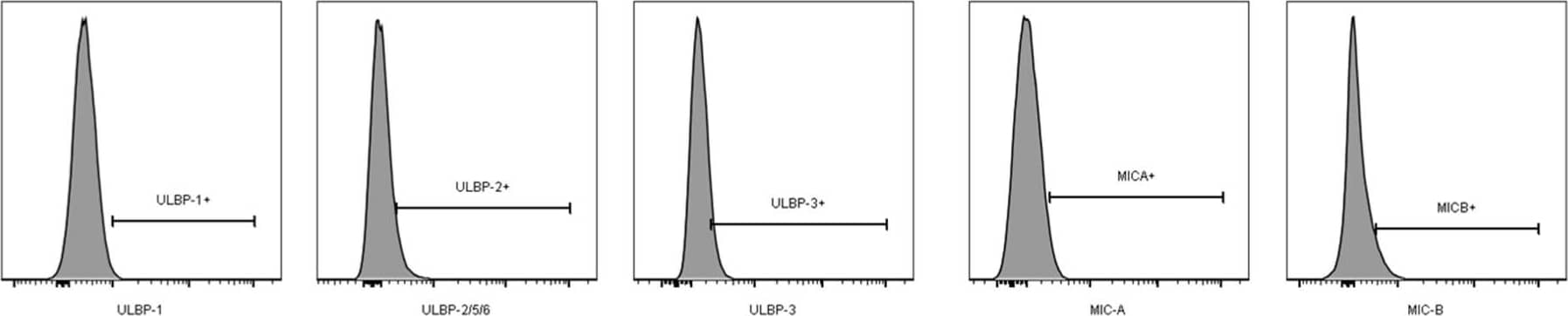
Scientific images may be resized, cropped, or adjusted for brightness or contrast for presentation purposes. These updates are limited to presentation and do not affect the underlying scientific interpretation of the data. Where available, additional source data may be provided upon request.
Conjugate
Catalog #
Key Product Details
Species Reactivity
Validated:
Human
Cited:
Human
Applications
Validated:
Flow Cytometry
Cited:
Flow Cytometry, FACS
Label
Phycoerythrin (Excitation = 488 nm, Emission = 565-605 nm)
Antibody Source
Monoclonal Mouse IgG2A Clone # 166510
Product Specifications
Immunogen
BaF3 mouse pro-B cell line transfected with human ULBP-3
Specificity
Detects human ULBP-3 in ELISAs. Does not cross-react with recombinant human (rh) ULBP-1 or rhULBP-2.
Clonality
Monoclonal
Host
Mouse
Isotype
IgG2A
Scientific Data Images for Human ULBP-3 PE-conjugated Antibody
Detection of ULBP‑3 in PC-3 Human Cell Line by Flow Cytometry.
PC-3 human prostate carcinoma cell line was stained with Mouse Anti-Human ULBP-3 PE-conjugated Monoclonal Antibody (Catalog # FAB1517P, filled histogram) or isotype control antibody (IC003P, open histogram). View our protocol for Staining Membrane-associated Proteins.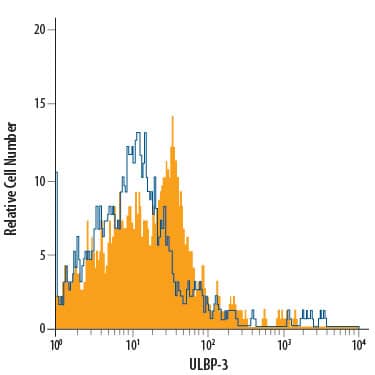
Detection of ULBP-3 in Human monocyte-derived dendritic cells by Flow Cytometry.
Human monocyte-derived dendritic cells were stained with Mouse Anti-Human ULBP-3 PE-conjugated Monoclonal Antibody (Catalog # FAB1517P, filled histogram) or isotype control antibody (Catalog # IC003P, open histogram). View our protocol for Staining Membrane-associated Proteins.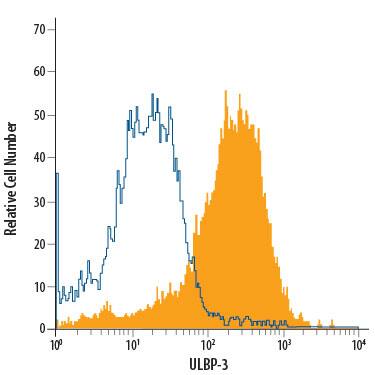
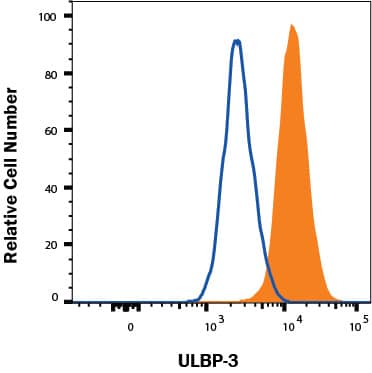
Detection of ULBP‑3 in BaF3 Mouse Cell Line Transfected with Human ULBP-3 by Flow Cytometry.
BaF3 mouse pro-B cell line transfected with human ULBP-3 was stained with Mouse Anti-Human ULBP-3 PE-conjugated Monoclonal Antibody (Catalog # FAB1517P, filled histogram) or isotype control antibody (IC003P, open histogram). View our protocol for Staining Membrane-associated Proteins.Applications for Human ULBP-3 PE-conjugated Antibody
Application
Recommended Usage
Flow Cytometry
10 µL/106 cells
Sample: Human PC-3 prostate carcinoma cell line, monocyte-derived dendritic cells and BaF3 mouse pro-B cell line transfected with human ULBP-3
Sample: Human PC-3 prostate carcinoma cell line, monocyte-derived dendritic cells and BaF3 mouse pro-B cell line transfected with human ULBP-3
Spectra Viewer
Plan Your Experiments
Use our spectra viewer to interactively plan your experiments, assessing multiplexing options. View the excitation and emission spectra for our fluorescent dye range and other commonly used dyes.
Spectra Viewer
Formulation, Preparation, and Storage
Purification
Protein A or G purified from hybridoma culture supernatant
Formulation
Supplied in a saline solution containing BSA and Sodium Azide.
Shipping
The product is shipped with polar packs. Upon receipt, store it immediately at the temperature recommended below.
Stability & Storage
Protect from light. Do not freeze.
- 12 months from date of receipt, 2 to 8 °C as supplied.
Background: ULBP-3
ULBP-3 is a member of a family of cell-surface proteins that function as ligands for human NKG2D. ULBP-3 has also been described under the names RaeT1N (retinoic acid early transcript), NKG2DL3, and ALCAN-gamma. The name ULBP-3 derives from the original identification of three proteins, ULBP-1, -2, and -3, as ligands for the human cytomegalovirus glycoprotein UL16; they were designated UL16 binding proteins (ULBP). The gene for ULBP-3 resides in a cluster of ten related genes, six of which encode potentially functional glycoproteins. Amino acid sequence identity within this family ranges from 30‑60%. These proteins are distantly related to MHC class I proteins, but they possess only the alpha1 and alpha2 Ig-like domains, and they have no capacity to bind peptide or interact with beta2‑microglobulin. Some family members, including ULBP-3, are anchored to the membrane via a GPI-linkage, whereas others have transmembrane domains. ULBP-3 and several other family members are known to bind to human NKG2D, an activating receptor expressed on NK cells, NKT cells, gamma delta T cells, and CD8+ alpha beta T cells. Engagement of NKG2D results in the activation of cytolytic activity and/or cytokine production by these effector cells. The ULBPs are expressed on some tumor cells and have been implicated in tumor surveillance (1‑7).
References
- Cosman, D. et al. (2001) Immunity 14:123.
- Kubin, M. et al. (2001) Eur. J. Immunol. 31:1428.
- Sutherland, C. et al. (2002) J. Immunol. 168:671.
- Steinle, A. et al. (2001) Immunogenetics 53:279.
- Sutherland, C. et al. (2001) Immunol. Rev. 181:185.
- Pende, D. et al. (2002) Cancer Res. 62:6178.
- Radosavljevic, M. et al. (2002) Genomics 79:114.
- NKG2D and its Ligands (2002) http://www.RnDSystems.com/.
Long Name
UL16 Binding Protein-3
Alternate Names
ULBP3
Entrez Gene IDs
79465 (Human)
Gene Symbol
ULBP3
Additional ULBP-3 Products
Product Documents for Human ULBP-3 PE-conjugated Antibody
Product Specific Notices for Human ULBP-3 PE-conjugated Antibody
For research use only
Loading...
Loading...
Loading...
Loading...
Loading...