
Human Pro-EGF Antibody
R&D Systems, part of Bio-Techne | Catalog # AF4289

Conjugate
Catalog #
Key Product Details
Species Reactivity
Validated:
Human
Cited:
Human
Applications
Validated:
Western Blot
Cited:
Western Blot, Immunodepletion
Label
Unconjugated
Antibody Source
Polyclonal Goat IgG
Product Specifications
Immunogen
Mouse myeloma cell line NS0-derived recombinant human Pro-EGF
Ser21-Arg1023
Accession # CAA28240
Ser21-Arg1023
Accession # CAA28240
Specificity
Detects human Pro-EGF in direct ELISAs and Western blots. In direct ELISAs, approximately 5% cross-reactivity with recombinant mouse Pro-EGF is observed and less than 1% cross-reactivity with mature recombinant human EGF is observed.
Clonality
Polyclonal
Host
Goat
Isotype
IgG
Scientific Data Images for Human Pro-EGF Antibody
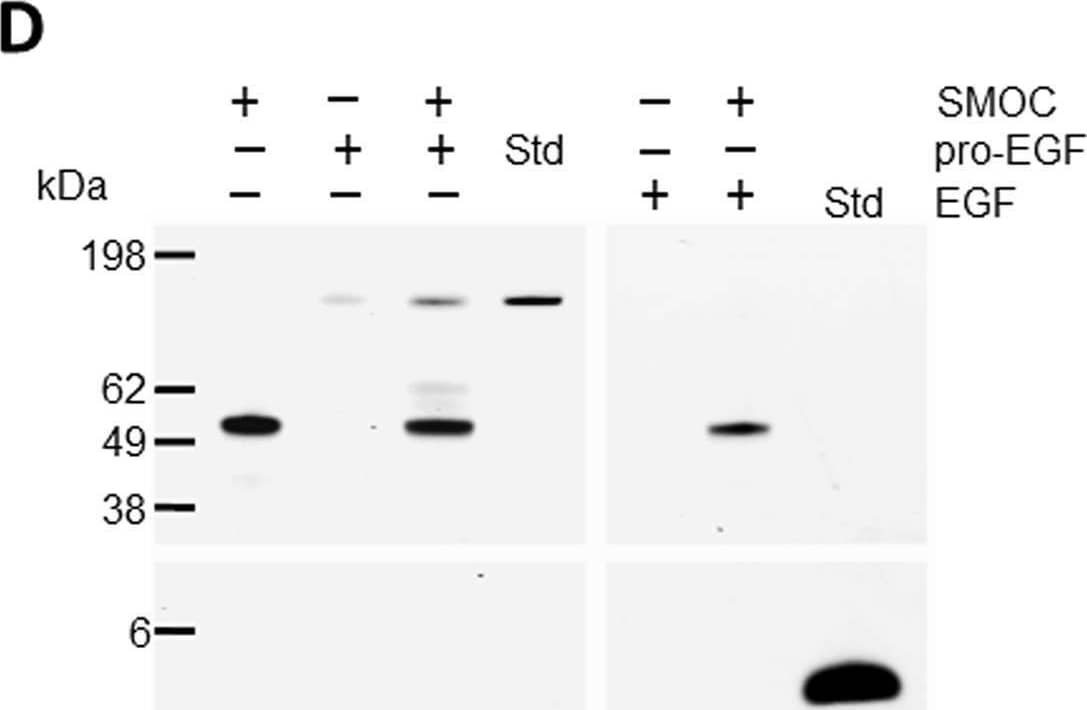
Detection of Pro-EGF by Western Blot
XSMOC-1 does not potentiate MAPK signaling by pro-EGF, but can bind to pro-EGF when bound to heparin sepharose.(A) Immunoblot of 32D/EGFR cell lysates showing Erk phosphorylation (dpErk) following a six minute exposure to a dilution series (0–500ng/ml) of pro-EGF. Total Erk is shown as loading control. (B) Graph showing relative dpErk fluorescence obtained on immunoblots from triplicate experiments of 32D/EGFR cells following a six minute exposure to submaximal concentrations of pro-EGF (2ng or 5ng/ml) in the presence or absence of XSMOC-1 (100μg/ml).The level of dpErk by pro-EGF was not significantly affected by XSMOC-1. (C) Coomassie-stained SDS-PAGE showing the heparin sepharose (HS) elution profile of pro-EGF in the presence of increasing concentrations of NaCl (D) Coomasie-stained SDS-PAGE showing HS elution profiles (±) following incubation of 5μg XSMOC-1 with 5μg of either pro-EGF or EGF in PBS/500mM NaCl, compared to each protein alone. A standard (std) lane is provided for pro-EGF and EGF to demonstrate their expected migration position. Image collected and cropped by CiteAb from the following open publication (https://pubmed.ncbi.nlm.nih.gov/27101391), licensed under a CC0-1.0 license. Not internally tested by R&D Systems.Applications for Human Pro-EGF Antibody
Application
Recommended Usage
Western Blot
0.1 µg/mL
Sample: Recombinant Human Pro EGF aa 21-1023 (Catalog # 4289-EG)
Sample: Recombinant Human Pro EGF aa 21-1023 (Catalog # 4289-EG)
Formulation, Preparation, and Storage
Purification
Antigen Affinity-purified
Reconstitution
Reconstitute at 0.2 mg/mL in sterile PBS. For liquid material, refer to CoA for concentration.
Formulation
Lyophilized from a 0.2 μm filtered solution in PBS with Trehalose. *Small pack size (SP) is supplied either lyophilized or as a 0.2 µm filtered solution in PBS.
Shipping
Lyophilized product is shipped at ambient temperature. Liquid small pack size (-SP) is shipped with polar packs. Upon receipt, store immediately at the temperature recommended below.
Stability & Storage
Use a manual defrost freezer and avoid repeated freeze-thaw cycles.
- 12 months from date of receipt, -20 to -70 °C as supplied.
- 1 month, 2 to 8 °C under sterile conditions after reconstitution.
- 6 months, -20 to -70 °C under sterile conditions after reconstitution.
Background: EGF
References
- Harris, R.C. et al. (2003) Exp. Cell Res. 284:2.
- Carpenter, G. and Cohen, S. (1990) J. Biol. Chem. 265:7709.
- Bell, G.I. et al. (1986) Nucl. Acids Res. 14:8427.
- Carpenter, G. and Zendegui, J.G. (1986) Exp. Cell Res. 164:1.
- Jorissen, R.N. et al. (2003) Exp. Cell Res. 284:31.
- Gamett, D.C. et al. (1997) J. Biol. Chem. 272:12052.
- Qian, X. et al. (1994) Proc. Natl. Acad. Sci. 91:1500.
- Qian, X. et al. (1999) J. Biol. Chem. 274:574.
Long Name
Epidermal Growth Factor
Alternate Names
HOMG4, URG, Urogastrone
Gene Symbol
EGF
UniProt
Additional EGF Products
Product Documents for Human Pro-EGF Antibody
Product Specific Notices for Human Pro-EGF Antibody
For research use only
Loading...
Loading...
Loading...
Loading...
Loading...