
Human/Mouse SSEA-3 Antibody
R&D Systems, part of Bio-Techne | Catalog # MAB1434

Scientific images may be resized, cropped, or adjusted for brightness or contrast for presentation purposes. These updates are limited to presentation and do not affect the underlying scientific interpretation of the data. Where available, additional source data may be provided upon request.
Conjugate
Catalog #
Key Product Details
Species Reactivity
Validated:
Human, Mouse
Cited:
Human, Mouse, Canine, Equine
Applications
Validated:
Flow Cytometry, Immunocytochemistry, CyTOF-ready
Cited:
Immunohistochemistry, Flow Cytometry, Immunocytochemistry
Label
Unconjugated
Antibody Source
Monoclonal Rat IgM Clone # MC-631
Product Specifications
Immunogen
Four to eight cell stage mouse embryos
Specificity
Recognizes a carbohydrate epitope of SSEA-3 (4, 5).
Clonality
Monoclonal
Host
Rat
Isotype
IgM
Scientific Data Images for Human/Mouse SSEA-3 Antibody
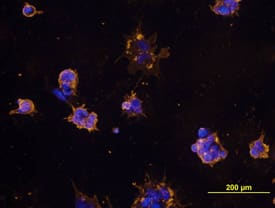
SSEA‑3 in BG01V Human Stem Cells.
SSEA-3 was detected in immersion fixed non-permeabilized BG01V human embryonic stem cells using Human/Mouse SSEA-3 Monoclonal Antibody (Catalog # MAB1434) at 10 µg/mL for 3 hours at room temperature. Cells were stained using the NorthernLights™ 557-conjugated Anti-Rat IgG Secondary Antibody (yellow; Catalog # NL013) and counterstained with DAPI (blue). View our protocol for Fluorescent ICC Staining of Cells on Coverslips.
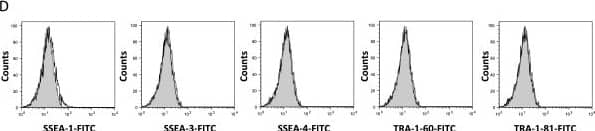
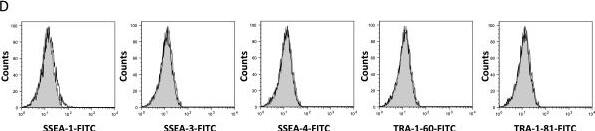
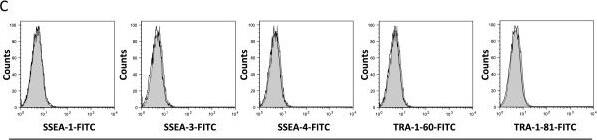
Detection of Canine SSEA-3 by Flow Cytometry
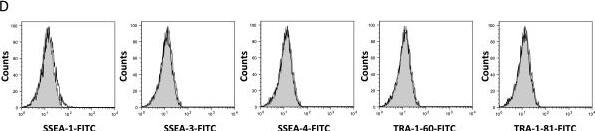
Flow cytometry. Comparison of cell surface proteins CD29, CD44, CD90, CD34, CD45, SSEA-1, SSEA-3, SSEA-4, TRA-1-60, and TRA-1-81 on primary cultures of BM-MSCs (A, C) and AT-MSCs (B, D). Solid histograms show nonspecific staining and open histograms show specific staining for the indicated marker. Three different donor MSC populations from each tissue type were analyzed and representative samples are shown. Image collected and cropped by CiteAb from the following publication (https://bmcvetres.biomedcentral.com/articles/10.1186/1746-6148-8-150), licensed under a CC-BY license. Not internally tested by R&D Systems.
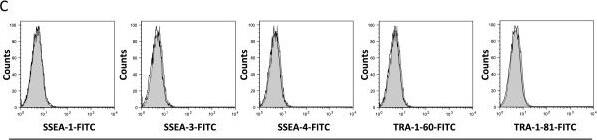
Detection of Canine SSEA-3 by Flow Cytometry
Flow cytometry. Comparison of cell surface proteins CD29, CD44, CD90, CD34, CD45, SSEA-1, SSEA-3, SSEA-4, TRA-1-60, and TRA-1-81 on primary cultures of BM-MSCs (A, C) and AT-MSCs (B, D). Solid histograms show nonspecific staining and open histograms show specific staining for the indicated marker. Three different donor MSC populations from each tissue type were analyzed and representative samples are shown. Image collected and cropped by CiteAb from the following publication (https://bmcvetres.biomedcentral.com/articles/10.1186/1746-6148-8-150), licensed under a CC-BY license. Not internally tested by R&D Systems.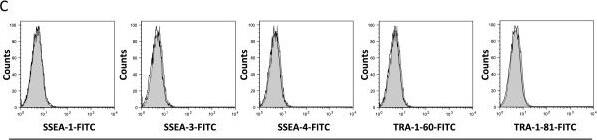
Applications for Human/Mouse SSEA-3 Antibody
Application
Recommended Usage
CyTOF-ready
Ready to be labeled using established conjugation methods. No BSA or other carrier proteins that could interfere with conjugation.
Flow Cytometry
2.5 µg/106 cells
Sample: D3 mouse embryonic stem cell line
Sample: D3 mouse embryonic stem cell line
Immunocytochemistry
8-25 µg/mL
Sample: Immersion fixed non-permeabilized BG01V human embryonic stem cells
Sample: Immersion fixed non-permeabilized BG01V human embryonic stem cells
Reviewed Applications
Read 6 reviews rated 4 using MAB1434 in the following applications:
Formulation, Preparation, and Storage
Purification
IgM-specific Affinity-purified from hybridoma culture supernatant
Reconstitution
Reconstitute at 0.5 mg/mL in sterile PBS. For liquid material, refer to CoA for concentration.
Formulation
Lyophilized from a 0.2 μm filtered solution in PBS with Trehalose. *Small pack size (SP) is supplied either lyophilized or as a 0.2 µm filtered solution in PBS.
Shipping
Lyophilized product is shipped at ambient temperature. Liquid small pack size (-SP) is shipped with polar packs. Upon receipt, store immediately at the temperature recommended below.
Stability & Storage
Use a manual defrost freezer and avoid repeated freeze-thaw cycles.
- 12 months from date of receipt, -20 to -70 °C as supplied.
- 1 month, 2 to 8 °C under sterile conditions after reconstitution.
- 6 months, -20 to -70 °C under sterile conditions after reconstitution.
Background: SSEA-3
SSEA-3, also known as glycolipid GB5, is expressed on the surface of human teratocarcinoma stem cells (EC), human embryonic germ cells (EG), and human embryonic stem cells (ES) (1). Expression of SSEA-3 is down regulated following differentiation of human EC cells. In contrast, the differentiation of murine EC and ES cells may be accompanied by an increase in SSEA-3 expression (2, 3).
References
-
Zhou, D. et al. (2000) J. Biol. Chem. 275:22631.
-
Thomson, J.A. and J.S. Odorico (2000) Trends Biotechnol. 18:53.
-
Draper, J.S. et al. (2002) J. Anat. 200:249.
-
Shevinsky, L.H. et al. (1982) Cell 30:697.
- Kannagi, R. et al. (1983) EMBO J. 2:2355.
Long Name
Stage-specific Embryonic Antigen-3
Alternate Names
SSEA3
Additional SSEA-3 Products
Product Documents for Human/Mouse SSEA-3 Antibody
Product Specific Notices for Human/Mouse SSEA-3 Antibody
For research use only
Loading...
Loading...
Loading...
Loading...
Loading...
Loading...