
Human LPAR1/LPA1/EDG-2 Antibody
R&D Systems, part of Bio-Techne | Catalog # AF9963

Conjugate
Catalog #
Key Product Details
Species Reactivity
Validated:
Human
Cited:
Human, Mouse
Applications
Validated:
Western Blot
Cited:
Immunohistochemistry, Western Blot
Label
Unconjugated
Antibody Source
Polyclonal Goat IgG
Product Specifications
Immunogen
E. coli-derived recombinant human LPAR-1 CD33 protein
containing the sequences for the four extracellular domains, amino acids (aa) 1-50, aa112-125,
aa190-205 and aa281-294
Accession # Q92633
Accession # Q92633
Specificity
Detects human LPAR-1/LPA
Clonality
Polyclonal
Host
Goat
Isotype
IgG
Scientific Data Images for Human LPAR1/LPA1/EDG-2 Antibody
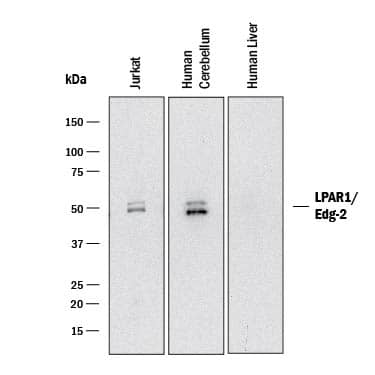
Detection of Human LPAR1/LPA1/EDG-2 by Western Blot.
Western blot shows lysates of Jurkat human acute T cell leukemia cell line, human brain (cerebellum) tissue, and human liver tissue (negative control). PVDF membrane was probed with 2 µg/mL of Goat Anti-Human LPAR1/LPA1/EDG-2 Antigen Affinity-purified Polyclonal Antibody (Catalog # AF9963) followed by HRP-conjugated Anti-Goat IgG Secondary Antibody (Catalog # HAF017). Specific bands were detected for LPAR1/LPA1/EDG-2 at approximately 48-51 kDa (as indicated). This experiment was conducted under reducing conditions and using Immunoblot Buffer Group 1.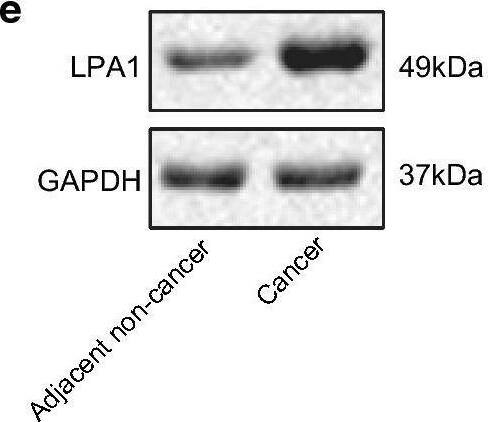
Detection of LPAR1/LPA1/EDG-2 by Western Blot
miR-367 downregulates LPA1 expression. a Bioinformatics prediction of binding sites for miR-367 and LPA1. b Luminescence activity of LPA1 by dual luciferase reporter gene assay. c RIP assay detection of the binding of miR-367 and LPA1 to Ago2. d Detection of relative expression of LPA1 in cancer tissues and adjacent normal tissues by RT-qPCR. e Analysis of protein level of LPA1 in cancer and adjacent normal tissues by western blot analysis. f Statistical expression of protein level of LPA1. g Correlation analysis between miR-367 and LPA1. h RT-qPCR results of the relative expression level of LPA1 in each group of cells. i Western blot analysis of LPA1 protein levels in each group of cells. j Statistical protein expression level of LPA1. Measurement data were expressed as mean ± standard deviation. Data in compliance with normal distribution and homogeneity between two groups were compared using t test. Comparisons among multiple groups were conducted by one-way ANOVA followed by Tukey’s post hoc test. *p < 0.05 vs. normal tissues or cells; #p < 0.05 vs. Inhibitor NC The experiment was repeated three times independently Image collected and cropped by CiteAb from the following open publication (https://pubmed.ncbi.nlm.nih.gov/33024414), licensed under a CC-BY license. Not internally tested by R&D Systems.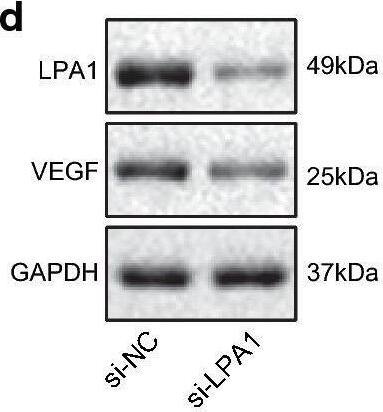
Detection of LPAR1/LPA1/EDG-2 by Western Blot
Low expression of LPA1 inhibits tumorigenic ability of ovarian cancer in nude mice. a Volume of mice tumor. b Weight of mice tumor. c RT-qPCR detection results of mRNA levels of related factors in tumor tissues. d Western blot analysis of the protein levels of related factors in tumor tissues. e Statistical graph of protein levels of related factors. f Immunohistochemistry for detecting CD34 expression (200×). Measurement data were expressed as mean ± standard deviation. Data in compliance with normal distribution and homogeneity between two groups were compared using t test. Comparisons among multiple groups were conducted by one-way ANOVA followed by Tukey’s post hoc test. Statistics of tumor volume at different time points was analyzed using repeated measures ANOVA. *p < 0.05 vs. normal tissues or cells. The experiment was repeated three times independently Image collected and cropped by CiteAb from the following open publication (https://pubmed.ncbi.nlm.nih.gov/33024414), licensed under a CC-BY license. Not internally tested by R&D Systems.Applications for Human LPAR1/LPA1/EDG-2 Antibody
Application
Recommended Usage
Western Blot
2 µg/mL
Sample: Jurkat human acute T cell leukemia cell line and Human brain (cerebellum) tissue
Sample: Jurkat human acute T cell leukemia cell line and Human brain (cerebellum) tissue
Formulation, Preparation, and Storage
Purification
Antigen Affinity-purified
Reconstitution
Reconstitute at 0.5 mg/mL in sterile PBS. For liquid material, refer to CoA for concentration.
Formulation
Lyophilized from a 0.2 μm filtered solution in PBS with Trehalose. *Small pack size (SP) is supplied either lyophilized or as a 0.2 µm filtered solution in PBS.
Shipping
Lyophilized product is shipped at ambient temperature. Liquid small pack size (-SP) is shipped with polar packs. Upon receipt, store immediately at the temperature recommended below.
Stability & Storage
Use a manual defrost freezer and avoid repeated freeze-thaw cycles.
- 12 months from date of receipt, -20 to -70 °C as supplied.
- 1 month, 2 to 8 °C under sterile conditions after reconstitution.
- 6 months, -20 to -70 °C under sterile conditions after reconstitution.
Background: LPAR1/LPA1/EDG-2
Lysophosphatidic acid receptor 1, LPAR1, also known as EDG-2, is a G protein-coupled receptor that binds the lipid signaling molecule lysophosphatidic acid (LPA). EDG molecules are G protein-coupled receptors that bind plasma lysophospholipids. The EDG family consists of two subfamilies; the S1P (sphingosine-1-phosphate) subfamily consisting of EDG-1, 3, 5, 6, and 8, and the LPA subfamily that contains EDG-2, 4 and 7. The S1P family regulates essential cellular processes such as proliferation, migration, cytoskeletal organization, and differentiation.
Long Name
Lysophosphatidic Acid Receptor 1
Alternate Names
EDG2, GPCR26, GPR26, LPA1, rec.1.3, vzg-1
Gene Symbol
LPAR1
UniProt
Additional LPAR1/LPA1/EDG-2 Products
Product Documents for Human LPAR1/LPA1/EDG-2 Antibody
Product Specific Notices for Human LPAR1/LPA1/EDG-2 Antibody
For research use only
Loading...
Loading...
Loading...
Loading...
Loading...