
Human LDLR APC-conjugated Antibody
R&D Systems, part of Bio-Techne | Catalog # FAB2148A

Conjugate
Catalog #
Key Product Details
Species Reactivity
Validated:
Human
Cited:
Human
Applications
Validated:
Flow Cytometry
Cited:
Flow Cytometry
Label
Allophycocyanin (Excitation = 620-650 nm, Emission = 660-670 nm)
Antibody Source
Monoclonal Mouse IgG1 Clone # 472413
Product Specifications
Immunogen
Chinese hamster ovary cell line CHO-derived recombinant human LDL R
Ala22-Arg788
Accession # P01130
Ala22-Arg788
Accession # P01130
Specificity
Detects human LDL R in ELISAs and Western blots. In direct ELISAs and Western blots, no cross-reactivity with recombinant mouse (rm) LDL R, recombinant human LRP-5, or rmLRP-6 is observed.
Clonality
Monoclonal
Host
Mouse
Isotype
IgG1
Scientific Data Images for Human LDLR APC-conjugated Antibody
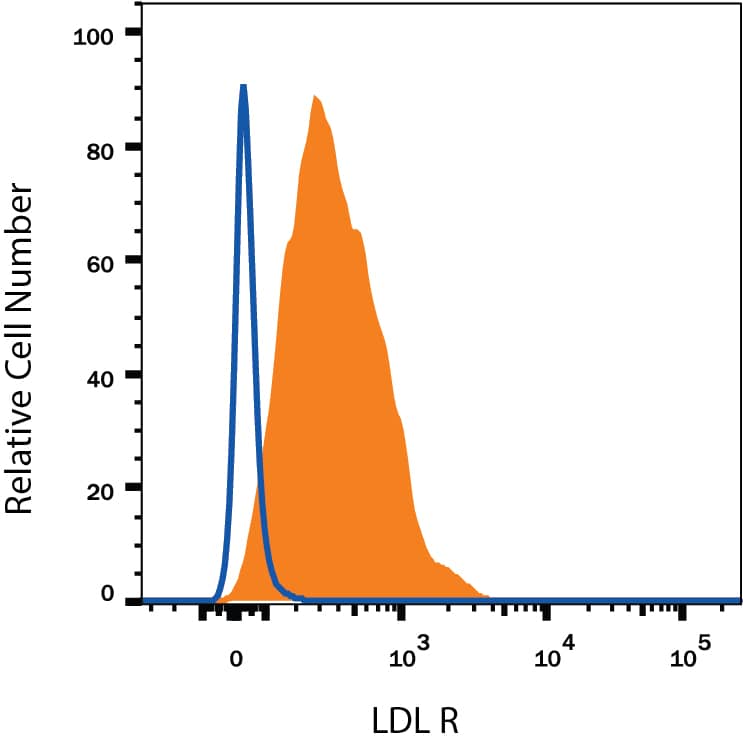
Detection of LDL R in HepG2 Human Cell Line by Flow Cytometry.
HepG2 human hepatocellular carcinoma cell line was stained with Mouse Anti-Human LDL R APC-conjugated Monoclonal Antibody (Catalog # FAB2148A, filled histogram) or isotype control antibody (Catalog # IC002A, open histogram). View our protocol for Staining Membrane-associated Proteins.Applications for Human LDLR APC-conjugated Antibody
Application
Recommended Usage
Flow Cytometry
10 µL/106 cells
Sample: HepG2 human hepatocellular carcinoma cell line
Sample: HepG2 human hepatocellular carcinoma cell line
Spectra Viewer
Plan Your Experiments
Use our spectra viewer to interactively plan your experiments, assessing multiplexing options. View the excitation and emission spectra for our fluorescent dye range and other commonly used dyes.
Spectra Viewer
Formulation, Preparation, and Storage
Purification
Protein A or G purified from hybridoma culture supernatant
Formulation
Supplied in a saline solution containing BSA and Sodium Azide.
Shipping
The product is shipped with polar packs. Upon receipt, store it immediately at the temperature recommended below.
Stability & Storage
Protect from light. Do not freeze.
- 12 months from date of receipt, 2 to 8 °C as supplied.
Background: LDLR
The Low Density Lipoprotein Receptor (LDL R) is the founding member of the LDL R family of scavenger receptors (1, 2). This family contains transmembrane molecules that are characterized by the presence of EGF repeats, complement-like repeats, and YWTD motifs that form beta-propellers. Although members of the family were originally thought to be endocytic receptors, it is now clear that some members interact with adjacent cell-surface molecules, expanding their range of activities (2). Human LDL R is synthesized as an 860 amino acid (aa) precursor that contains a 21 aa signal sequence, a 767 aa extracellular region, a 22 aa transmembrane segment and a 50 aa cytoplasmic tail (3). The extracellular region is complex. It consists of seven N-terminal complement-like cysteine-rich repeats that bind ligand. Cysteine residues in this region participate in intrachain disulfide bonds. This region is followed by three EGF-like repeats with a beta-propeller YWTD containing motif. The EGF-like repeats are responsible for ligand bonding and dissociation. Finally, there is a 50 aa membrane proximal Ser/Thr-rich region that serves as a carbohydrate attachment point (1, 3, 4). There is extensive O-linked and modest N-linked glycosylation. Thus the receptor’s predicted molecular weight of 93 kDa is increased to a native molecular weight of 120-160 kDa (3, 4). Within the 50 aa cytoplasmic tail, there is an NPXY motif that links the receptor to clathrin pits (1). The extracellular region of human LDL R is 51% aa identical to the extracellular region of human VLDL R, and 79% aa identical to the extracellular region of mouse LDL R. LDL R is constitutively expressed and binds ApoB of LDL and ApoE of VLDL (5). It is responsible for clearing 70% of plasma LDL in liver (5). Mutations in the LDL R gene cause the autosomal dominant disorder, familial hypercholesterolemia (6).
References
- Strickland, D.K. et al. (2002) Trends Endocrinol. Metab. 13:66.
- Nykjaer, A. and T.E. Willnow (2002) Trends Cell Biol. 12:273.
- Yamamoto, T. et al. (1984) Cell 39:27.
- Davis, C.G. et al. (1986) J. Biol. Chem. 261:2828.
- Defesche, J.C. (2004) Semin. Vasc. Med. 4:5.
- Varret, M. et al. (2008) Clin Genet. 73:1.
Long Name
Low Density Lipoprotein Receptor
Alternate Names
LDL R
Entrez Gene IDs
Gene Symbol
LDLR
UniProt
Additional LDLR Products
Product Documents for Human LDLR APC-conjugated Antibody
Product Specific Notices for Human LDLR APC-conjugated Antibody
For research use only
Loading...
Loading...
Loading...
Loading...
Loading...