
Human KLF6 Antibody
R&D Systems, part of Bio-Techne | Catalog # AF3499

Conjugate
Catalog #
Key Product Details
Species Reactivity
Validated:
Human
Cited:
Human
Applications
Validated:
Western Blot
Cited:
Western Blot, Immunoprecipitation
Label
Unconjugated
Antibody Source
Polyclonal Sheep IgG
Product Specifications
Immunogen
E. coli-derived recombinant human KLF6
Met1-Ser109
Accession # Q99612
Met1-Ser109
Accession # Q99612
Specificity
Detects human KLF6 in direct ELISAs and Western blots. In direct ELISAs and Western blots, this antibody shows less than 5% cross‑reactivity with rhKLF4, rhKLF5 and rmKLF15.
Clonality
Polyclonal
Host
Sheep
Isotype
IgG
Scientific Data Images for Human KLF6 Antibody
Detection of KLF6 by Western Blot
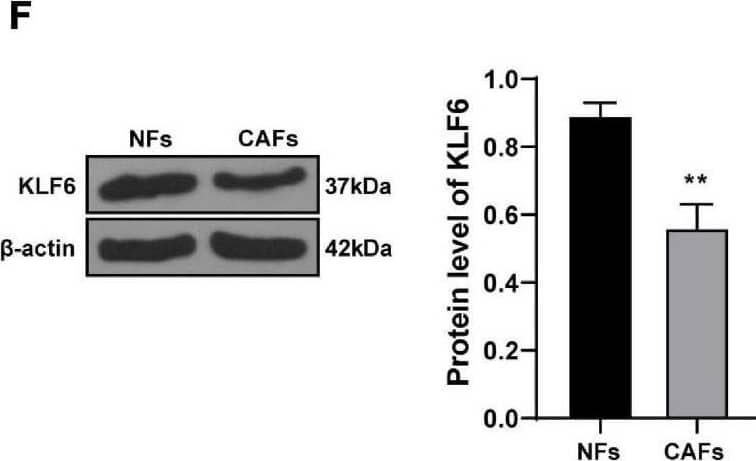
miR-630 targeted KLF6. (A) Target genes of miR-630 were predicted through TargetScan7, RNAInter (Score > 0.70), and miRDB (Score > 70) databases; (B) binding site between miR-630 and KLF6 was predicted through databases; (C) targeting relationship between miR-630 and KLF6 was verified using dual-luciferase reporter gene assay; (D) RIP assay verified the interaction between miR-630 and KLF6 mRNA; (E,F) KLF6 expression in cells in each group was detected using RT-qPCR and Western blotting; (G–J) KLF6 expression in NFs after different treatments was detected using RT-qPCR and Western blotting. The experiment was repeated three times independently. Data are presented as mean ± standard deviation. Data in panel (C–F) were analyzed using t-test, and data in panels (G–J) were analyzed using one-way ANOVA, followed by Tukey’s multiple comparison test, **p < 0.01, ***p < 0.001. A2780 and SKOV3 in panels (I,J) indicated the source of EVs. Image collected and cropped by CiteAb from the following open publication (https://pubmed.ncbi.nlm.nih.gov/34277601), licensed under a CC-BY license. Not internally tested by R&D Systems.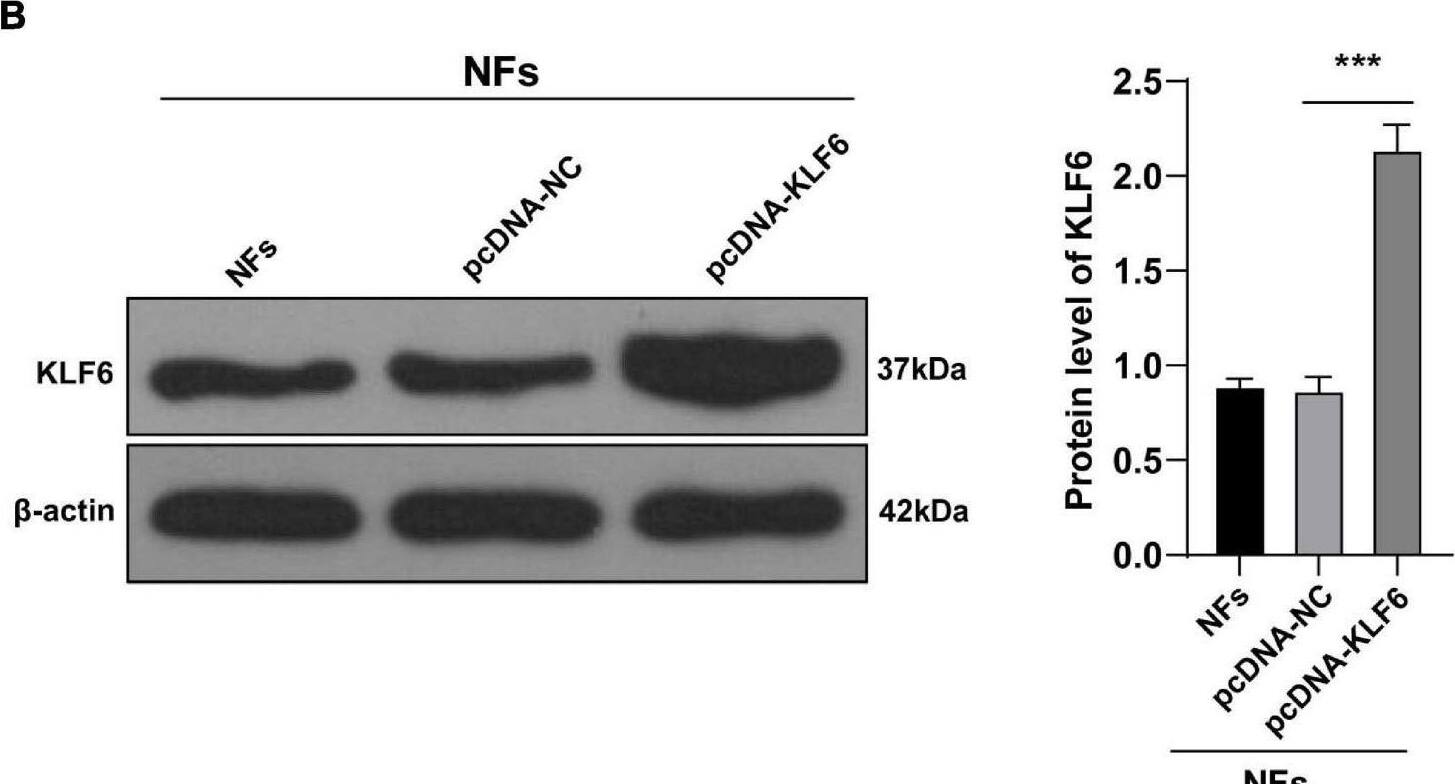
Detection of KLF6 by Western Blot
Overexpression of KLF6 attenuated EVs-induced activation of CAFs. NFs were co-treated with A2780 or SKOV3 cells-derived EVs and KLF6 pcDNA or its NC. (A,B) Transfection efficiency of KLF6 pcDNA was confirmed using RT-qPCR and Western blotting; (C,D) levels of CAFs marker proteins ( alpha-SMA and FAP) in NFs were detected using RT-qPCR and Western blotting. (E) Migration of NFs in each group was detected using Transwell assay; the migrated cells were counted and representative images were displayed. The experiment was repeated three times independently. Data are presented as mean ± standard deviation and analyzed using one-way ANOVA, followed by Tukey’s multiple comparison test, **p < 0.01, ***p < 0.001. A2780 and SKOV3 in the panels (C,D) indicated the source of EVs. Image collected and cropped by CiteAb from the following open publication (https://pubmed.ncbi.nlm.nih.gov/34277601), licensed under a CC-BY license. Not internally tested by R&D Systems.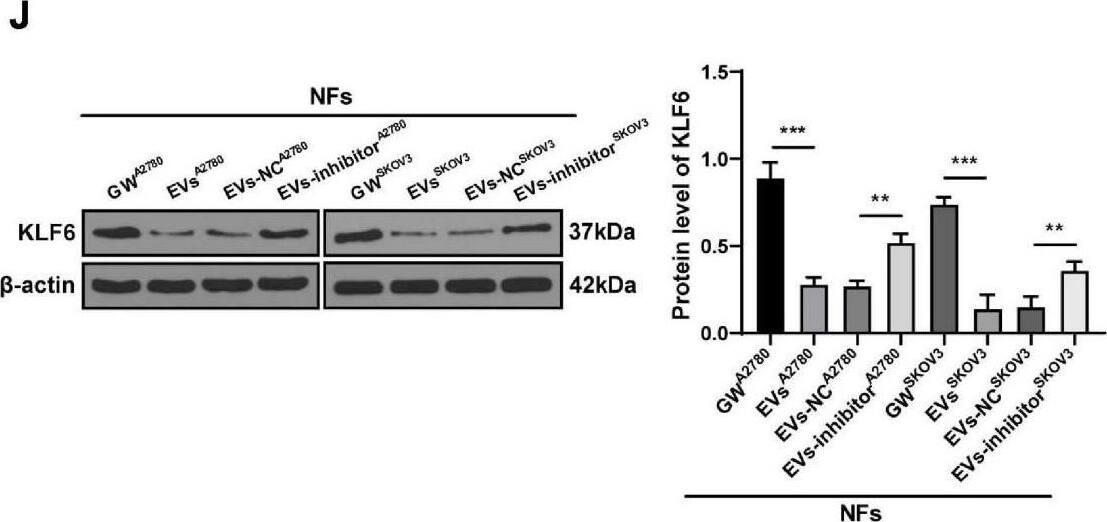
Detection of KLF6 by Western Blot
miR-630 targeted KLF6. (A) Target genes of miR-630 were predicted through TargetScan7, RNAInter (Score > 0.70), and miRDB (Score > 70) databases; (B) binding site between miR-630 and KLF6 was predicted through databases; (C) targeting relationship between miR-630 and KLF6 was verified using dual-luciferase reporter gene assay; (D) RIP assay verified the interaction between miR-630 and KLF6 mRNA; (E,F) KLF6 expression in cells in each group was detected using RT-qPCR and Western blotting; (G–J) KLF6 expression in NFs after different treatments was detected using RT-qPCR and Western blotting. The experiment was repeated three times independently. Data are presented as mean ± standard deviation. Data in panel (C–F) were analyzed using t-test, and data in panels (G–J) were analyzed using one-way ANOVA, followed by Tukey’s multiple comparison test, **p < 0.01, ***p < 0.001. A2780 and SKOV3 in panels (I,J) indicated the source of EVs. Image collected and cropped by CiteAb from the following open publication (https://pubmed.ncbi.nlm.nih.gov/34277601), licensed under a CC-BY license. Not internally tested by R&D Systems.Applications for Human KLF6 Antibody
Application
Recommended Usage
Western Blot
0.1 µg/mL
Sample: Recombinant Human KLF6
Sample: Recombinant Human KLF6
Formulation, Preparation, and Storage
Purification
Antigen Affinity-purified
Reconstitution
Reconstitute at 0.2 mg/mL in sterile PBS. For liquid material, refer to CoA for concentration.
Formulation
Lyophilized from a 0.2 μm filtered solution in PBS with Trehalose. *Small pack size (SP) is supplied either lyophilized or as a 0.2 µm filtered solution in PBS.
Shipping
Lyophilized product is shipped at ambient temperature. Liquid small pack size (-SP) is shipped with polar packs. Upon receipt, store immediately at the temperature recommended below.
Stability & Storage
Use a manual defrost freezer and avoid repeated freeze-thaw cycles.
- 12 months from date of receipt, -20 to -70 °C as supplied.
- 1 month, 2 to 8 °C under sterile conditions after reconstitution.
- 6 months, -20 to -70 °C under sterile conditions after reconstitution.
Background: KLF6
KLF6 is a ubiquitously expressed nuclear protein belonging to the Kruppel C2H2-type zinc finger transcription factor family. It is a 283 amino acid (aa) protein that contains an N-terminal acidic domain, a Ser/Thr-rich region and three zinc-finger motifs. The acidic region may interact with other transcription factors. The Ser-Thr-rich region likely serves as an activation domain, and the zinc-finger motifs bind DNA. One alternate splice form is known that shows a 55 aa substitution for the C‑terminal 57 amino acids. KLF6 is considered a tumor-suppressor gene. It also promotes iNOS and TGF-beta 1 expression. Human KLF6 shares 94%, 95% and 94% aa sequence identity with rat, mouse and canine KLF6, respectively.
Long Name
Kruppel-Like Factor 6
Alternate Names
BCD1, COPEB, CPBP, Transcription factor Zf9
Gene Symbol
KLF6
UniProt
Additional KLF6 Products
Product Documents for Human KLF6 Antibody
Product Specific Notices for Human KLF6 Antibody
For research use only
Loading...
Loading...
Loading...
Loading...