
Human IL-17F Antibody
R&D Systems, part of Bio-Techne | Catalog # MAB13352

Scientific images may be resized, cropped, or adjusted for brightness or contrast for presentation purposes. These updates are limited to presentation and do not affect the underlying scientific interpretation of the data. Where available, additional source data may be provided upon request.
Conjugate
Catalog #
Key Product Details
Species Reactivity
Validated:
Human
Cited:
Human
Applications
Validated:
Neutralization
Cited:
Neutralization
Label
Unconjugated
Antibody Source
Monoclonal Mouse IgG1 Clone # 775620
Product Specifications
Immunogen
Mouse myeloma cell line NS0-derived recombinant human IL-17F
Gly21-Thr153
Accession # Q96PD4
Gly21-Thr153
Accession # Q96PD4
Specificity
Detects human IL-17F in ELISAs. In direct ELISAs, no cross-reactivity with recombinant human IL-17A, recombinant mouse IL-17F, or recombinant rat IL-17F is observed.
Clonality
Monoclonal
Host
Mouse
Isotype
IgG1
Endotoxin Level
<0.10 EU per 1 μg of the antibody by the LAL method.
Scientific Data Images for Human IL-17F Antibody
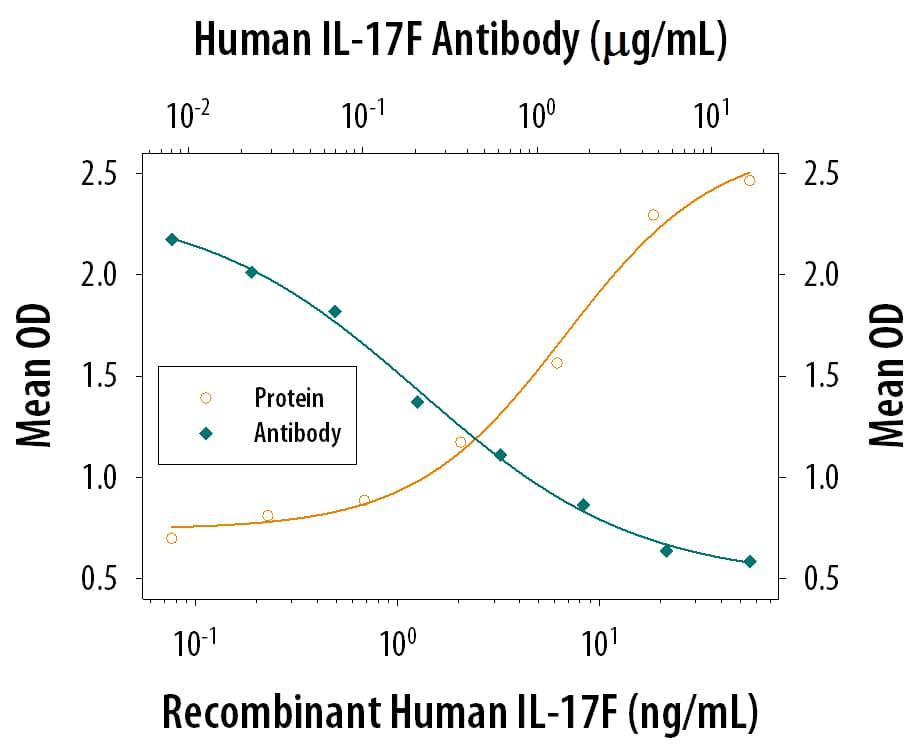
IL-6 Secretion Induced by IL‑17F and Neutralization by Human IL‑17F Antibody.
Recombinant Human IL-17F induces IL-6 secretion in the NIH-3T3 mouse embryonic fibroblast cell line in a dose-dependent response (orange line), as measured by the Mouse IL-6 Quantikine kit (Catalog # M6000B). Under these conditions, IL-6 secretion elicited by IL-17F is neutralized (green line) by increasing concentrations of Mouse Anti-Human IL-17F Monoclonal Antibody (Catalog # MAB13352). The ND50 is typically 0.1-0.6 µg/mL.Applications for Human IL-17F Antibody
Application
Recommended Usage
Neutralization
Measured by its ability to neutralize IL‑17F-induced IL-6 secretion in the NIH‑3T3 mouse embryonic fibroblast cell line. Yao, Z. et al. (1995) Immunity 3:811.The Neutralization Dose (ND50) is typically 0.1-0.6 μg/mL in the presence of 25 ng/mL Recombinant Human IL‑17F.
Reviewed Applications
Read 2 reviews rated 5 using MAB13352 in the following applications:
Formulation, Preparation, and Storage
Purification
Protein A or G purified from hybridoma culture supernatant
Reconstitution
Sterile PBS to a final concentration of 0.5 mg/mL. For liquid material, refer to CoA for concentration.
Formulation
Lyophilized from a 0.2 μm filtered solution in PBS with Trehalose. *Small pack size (SP) is supplied either lyophilized or as a 0.2 µm filtered solution in PBS.
Shipping
Lyophilized product is shipped at ambient temperature. Liquid small pack size (-SP) is shipped with polar packs. Upon receipt, store immediately at the temperature recommended below.
Stability & Storage
Use a manual defrost freezer and avoid repeated freeze-thaw cycles.
- 12 months from date of receipt, -20 to -70 °C as supplied.
- 1 month, 2 to 8 °C under sterile conditions after reconstitution.
- 6 months, -20 to -70 °C under sterile conditions after reconstitution.
Background: IL-17F
The Interleukin 17 (IL-17) family proteins, comprising six members (IL-17A through IL-17F), are secreted, structurally related proteins that share a conserved cystine‑knot fold near the C-terminus, but have considerable sequence divergence at the N-terminus. With the exception of IL-17B, which exists as a non-covalently linked dimer, all IL-17 family members are disulfide-linked dimers. IL-17 family proteins are pro-inflammatory cytokines that induce local cytokine production and are involved in the regulation of immune functions (1, 2).
Human IL-17F cDNA encodes a 163 aa protein with a putative 30 aa signal peptide. Among IL-17 family members, IL-17F is most closely related to IL-17A (approximately 44% aa sequence homology), but shares only limited sequence homology (16 - 30%) with IL-17B, C, D and E. Human and mouse IL-17F share 55% sequence identity. IL-17F is expressed in activated CD4+ T-cells and activated monocytes. Five receptors (IL-17 RA, B, C, D and E) have been identified (5). Although the ligands for IL-17 RD and E are not known yet, it is reported that IL-17 RA binds IL-17A, and IL-17 RB binds IL-17B and IL-17E. IL-17 RC binds IL-17A and IL-17F with similarly high affinity and functions as a receptor for both IL-17A and IL-17F (5, 6). The biological activities mediated by IL-17F are similar to those of IL‑17. IL‑17F stimulates production of IL-6, IL-8, G-CSF, and regulates cartilage matrix turnover by increasing matrix release and inhibiting new matrix synthesis (4). IL‑17F also inhibits angiogenesis and induces production of IL-2, TGF-beta, and monocyte chemoattractant protein-1 in endothelial cells (3).
References
- Aggarwal, S. and A.L. Gurney (2002) J. Leukoc. Biol. 71:1.
- Moseley, T.A. et al. (2003) Cytokine & Growth Factor Rev. 14:155.
- Starnes, T. et al. (2001) J. Immunol. 167:4137.
- Shen, F. & S. L. Gaffen (2008) Cytokine 41:92.
- Kuestner, R.E. et al. (2007) J. Immunol. 179:5462.
Long Name
Interleukin 17F
Alternate Names
IL17F
Gene Symbol
IL17F
UniProt
Additional IL-17F Products
Product Documents for Human IL-17F Antibody
Product Specific Notices for Human IL-17F Antibody
For research use only
Loading...
Loading...
Loading...
Loading...