
Human IL-13 Antibody
R&D Systems, part of Bio-Techne | Catalog # AF-213-NA

Scientific images may be resized, cropped, or adjusted for brightness or contrast for presentation purposes. These updates are limited to presentation and do not affect the underlying scientific interpretation of the data. Where available, additional source data may be provided upon request.
Conjugate
Catalog #
Key Product Details
Species Reactivity
Validated:
Human
Cited:
Human
Applications
Validated:
Western Blot, Neutralization, Intracellular Staining by Flow Cytometry, CyTOF-ready
Cited:
Immunohistochemistry-Paraffin, Western Blot, Neutralization, Immunocytochemistry
Label
Unconjugated
Antibody Source
Polyclonal Goat IgG
Product Specifications
Immunogen
E. coli-derived recombinant human IL-13
Gly21-Asn132
Accession # AAK53823
Gly21-Asn132
Accession # AAK53823
Specificity
Detects human IL-13 in direct ELISAs and Western blots. In direct ELISAs, approximately 100% cross‑reactivity with recombinant rhesus monkey IL-13 is observed,
Clonality
Polyclonal
Host
Goat
Isotype
IgG
Endotoxin Level
<0.10 EU per 1 μg of the antibody by the LAL method.
Scientific Data Images for Human IL-13 Antibody
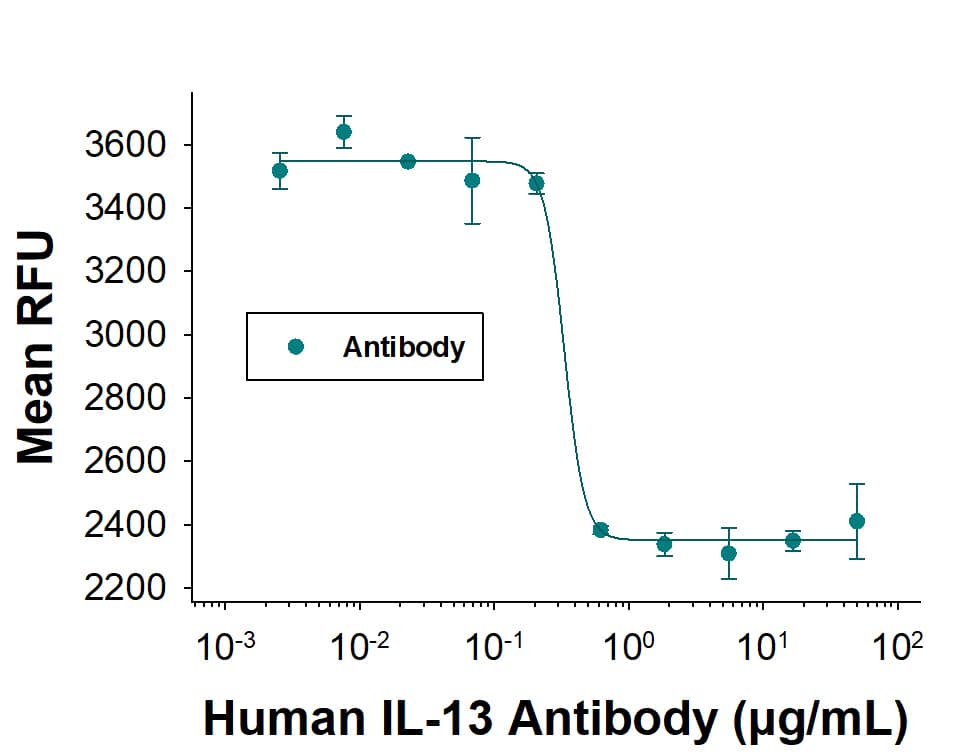
Neutralization by Human IL 13 Antibody
Human IL-13 Antibody (Catalog # AF-213-NA) neutralizes Recombinant Human IL-13 (213-ILB) induced proliferation in the TF 1 human erythroleukemic cell line. The Neutralization Dose (ND50) for this effect is typically
Human IL-13 ELISA Standard Curve
Recombinant Human IL-13 (213-ILB) was serially diluted and captured by Mouse Anti-Human IL-13 Monoclonal Antibody (MAB213) coated on a Clear Polystyrene Microplate (DY990). Goat Anti-Human IL-13 Antigen Affinity-purified Polyclonal Antibody (Catalog # AF-213-NA) was biotinylated and incubated with the protein captured on the plate. Detection of the standard curve was achieved by incubating Streptavidin-HRP (DY998)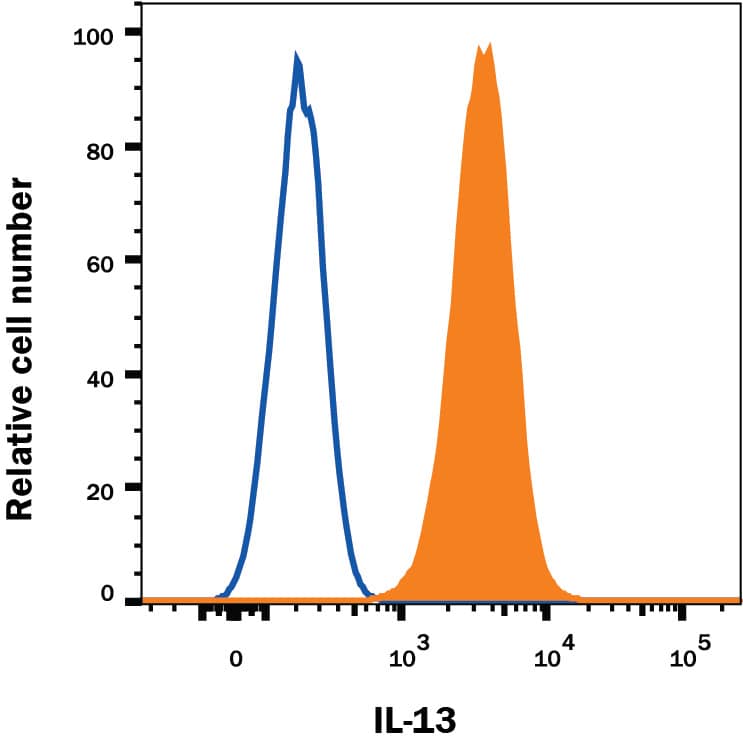
Detection of IL‑13 in NS0 Mouse Cell Line Transfected with Human IL-13 by Flow Cytometry.
NS0 mouse myeloma cell line transfected with human IL-13 was stained with Goat Anti-Human IL-13 Polyclonal Antibody (AF-213-NA, filled histogram) or isotype control antibody (AB-108-C, open histogram), followed by Phycoerythrin-conjugated Anti-Goat IgG Secondary Antibody (F0107). To facilitate intracellular staining, cells were fixed with Flow Cytometry Fixation Buffer (Catalog # FC004) and permeabilized with Flow Cytometry Permeabilization/Wash Buffer I (Catalog # FC005). View our protocol for Staining Intracellular Molecules.Applications for Human IL-13 Antibody
Application
Recommended Usage
CyTOF-ready
Ready to be labeled using established conjugation methods. No BSA or other carrier proteins that could interfere with conjugation.
Intracellular Staining by Flow Cytometry
5 µg/106 cells
Sample: Human IL-13 transfected NS0 cells fixed with paraformaldehyde and permeabilized with saponin
Sample: Human IL-13 transfected NS0 cells fixed with paraformaldehyde and permeabilized with saponin
Western Blot
0.1 µg/mL
Sample: Recombinant Human IL‑13 (Catalog # 213-ILB)
Sample: Recombinant Human IL‑13 (Catalog # 213-ILB)
Neutralization
Human IL-13 Antibody (Catalog # AF-213-NA) neutralizes Recombinant Human IL-13 (Catalog # 213-ILB) induced proliferation in the TF 1 human erythroleukemic cell line. The Neutralization Dose (ND50) for this effect is typically <3.00 µg/mL in the presence of 10 ng/mL Recombinant Human IL-13.
Reviewed Applications
Read 2 reviews rated 4 using AF-213-NA in the following applications:
Formulation, Preparation, and Storage
Purification
Antigen Affinity-purified
Reconstitution
Reconstitute at 0.2 mg/mL in sterile PBS. For liquid material, refer to CoA for concentration.
Formulation
Lyophilized from a 0.2 μm filtered solution in PBS with Trehalose. See Certificate of Analysis for details.
*Small pack size (-SP) is supplied either lyophilized or as a 0.2 µm filtered solution in PBS.
*Small pack size (-SP) is supplied either lyophilized or as a 0.2 µm filtered solution in PBS.
Shipping
Lyophilized product is shipped at ambient temperature. Liquid small pack size (-SP) is shipped with polar packs. Upon receipt, store immediately at the temperature recommended below.
Stability & Storage
Use a manual defrost freezer and avoid repeated freeze-thaw cycles.
- 12 months from date of receipt, -20 to -70 °C as supplied.
- 1 month, 2 to 8 °C under sterile conditions after reconstitution.
- 6 months, -20 to -70 °C under sterile conditions after reconstitution.
Background: IL-13
IL-13 is a 17 kDa immunoregulatory cytokine that plays a key role in the pathogenesis of allergic asthma and atopy. It is secreted by Th1 and Th2 CD4+ T cells, NK cells, visceral smooth muscle cells, eosinophils, mast cells, and basophils (1-3). IL-13 circulates as a monomer with two internal disulfide bonds that contribute to a bundled four alpha-helix configuration (4, 5). Mature human IL-13 shares 57%, 59%, and 94% amino acid sequence identity with mouse, rat, and rhesus macaque IL-13, respectively. Despite the low homology, it exhibits cross-species activity between human, mouse, and rat (6, 7). IL-13 has diverse activities on numerous cell types (8). On macrophages, IL-13 suppresses the production of pro-inflammatory cytokines and other cytotoxic substances. On B cells, IL-13 induces immunoglobulin class switching to IgE, upregulates the expression of MHC class II, CD71, CD72, and CD23, and costimulates proliferation. IL-13 upregulates IL-6 while downregulating IL-1 and TNF-alpha production by fibroblasts and endothelial cells. IL-13 binds with low affinity to IL-13 R alpha1, triggering IL-13 R alpha1 association with IL-4 R alpha. This high affinity receptor complex also functions as the type 2 IL-4 receptor complex (9, 10). Additionally, IL-13 binds with high affinity to IL-13 R alpha2 which is expressed intracellularly, on the cell surface, and as a soluble molecule (11-14). IL-13 R alpha2 regulates the bioavailability of both IL-13 and IL-4 and is over-expressed in glioma and several bronchial pathologies (10, 15, 16). Compared to wild type IL-13, the atopy-associated R110Q variant of IL-13 elicits increased responsiveness from eosinophils that express low levels of IL-13 R alpha2 (17).
References
- Wills-Karp, M. (2004) Immunol. Rev. 202:175.
- Nakajima H. and K. Takatsu (2007) Int. Arch. Allergy Immunol. 142:265.
- McKenzie, A.N. et al. (1993) Proc. Natl. Acad. Sci. USA 90:3735.
- Moy, F.J. et al. (2001) J. Mol. Biol. 310:219.
- Eisenmesser, E.Z. et al. (2001) J. Mol. Biol. 310:231.
- Ruetten, H. and C. Thiemermann (1997) Shock 8:409.
- Lakkis, F.G. et al. (1997) Biochem. Biophys. Res. Commun. 235:529.
- Wynn, T.A. (2003) Annu. Rev. Immunol. 21:425.
- Andrews, A.L. et al. (2002) J. Biol. Chem. 277:46073.
- Tabata, Y. et al. (2007) Curr. Allergy Asthma Rep. 7:338.
- Chiaramonte, M.G. et al. (2003) J. Exp. Med. 197:687.
- Daines, M.O. and G.K. Hershey (2002) J. Biol. Chem. 227:10387.
- Matsumura, M. et al. (2007) Biochem. Biophys. Res. Commun. 360:464.
- Tabata, Y. et al. (2007) J. Immunol. 177:7905.
- Andrews, A.L. et al. (2006) J. Allergy Clin. Immunol. 118:858.
- Joshi, B.H. et al. (2006) Vitam. Horm. 74:479.
- Andrews, A-L. et al. (2007) J. Allergy Clin. Immunol. 120:91.
Long Name
Interleukin 13
Alternate Names
IL13, NC30, P600
Gene Symbol
IL13
UniProt
Additional IL-13 Products
Product Documents for Human IL-13 Antibody
Product Specific Notices for Human IL-13 Antibody
For research use only
Loading...
Loading...
Loading...
Loading...
Loading...
Loading...