
Human GFR alpha-2/GDNF R alpha-2 Antibody
R&D Systems, part of Bio-Techne | Catalog # AF613

Conjugate
Catalog #
Key Product Details
Species Reactivity
Validated:
Human
Cited:
Guinea Pig
Applications
Validated:
Immunohistochemistry, Western Blot, Blockade of Receptor-ligand Interaction
Cited:
Immunocytochemistry
Label
Unconjugated
Antibody Source
Polyclonal Goat IgG
Product Specifications
Immunogen
Mouse myeloma cell line NS0-derived recombinant human GFR alpha‑2/GDNF R alpha‑2
Ser22-Ser441
Accession # O00451
Ser22-Ser441
Accession # O00451
Specificity
Detects human GFR alpha‑2/GDNF R alpha‑2 in direct ELISAs and Western blots. In direct ELISAs, approximately 75% cross‑reactivity with recombinant mouse GFR alpha-2 is observed and less than 5% cross-reactivity with recombinant human GFR alpha-1 is observed.
Clonality
Polyclonal
Host
Goat
Isotype
IgG
Scientific Data Images for Human GFR alpha-2/GDNF R alpha-2 Antibody
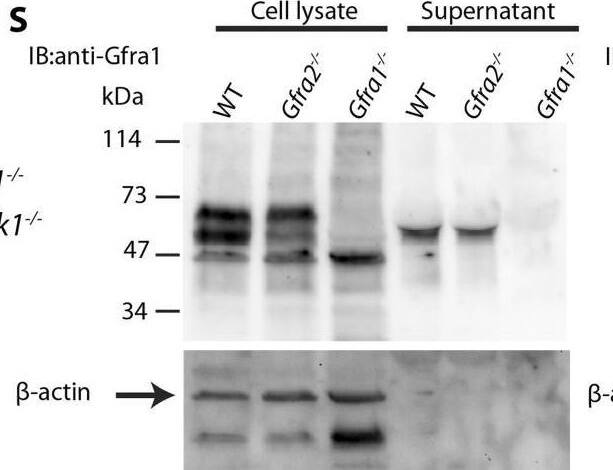
Detection of GFR alpha-2/GDNF R alpha-2 by Western Blot
RA mechanoreceptors utilize GFRa1 produced by neighboring neurons to respond to GDNF. Western blot analysis of cell lysates and concentrated supernatants from cultured dissociated DRG neurons of E18.5-P1 wild-type, Gfra2 null, and Gfra1 null mice. (S) The specificity of the anti-GFRa1 antibody was confirmed by the loss of a doublet at the predicted size of GFRa1 in Gfra1 null cell lysates. GFRa1 was also detected in the supernatants of wild-type and Gfra2 null cultures, but not Gfra1 null cultures, indicating that GFRa1 is shed from the membrane of DRGs of both wild-type and Gfra2 mutants. Note that the size of cleaved GFRa1 is slightly smaller than that tethered to cells, which is consistent with previous publication (Paratcha et al., 2001). Following detection of GFRa1, membranes were stripped and probed for beta-actin, which served as a loading control and confirmation that the supernatant fraction was not contaminated with cells or cellular debris (lower panel). Image collected and cropped by CiteAb from the following open publication (https://pubmed.ncbi.nlm.nih.gov/25838128), licensed under a CC-BY license. Not internally tested by R&D Systems.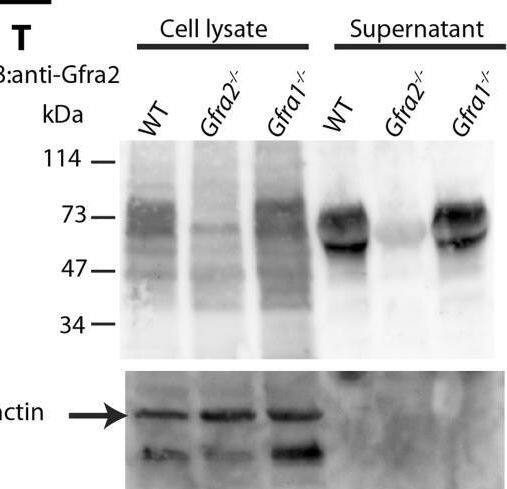
Detection of GFR alpha-2/GDNF R alpha-2 by Western Blot
RA mechanoreceptors utilize GFRa1 produced by neighboring neurons to respond to GDNF. (S–V) Western blot analysis of cell lysates and concentrated supernatants from cultured dissociated DRG neurons of E18.5-P1 wild-type, Gfra2 null, and Gfra1 null mice. (T) The specificity of the anti-GFRa2 antibody was confirmed by the loss of a band ∼75 kDa in Gfra2 null cell lysates. The larger than predicted size of GFRa2 may be due to post-translational modifications. Two GFRa2 specific bands were also detected in the supernatants of wild-type and Gfra1 null cultures, but not Gfra2 null cultures, indicating that GFRa2 is also shed from DRG cell membranes. The size of cleaved GFRa2 is also smaller than that tethered to cells. Image collected and cropped by CiteAb from the following open publication (https://pubmed.ncbi.nlm.nih.gov/25838128), licensed under a CC-BY license. Not internally tested by R&D Systems.Applications for Human GFR alpha-2/GDNF R alpha-2 Antibody
Application
Recommended Usage
Blockade of Receptor-ligand Interaction
In a functional ELISA, 2-6 µg/mL of this antibody will block 50% of the binding of 2 ng/mL of Recombinant Human GDNF (Catalog # 212-GD) to immobilized Recombinant Human GFR alpha-2 Fc Chimera (Catalog # 613-FR) coated at 1 µg/mL (100 µL/well). At 20 μg/mL, this antibody will block >90% of the binding.
Immunohistochemistry
5-15 µg/mL
Sample: Immersion fixed paraffin-embedded sections of human dorsal root ganglia
Sample: Immersion fixed paraffin-embedded sections of human dorsal root ganglia
Western Blot
0.1 µg/mL
Sample: Recombinant Human GFR alpha-2/GDNF R alpha-2 Fc Chimera (Catalog # 613-FR)
Sample: Recombinant Human GFR alpha-2/GDNF R alpha-2 Fc Chimera (Catalog # 613-FR)
Reviewed Applications
Read 5 reviews rated 4.2 using AF613 in the following applications:
Formulation, Preparation, and Storage
Purification
Antigen Affinity-purified
Reconstitution
Reconstitute at 0.2 mg/mL in sterile PBS. For liquid material, refer to CoA for concentration.
Formulation
Lyophilized from a 0.2 μm filtered solution in PBS with Trehalose. *Small pack size (SP) is supplied either lyophilized or as a 0.2 µm filtered solution in PBS.
Shipping
Lyophilized product is shipped at ambient temperature. Liquid small pack size (-SP) is shipped with polar packs. Upon receipt, store immediately at the temperature recommended below.
Stability & Storage
Use a manual defrost freezer and avoid repeated freeze-thaw cycles.
- 12 months from date of receipt, -20 to -70 °C as supplied.
- 1 month, 2 to 8 °C under sterile conditions after reconstitution.
- 6 months, -20 to -70 °C under sterile conditions after reconstitution.
Background: GFR alpha-2/GDNF R alpha-2
Glial cell line-derived growth factor (GDNF), neurturin (NTN), persephin (PSP) and artemin, distant members of theTGF-beta superfamily, are neurotrophic factors for a variety of neuronal populations in the central and peripheral nervous systems. The bioactivities of GDNF and NTN are mediated through a receptor complex composed of the non ligand-binding signaling subunit (c-Ret receptor tyrosine kinase) and either of two ligand binding subunits (GDNF receptor alpha-1 [GFR alpha-1], also known as Trn R1 or GFR alpha-2, also known as Trn R2). GFR alpha-1 and -2 are members of a family of at least four cysteine-rich glycosyl-phosphatidylinositol (GPI)-linked cell surface proteins that share conserved placements of many of their cysteine residues. Binding of GDNF or NTN to membrane-associated GFR alpha-1 or GFR alpha-2 initiates the association with and activation of the Ret tyrosine kinase.
Human GFR alpha-2 cDNA encodes a 464 amino acid (aa) residue protein with a putative N-terminal 21 aa residue hydrophobic signal peptide. Like other GPI-linked proteins, human GFR alpha-2 has a C-terminal hydrophobic region which is preceded by a three aa residue (GPS) GPI-binding site. Human GFR alpha-2 shares 96.5% amino acid identity with mouse GFR alpha-2. The expression of the various GFR alphas are differentially regulated in the central and peripheral nervous system, suggesting complementary roles for the GFR alphas in mediating the activities of the GDNF family of neurotrophic factors.
References
- Thompson, J. et al. (1998) Mol. Cell Neurosci. 11:117.
- Trupp, M. et al. (1998) Mol. Cell Neurosci. 11:47.
- Baloh, R.H. et al. (1998) Proc. Natl. Acad. Sci. USA 95:5801.
- Baloh, R.H. et al. (1998) Neuron 21:1291.
Long Name
Glial Cell line-derived Neurotrophic Factor Receptor alpha 2
Alternate Names
GDNF R alpha-2, GFR alpha2, GFRa-2, GFRA2
Gene Symbol
GFRA2
UniProt
Additional GFR alpha-2/GDNF R alpha-2 Products
Product Documents for Human GFR alpha-2/GDNF R alpha-2 Antibody
Product Specific Notices for Human GFR alpha-2/GDNF R alpha-2 Antibody
For research use only
Loading...
Loading...
Loading...
Loading...
Loading...