
Human C-Peptide Antibody
R&D Systems, part of Bio-Techne | Catalog # MAB80561

Scientific images may be resized, cropped, or adjusted for brightness or contrast for presentation purposes. These updates are limited to presentation and do not affect the underlying scientific interpretation of the data. Where available, additional source data may be provided upon request.
Conjugate
Catalog #
Key Product Details
Species Reactivity
Validated:
Human
Cited:
Human
Applications
Validated:
Immunohistochemistry
Cited:
Immunohistochemistry
Label
Unconjugated
Antibody Source
Monoclonal Mouse IgG1 Clone # 915612
Product Specifications
Immunogen
Human C-Peptide synthetic peptide
EAEDLQVGQVELGGGPGAGSLQPLALEGSLQ
Accession # P01308
EAEDLQVGQVELGGGPGAGSLQPLALEGSLQ
Accession # P01308
Specificity
Detects human C-Peptide in direct ELISAs.
Clonality
Monoclonal
Host
Mouse
Isotype
IgG1
Scientific Data Images for Human C-Peptide Antibody
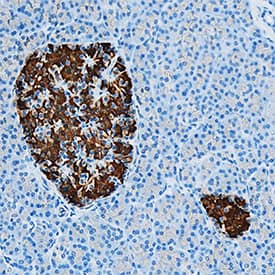
C-Peptide in Human Pancreas.
C-Peptide was detected in immersion fixed paraffin-embedded sections of human pancreas using Mouse Anti-Human C-Peptide Monoclonal Antibody (Catalog # MAB80561) at 15 µg/mL overnight at 4 °C. Tissue was stained using the Anti-Mouse HRP-DAB Cell & Tissue Staining Kit (brown; Catalog # CTS002) and counterstained with hematoxylin (blue). Specific staining was localized to islets. View our protocol for Chromogenic IHC Staining of Paraffin-embedded Tissue Sections.Applications for Human C-Peptide Antibody
Application
Recommended Usage
Immunohistochemistry
8-25 µg/mL
Sample: Immersion fixed paraffin-embedded sections of human pancreas
Sample: Immersion fixed paraffin-embedded sections of human pancreas
Formulation, Preparation, and Storage
Purification
Protein A or G purified from hybridoma culture supernatant
Reconstitution
Reconstitute at 0.5 mg/mL in sterile PBS. For liquid material, refer to CoA for concentration.
Formulation
Lyophilized from a 0.2 μm filtered solution in PBS with Trehalose. *Small pack size (SP) is supplied either lyophilized or as a 0.2 µm filtered solution in PBS.
Shipping
Lyophilized product is shipped at ambient temperature. Liquid small pack size (-SP) is shipped with polar packs. Upon receipt, store immediately at the temperature recommended below.
Stability & Storage
Use a manual defrost freezer and avoid repeated freeze-thaw cycles.
- 12 months from date of receipt, -20 to -70 °C as supplied.
- 1 month, 2 to 8 °C under sterile conditions after reconstitution.
- 6 months, -20 to -70 °C under sterile conditions after reconstitution.
Background: C-Peptide
Insulin is a peptide hormone that facilitates the cellular uptake of glucose by regulating the appearance of membrane glucose transporters. The single chain insulin propeptide consists of a 30 amino acid B chain (aa 25-54), a C-peptide (aa 55-89), and a 21 aa A chain (aa 90-110). Removal of the C-peptide by proteolysis enables the formation of mature Insulin, a disulfide-linked heterodimer of the A and B chains. Circulating C-peptide levels are elevated in hyperinsulinism, obesity, and type II diabetes. The human Insulin C-peptide shares 61% and 68% aa sequence identity with mouse and rat Insulin C-peptide, respectively.
Long Name
Proinsulin C-Peptide
Alternate Names
C-P, Insulin C-Peptide, Proinsulin C-Peptide
Gene Symbol
INS
UniProt
Additional C-Peptide Products
Product Documents for Human C-Peptide Antibody
Product Specific Notices for Human C-Peptide Antibody
For research use only
Loading...
Loading...
Loading...
Loading...
Loading...