
Human Bcl9-2 Antibody
R&D Systems, part of Bio-Techne | Catalog # AF4967


Conjugate
Catalog #
Key Product Details
Species Reactivity
Validated:
Human
Cited:
Human
Applications
Validated:
Western Blot
Cited:
Western Blot, Immunocytochemistry, Immunoprecipitation, ELISA Capture
Label
Unconjugated
Antibody Source
Polyclonal Sheep IgG
Product Specifications
Immunogen
E. coli-derived recombinant human Bcl9-2
Met38-Val206
Accession # Q86UU0
Met38-Val206
Accession # Q86UU0
Specificity
Detects endogenous human Bcl9-2 in Western blots.
Clonality
Polyclonal
Host
Sheep
Isotype
IgG
Scientific Data Images for Human Bcl9-2 Antibody
Detection of Human Bcl9-2 by Western Blot.
Western blot shows lysates of A172 human glioblastoma cell line and MCF-7 human breast cancer cell line. PVDF membrane was probed with 1 µg/mL of Human Bcl9-2 Antigen Affinity-purified Polyclonal Antibody (Catalog # AF4967) followed by HRP-conjugated Anti-Sheep IgG Secondary Antibody (Catalog # HAF016). A specific band was detected for Bcl9-2 at approximately 190 kDa (as indicated). This experiment was conducted under reducing conditions and using Immunoblot Buffer Group 1.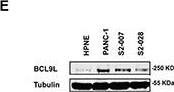
Detection of Bcl9-2 by Western Blot
BCL9L expression in primary pancreatic tumor tissue and cell lines(A) Box-and-whisker plot showing results from BCL9L mRNA expression analysis by qRT-PCR in tissue samples derived from primary human pancreatic tumors (n = 26 cases), chronic pancreatitis (n = 6 cases) and normal pancreas (n = 13 cases). Expression was normalized to ribosomal protein, large, P0 (RPLP0) mRNA levels. Bars represent median and 2nd and 3rd quartiles (boxes) as well as minimum and maximum values (whiskers). **p ≤ 0.01, ***p ≤ 0.001 (Student's t-test). (B) BCL9L mRNA levels in pancreatic cancer (8988t, IMIM PC1, IMIM PC2, MiaPaca-2, Panc1, S2-007, S2-028) and control (HEK 293) cell lines. (C) Staining of tissue microarrays (TMA) for BCL9L expression using immunohistochemistry. Enhanced expression was seen in PDAC tissues (bottom panels) compared to normal pancreas (upper panels). Staining intensity in PDAC tissues increased with tumor grade (bottom left: G1, bottom middle: G2, bottom right: G3). (D) BCL9L staining intensity of tissue microarrays was quantitatively evaluated and scored in normal and PDAC cases as described in Materials and Methods. Scores significantly increased with the progression to less differentiated PDAC (grade 2 and 3). ***p ≤ 0.001 (Mann-Whitney and Kruskal-Wallis non parametric test) (E) BCL9L protein expression in pancreatic cancer and control (HPNE) cell lines was quantified by western blotting. Detection of alpha-tubulin was used as a loading control. Shown is a representative image of 3 experiments. Image collected and cropped by CiteAb from the following open publication (https://pubmed.ncbi.nlm.nih.gov/27713160), licensed under a CC-BY license. Not internally tested by R&D Systems.Applications for Human Bcl9-2 Antibody
Application
Recommended Usage
Western Blot
1 µg/mL
Sample: A172 human glioblastoma cell line and MCF-7 human breast cancer cell line
Sample: A172 human glioblastoma cell line and MCF-7 human breast cancer cell line
Formulation, Preparation, and Storage
Purification
Antigen Affinity-purified
Reconstitution
Reconstitute at 0.2 mg/mL in sterile PBS. For liquid material, refer to CoA for concentration.
Formulation
Lyophilized from a 0.2 μm filtered solution in PBS with Trehalose. *Small pack size (SP) is supplied either lyophilized or as a 0.2 µm filtered solution in PBS.
Shipping
Lyophilized product is shipped at ambient temperature. Liquid small pack size (-SP) is shipped with polar packs. Upon receipt, store immediately at the temperature recommended below.
Stability & Storage
Use a manual defrost freezer and avoid repeated freeze-thaw cycles.
- 12 months from date of receipt, -20 to -70 °C as supplied.
- 1 month, 2 to 8 °C under sterile conditions after reconstitution.
- 6 months, -20 to -70 °C under sterile conditions after reconstitution.
Background: Bcl9-2
Bcl9-2 (B-cell lymphoma 9-like protein; also Bcl9L and B9L) is a 200-220 kDa transcriptional regulator that belongs to the Bcl9 family of proteins. It is expressed in multiple tissues, particularly breast, and serves to recruit Pygopus to the Wnt-pathway beta-catenin-TCF complex in the nucleus. Bcl9-2 and Bcl9 are considered evolutionary duplicates of Legless that perform the same task with different regulation. Human Bcl9-2 is 1499 amino acids (aa) in length. It contains two Pro-rich regions (aa 280-493 and 891-1378). There are four potential alternate start sites at Met879, Met1000, Met708 and Met472. The last two start sites are accompanied by a deletion of aa 1241-1286, and a 62 aa substitution for the C-terminal 167 aa, respectively. Over aa 38-206, human Bcl9-2 is 94% aa identical to mouse Bcl9-2. Bcl9-2 has been identified as a phosphoprotein in several human cancer cell lines and mouse liver.
Long Name
B Cell Lymphoma/Leukemia 9-like Protein
Alternate Names
Bcl92, DLNB11
Gene Symbol
BCL9L
UniProt
Additional Bcl9-2 Products
Product Documents for Human Bcl9-2 Antibody
Product Specific Notices for Human Bcl9-2 Antibody
For research use only
Loading...
Loading...
Loading...
Loading...