
Human ALK-1 Antibody
R&D Systems, part of Bio-Techne | Catalog # AF370

Conjugate
Catalog #
Key Product Details
Species Reactivity
Validated:
Human
Cited:
Human, Mouse, Rat, Transgenic Mouse
Applications
Validated:
Western Blot, Immunoprecipitation
Cited:
Immunohistochemistry, Immunohistochemistry-Frozen, Western Blot, Neutralization, Flow Cytometry, Immunocytochemistry, Immunoprecipitation, Surface Plasmon Resonance
Label
Unconjugated
Antibody Source
Polyclonal Goat IgG
Product Specifications
Immunogen
Mouse myeloma cell line NS0-derived recombinant human ALK-1
Asp22-Gln118
Accession # P37023
Asp22-Gln118
Accession # P37023
Specificity
Detects human ALK-1 in direct ELISAs and Western blots. In direct ELISAs and Western blots, approximately 10% cross‑reactivity with recombinant mouse ALK-1 is observed and less than 1% cross-reactivity with recombinant human (rh) Activin RIA and rhActivin RIB is observed.
Clonality
Polyclonal
Host
Goat
Isotype
IgG
Scientific Data Images for Human ALK-1 Antibody
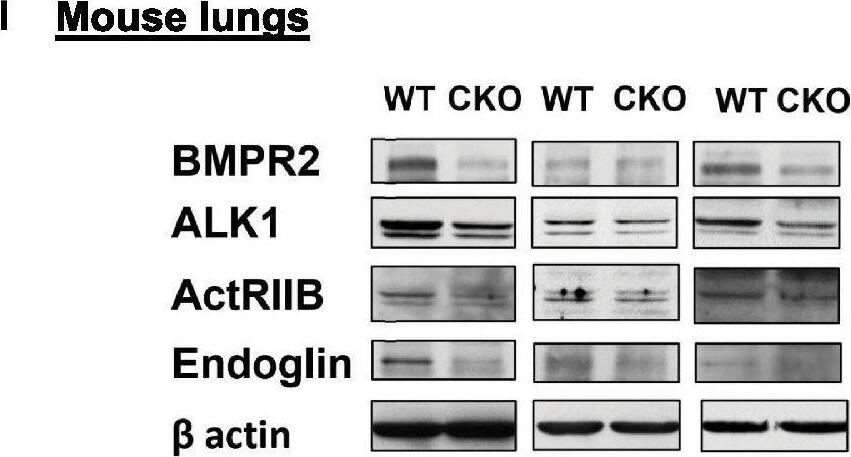
Detection of Mouse ALK-1 by Western Blot
GATA6 deficiency in PAEC and PASMC results in loss of BMP receptors. (A) qPCR of HPAECs transfected with GATA6 or control scr siRNA ( − ) to measure indicated mRNA, each experiment was repeated at least three times. Data are means ± SE, n = 4–7. **p < 0.01, ***p < 0.001 by Mann Whitney U test. (B) Chromatin immune precipitation (ChiP) assay in HPAECs, n = 8–10. Representative gel images and data quantification are shown. Data are means ± SE, ***p < 0.001, ****p < 0.0001 by Mann Whitney U test. (C,D) Immunoblot analysis of control human PASMC transfected with siRNA GATA6 or control scr siRNA for 48 h. Data are means ± SE, 3 subjects/group, *p < 0.05 by Mann Whitney U test. Please see Fig. 2F,G for GATA6 immunoblots. (E,F) Expression of BmpR2, Alk1, ActRIIB, and endoglin measured by qPCR in PAEC (F) and whole lungs (G) from WT and Gata6 CKO mice. Data are means ± SE; E: n = 4–5/group; F: n = 6–11 mice/group. Male and female mice responded similarly. *p < 0.05, **p < 0.01 by Mann Whitney U test ((E,F) BmpR2, Alk1, and ActRIIB) and unpaired tau test (F Endoglin). (G,H) Control HPAECs transfected with siGATA6 or control scr siRNA ( − ) were assayed by immunoblot analysis to detect indicated BMP receptors. Values are means ± SE of the relative protein levels by densitometry, n = 4–7.*p < 0.05, ***p < 0.001 by Mann Whitney U test. (I,J) Immunoblot analysis of whole lung tissue from Gata6 CKO and WT mice. Values are means ± SE of the relative protein levels by densitometry, n = 3–5/group. Male and female mice responded similarly. *p < 0.05, **p < 0.01 by Mann Whitney U test. The original blots are presented in Supplementary Fig. S17. Image collected and cropped by CiteAb from the following open publication (https://pubmed.ncbi.nlm.nih.gov/37087509), licensed under a CC-BY license. Not internally tested by R&D Systems.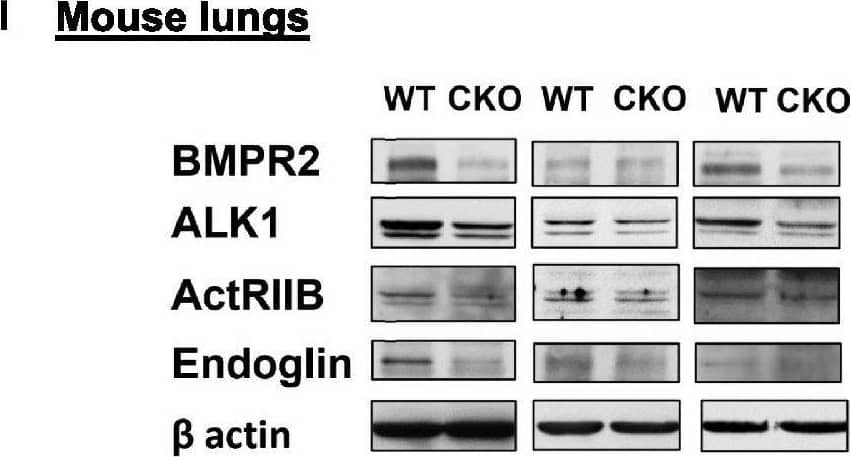
Detection of Mouse ALK-1 by Western Blot
GATA6 deficiency in PAEC and PASMC results in loss of BMP receptors. (A) qPCR of HPAECs transfected with GATA6 or control scr siRNA ( − ) to measure indicated mRNA, each experiment was repeated at least three times. Data are means ± SE, n = 4–7. **p < 0.01, ***p < 0.001 by Mann Whitney U test. (B) Chromatin immune precipitation (ChiP) assay in HPAECs, n = 8–10. Representative gel images and data quantification are shown. Data are means ± SE, ***p < 0.001, ****p < 0.0001 by Mann Whitney U test. (C,D) Immunoblot analysis of control human PASMC transfected with siRNA GATA6 or control scr siRNA for 48 h. Data are means ± SE, 3 subjects/group, *p < 0.05 by Mann Whitney U test. Please see Fig. 2F,G for GATA6 immunoblots. (E,F) Expression of BmpR2, Alk1, ActRIIB, and endoglin measured by qPCR in PAEC (F) and whole lungs (G) from WT and Gata6 CKO mice. Data are means ± SE; E: n = 4–5/group; F: n = 6–11 mice/group. Male and female mice responded similarly. *p < 0.05, **p < 0.01 by Mann Whitney U test ((E,F) BmpR2, Alk1, and ActRIIB) and unpaired tau test (F Endoglin). (G,H) Control HPAECs transfected with siGATA6 or control scr siRNA ( − ) were assayed by immunoblot analysis to detect indicated BMP receptors. Values are means ± SE of the relative protein levels by densitometry, n = 4–7.*p < 0.05, ***p < 0.001 by Mann Whitney U test. (I,J) Immunoblot analysis of whole lung tissue from Gata6 CKO and WT mice. Values are means ± SE of the relative protein levels by densitometry, n = 3–5/group. Male and female mice responded similarly. *p < 0.05, **p < 0.01 by Mann Whitney U test. The original blots are presented in Supplementary Fig. S17. Image collected and cropped by CiteAb from the following open publication (https://pubmed.ncbi.nlm.nih.gov/37087509), licensed under a CC-BY license. Not internally tested by R&D Systems.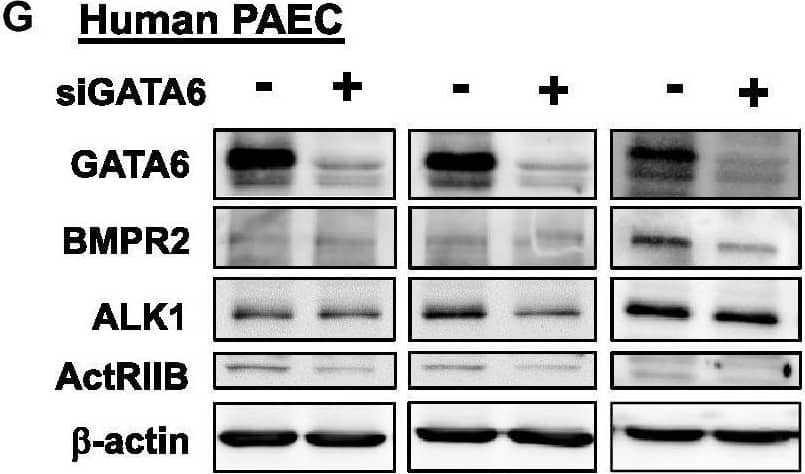
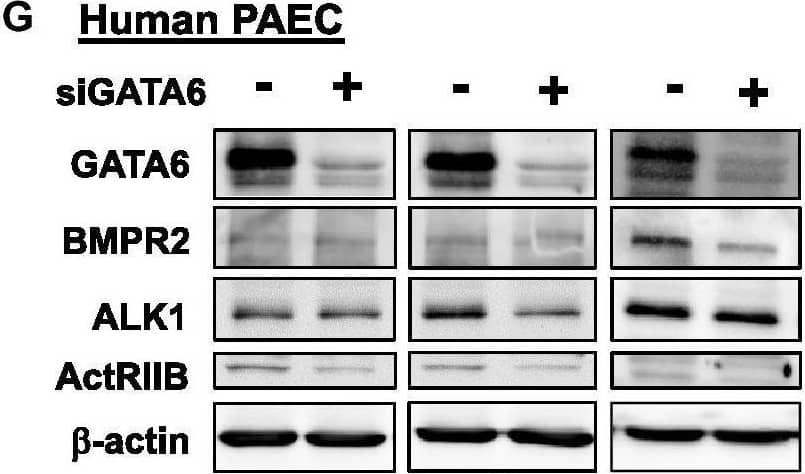
Detection of Human ALK-1 by Western Blot
GATA6 deficiency in PAEC and PASMC results in loss of BMP receptors. (A) qPCR of HPAECs transfected with GATA6 or control scr siRNA ( − ) to measure indicated mRNA, each experiment was repeated at least three times. Data are means ± SE, n = 4–7. **p < 0.01, ***p < 0.001 by Mann Whitney U test. (B) Chromatin immune precipitation (ChiP) assay in HPAECs, n = 8–10. Representative gel images and data quantification are shown. Data are means ± SE, ***p < 0.001, ****p < 0.0001 by Mann Whitney U test. (C,D) Immunoblot analysis of control human PASMC transfected with siRNA GATA6 or control scr siRNA for 48 h. Data are means ± SE, 3 subjects/group, *p < 0.05 by Mann Whitney U test. Please see Fig. 2F,G for GATA6 immunoblots. (E,F) Expression of BmpR2, Alk1, ActRIIB, and endoglin measured by qPCR in PAEC (F) and whole lungs (G) from WT and Gata6 CKO mice. Data are means ± SE; E: n = 4–5/group; F: n = 6–11 mice/group. Male and female mice responded similarly. *p < 0.05, **p < 0.01 by Mann Whitney U test ((E,F) BmpR2, Alk1, and ActRIIB) and unpaired tau test (F Endoglin). (G,H) Control HPAECs transfected with siGATA6 or control scr siRNA ( − ) were assayed by immunoblot analysis to detect indicated BMP receptors. Values are means ± SE of the relative protein levels by densitometry, n = 4–7.*p < 0.05, ***p < 0.001 by Mann Whitney U test. (I,J) Immunoblot analysis of whole lung tissue from Gata6 CKO and WT mice. Values are means ± SE of the relative protein levels by densitometry, n = 3–5/group. Male and female mice responded similarly. *p < 0.05, **p < 0.01 by Mann Whitney U test. The original blots are presented in Supplementary Fig. S17. Image collected and cropped by CiteAb from the following open publication (https://pubmed.ncbi.nlm.nih.gov/37087509), licensed under a CC-BY license. Not internally tested by R&D Systems.Applications for Human ALK-1 Antibody
Application
Recommended Usage
Immunoprecipitation
David, L. et al. (2007) Blood. 109:1953.
Western Blot
0.1 µg/mL
Sample: Recombinant Human ALK-1 Fc Chimera (Catalog # 370-AL)
Sample: Recombinant Human ALK-1 Fc Chimera (Catalog # 370-AL)
Reviewed Applications
Read 2 reviews rated 5 using AF370 in the following applications:
Formulation, Preparation, and Storage
Purification
Antigen Affinity-purified
Reconstitution
Reconstitute at 0.2 mg/mL in sterile PBS. For liquid material, refer to CoA for concentration.
Formulation
Lyophilized from a 0.2 μm filtered solution in PBS with Trehalose. See Certificate of Analysis for details.
*Small pack size (-SP) is supplied either lyophilized or as a 0.2 µm filtered solution in PBS.
*Small pack size (-SP) is supplied either lyophilized or as a 0.2 µm filtered solution in PBS.
Shipping
Lyophilized product is shipped at ambient temperature. Liquid small pack size (-SP) is shipped with polar packs. Upon receipt, store immediately at the temperature recommended below.
Stability & Storage
Use a manual defrost freezer and avoid repeated freeze-thaw cycles.
- 12 months from date of receipt, -20 to -70 °C as supplied.
- 1 month, 2 to 8 °C under sterile conditions after reconstitution.
- 6 months, -20 to -70 °C under sterile conditions after reconstitution.
Background: ALK-1
Transforming Growth Factor beta (TGF-beta) superfamily ligands exert their biological activities via binding to heteromeric receptor complexes of two types (I and II) of serine/threonine kinases. Type II receptors are constitutively active kinases that phosphorylate type I receptors upon ligand binding. In turn, activated type I kinases phosphorylate downstream signaling molecules including the various smads. Transmembrane proteoglycans, including the type III receptor (betaglycan) and endoglin, can bind and present some of the TGF-beta superfamily ligands to type I and II receptor complexes and enhance their cellular responses. Seven type I receptors (also termed activin receptor-like kinase (ALK)) and five type II receptors have been isolated from mammals. ALK-2, -3, -4, -5, and -6 are also known as Activin R1A, BMPR-1A, Activin R1B, TGF-beta R1, and BMPR-1B, respectively, reflecting their ligand preferences. Evidence suggests that TGF-beta 1, TGF-beta 3 and an unknown ligand present in serum can activate chimeric ALK-1. ALK-1 shares with other type I receptors a cysteine-rich domain with conserved cysteine spacing in the extracellular region, and a glycine- and serine-rich domain (the GS domain) preceding the kinase domain. ALK-1 is expressed highly in endothelial cells and other highly vascularized tissues. The expression patterns of ALK-1 parallels that of endoglin. Mutations in ALK-1 as well as in endoglin are associated with hereditary hemorrhagic telangiectasia (HHT), suggesting a critical role for ALK-1 in the control of blood vessel development or repair. Human and mouse ALK-1 share approximately 71% amino acid sequence identity in their extracellular regions.
References
- ten Dijke, P. et al. (1993) Oncogene 8:2879.
- ten Dijke, P. et al. (1994) Science 264:101.
- Lux, A. et al. (1999) J. Biol. Chem. 274:9984.
Long Name
Activin Receptor-like Kinase 1
Alternate Names
ACVRL1, ALK1
Gene Symbol
ACVRL1
UniProt
Additional ALK-1 Products
Product Documents for Human ALK-1 Antibody
Product Specific Notices for Human ALK-1 Antibody
For research use only
Loading...
Loading...
Loading...
Loading...
Loading...