
Human ADAM10 Ectodomain Antibody
R&D Systems, part of Bio-Techne | Catalog # MAB1427

Scientific images may be resized, cropped, or adjusted for brightness or contrast for presentation purposes. These updates are limited to presentation and do not affect the underlying scientific interpretation of the data. Where available, additional source data may be provided upon request.
Conjugate
Catalog #
Key Product Details
Species Reactivity
Validated:
Human
Cited:
Human, Mouse, Transgenic Mouse
Applications
Validated:
Western Blot, Intracellular Staining by Flow Cytometry, Immunoprecipitation, CyTOF-ready
Cited:
Immunohistochemistry, Western Blot, Flow Cytometry, Immunocytochemistry
Label
Unconjugated
Antibody Source
Monoclonal Mouse IgG2B Clone # 163003
Product Specifications
Immunogen
Mouse myeloma cell line NS0-derived recombinant human ADAM10
Thr214-Glu672
Accession # O14672
Thr214-Glu672
Accession # O14672
Specificity
Detects human ADAM10 in direct ELISAs and Western blots. In Western blots, shows less than 5% cross-reactivity with recombinant human (rh) ADAM8, 9, 15, 17/TACE, and recombinant mouse ADAM10.
Clonality
Monoclonal
Host
Mouse
Isotype
IgG2B
Scientific Data Images for Human ADAM10 Ectodomain Antibody
Detection of ADAM10 Ectodomain by Western Blot
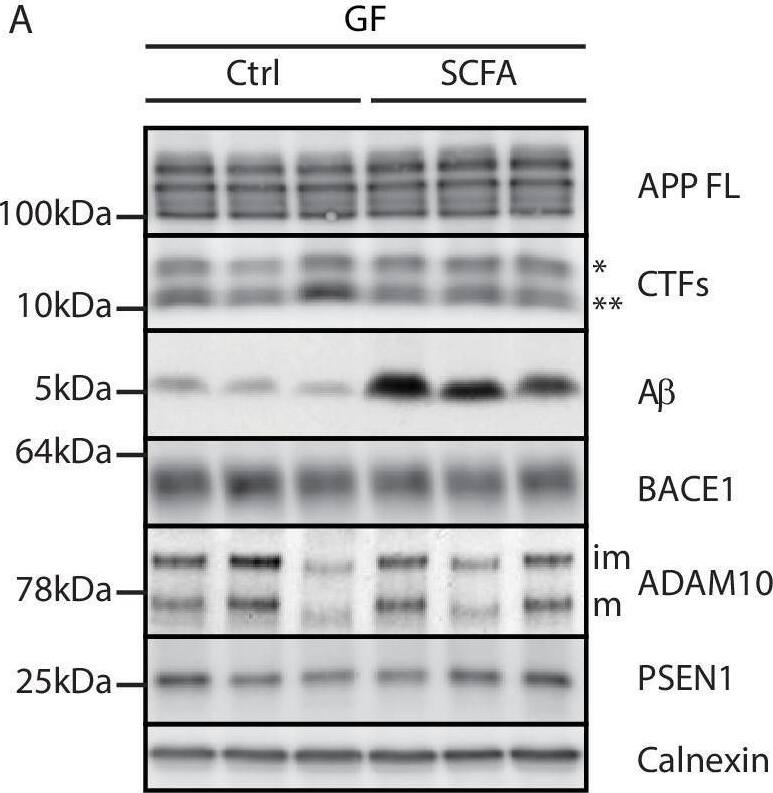
Short chain fatty acids (SCFA) mildly increase amyloidogenic processing.(A) Western blot analysis and (B) its densitometry quantification of 3 months old brain homogenates of control (Ctrl)- and SCFA-supplemented germ-free (GF) APPPS1 animals. The A beta level is significantly increased in SCFA group in comparison to Ctrl, despite unaffected APP FL levels. APP CTFs show a decreased C83 (**) to C99 (*) ratio. We could not detect alterations in protein levels of secretases involved in APP processing (ADAM10, BACE1, and gamma-secretase/PSEN1). m = ADAM10 mature form; im = ADAM10 immature form. Data represent mean ± SEM (unpaired T-test; n(Ctrl) = 3, n(SCFA) = 3). (C) Upper panel: gamma-Secretase reconstituted into lipid vesicles was incubated at 37°C together with the C99-based substrate C100-His6 in the presence of increasing doses of a SCFA mixture (375 and 750 μM final concentration of total SCFA of an equimolar mixture of Na-acetate, Na-propionate, and Na-butyrate) for 24 hr. Production of A beta was analyzed by immunoblotting. gamma-Secretase inhibitor (GSI) L-685,458 (0.4 μM) was used as a negative control. No alterations in A beta levels were detected in the presence of SCFA. Lower panel: Qualitative analysis of individual A beta species via Tris‐Bicine‐Urea SDS‐PAGE reveals that SCFA treatment does not alter the ratio among the different A beta species (A beta37-38-40-42/43) suggesting no direct effects on modulation of gamma-secretase cleavage. (D) Aggregation kinetics of monomeric A beta40 recorded by the increase in fluorescence of Thioflavin T incubated with either 30 mM NaCl (Ctrl) or 30 mM SCFA mixture do not show any significant difference, suggesting that SCFA do not directly modify A beta fibrillarization. Data points represent mean ± SD from three independent experiments. Image collected and cropped by CiteAb from the following open publication (https://pubmed.ncbi.nlm.nih.gov/33845942), licensed under a CC-BY license. Not internally tested by R&D Systems.Applications for Human ADAM10 Ectodomain Antibody
Application
Recommended Usage
CyTOF-ready
Ready to be labeled using established conjugation methods. No BSA or other carrier proteins that could interfere with conjugation.
Immunoprecipitation
25 µg/mL
Sample: Conditioned cell culture medium spiked with Recombinant Human ADAM10 (Catalog # 936‑AD), see our available Western blot detection antibodies
Sample: Conditioned cell culture medium spiked with Recombinant Human ADAM10 (Catalog # 936‑AD), see our available Western blot detection antibodies
Intracellular Staining by Flow Cytometry
2.5 µg/106 cells
Sample: MCF-7 human breast cancer cell line fixed with paraformaldehyde and permeabilized with saponin
Sample: MCF-7 human breast cancer cell line fixed with paraformaldehyde and permeabilized with saponin
Western Blot
1 µg/mL
Sample: Recombinant Human ADAM10 (Catalog # 936-AD)
under non-reducing conditions only
Sample: Recombinant Human ADAM10 (Catalog # 936-AD)
under non-reducing conditions only
Formulation, Preparation, and Storage
Purification
Protein A or G purified from hybridoma culture supernatant
Reconstitution
Reconstitute at 0.5 mg/mL in sterile PBS. For liquid material, refer to CoA for concentration.
Formulation
Lyophilized from a 0.2 μm filtered solution in PBS with Trehalose. *Small pack size (SP) is supplied either lyophilized or as a 0.2 µm filtered solution in PBS.
Shipping
Lyophilized product is shipped at ambient temperature. Liquid small pack size (-SP) is shipped with polar packs. Upon receipt, store immediately at the temperature recommended below.
Stability & Storage
Use a manual defrost freezer and avoid repeated freeze-thaw cycles.
- 12 months from date of receipt, -20 to -70 °C as supplied.
- 1 month, 2 to 8 °C under sterile conditions after reconstitution.
- 6 months, -20 to -70 °C under sterile conditions after reconstitution.
Background: ADAM10
ADAM10 (also known as Kuzbanian, mammalian disintegrin metalloprotease, myelin-associated metalloproteinase) is a member of the ADAM family that contains a disintegrin and metalloprotease-like domain (1, 2). Like other membrane-anchored ADAMs, ADAM10 consists of the following domains, pro with a cysteine switch and furin cleavage sequence, catalytic with the zinc-binding site and Met-turn expected for reprolysins, disintegrin-like, cysteine-rich, EGF-like, transmembrane, and cytoplasmic. ADAM10 is highly conserved, with 97% amino acid identity between mouse, rat, bovine and human and 45% identity between mouse and Drosophila. The active enzyme processes notch, notch ligand delta, and amyloid protein precursor at the alpha site, playing an important role in neurogenesis (3, 4). It also processes the 26 kDa membrane-anchored pro-tumor necrosis factor-alpha (TNF-alpha) to the 17 kDa mature TNF-alpha (5). It cleaves myelin basic protein and type IV collagen (6, 7). ADAM10 is widely expressed in tissues and resides both on the cell surface and in the cell (8, 9).
References
- Rooke, et al. (1996) Science 273:1227.
- Pan and Rubin (1997) Cell 90:271.
- Qi, et al. (1999) Science 283:91.
- Lammich, et al. (1999) Proc. Natl. Acad. Sci. USA 96:3922.
- Rosendahl, et al. (1997) J. Biol. Chem. 272:24588.
- Chantry, et al. (1989) J. Biol. Chem. 264:21603.
- Millichip, et al. (1998) Biochem. Biophys. Res. Comm. 245:594.
- Chantry and Glynn (1990) Biochem. J. 268:245.
- Fahrenholz, et al. (2000) Ann. N.Y. Acad. Sci. 920:215.
Long Name
A Disintegrin and Metalloprotease-like Domain 10
Alternate Names
CD156c, Kuzbanian, MADM
Gene Symbol
ADAM10
UniProt
Additional ADAM10 Products
Product Documents for Human ADAM10 Ectodomain Antibody
Product Specific Notices for Human ADAM10 Ectodomain Antibody
For research use only
Loading...
Loading...
Loading...
Loading...
Loading...
Loading...